MIT Vocal Jazz Ensemble performs their fall collection
The performance featured two original, student compositions





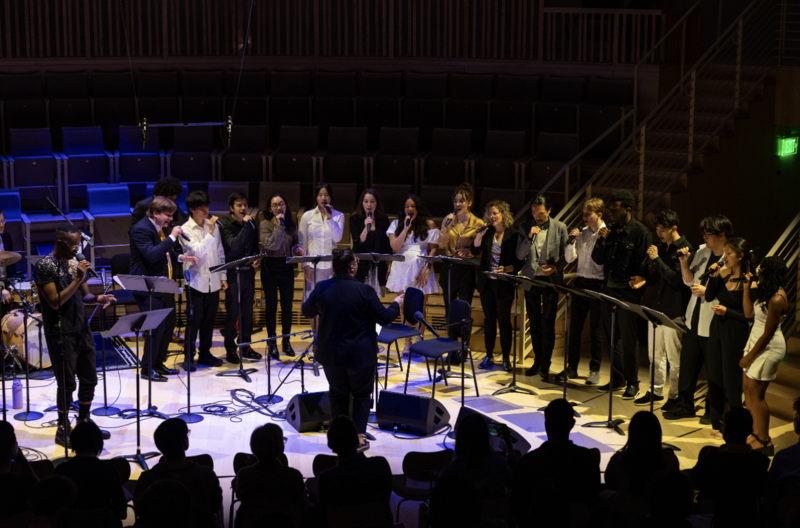
PHOTO COURTESY OF Caroline Aldem
PHOTO COURTESY OF Caroline Aldem
Fall Collection
MIT Vocal Jazz Ensemble
Directed by Laura Grill Jaye
Thomas Tull Concert Hall
Nov. 23, 2025
On Sunday, Nov. 23, the first snowy evening of the year, the MIT Vocal Jazz Ensemble (VJE) performed their fall collection, which included Chet Baker’s “A Dandy Line” (1954), Olivia Dean’s “So Easy (To Fall In Love)” (2025), and original songs by VJE students Mariabelle Azemar ’27 and Alejandro Reyes ’26.
The atmosphere inside Tull was atypical for that of a concert hall. Before the performance began, VJE director Laura Grill Jaye encouraged the audience to whistle, clap, jazz moan along, and lean fully into the looseness of jazz. “I want you to feel like you’re in a jazz club,” Jaye said.
The night opened with the VJE band, whose rotating lineup of soloists included pianist Coleman Gliddon G, bassist and guitarist Sebastian Franjou ’22, drummer Hector Falu-guzman, trombonist Alex Jin ’27, and tenor saxophonist Rushil Srikakolapu ’29. The performance’s first piece, “Honeysuckle Rose” (1929/2025), arranged by Jaye, featured just the singers. With a crisp and steady tempo, lively scat-like syllables, and a standout bass voice anchoring the ensemble, the piece immediately set the mood for an exciting show.
The program unfolded as a series of solos backed by varying combinations of the band. Chelsy Goodwill ’27 delivered a smooth, velvety performance of Ronnell Bright’s “Sweet Pumpkin” (1959), supported by piano, drums, and bass. Following Goodwill, Anikita Ghoshal MBA ’26 gave one of the most technically precise performances of the evening in “Time After Time” (1947). Her pitch was effortless and clean, and her musical connection with the band made the piece glow with personality.
With piano accompaniment, Nicholas Wei ’26 sang a heartfelt “Skylark” (1947), a piece chosen for him by a friend. The mood shifted again when Rachel Loh ’25 sang Olivia Dean’s “So Easy (To Fall in Love)” (2025) accompanied by the full band. The tenor saxophone solo in this number was a particular highlight, blending well with the vocals. MIT staff member Claire Walsh followed with a warm-toned, expressive version of “I Can’t Give You Anything But Love” (1928). Piano and bass both had compelling solo moments, and the band’s dynamic control made the arrangement shine. Maxine Perroni-Scharf G followed with a Laufey-like softness to “Bewitched, Bothered, and Bewildered” (1941).
One unique moment of the evening was “No More Blues” (1958), sung by Charlotte Wickery G. She doubled on flute, a surprisingly natural color in the jazz style. Her vocal range and timbral control were impressive, making the piece memorable. All VJE members returned for “The Nearness of You” (1937/2018, arr. Graveley), a lush, highline-style ballad carried by rich harmonies and accompaniment by bass, saxophone, and drums.
The two original compositions brought a unique, personal aspect to the concert. Mariabelle Azemar ’27 sang her own piece, “The Two That Shouldn’t Be” (2025), an allegro-tempo work that showcased her expressive voice and compositional clarity. Alejandro Reyes ’26 followed with “Tus Entrañas en la Arena” (2025), inspired by a vivid personal dream. Sung in Spanish and supported by three additional vocalists, it stylistically stood apart from the evening’s jazz-centered repertoire.
The full band returned for a seasonally fitting “Autumn Leaves” (1945), complete with an energetic drum solo and an arrangement that pushed beyond standard jazz conventions. The singers then reunited for “A Quiet Place” (1969/1988), a Take 6–style ballad with close harmonies. The night closed on a joyful note with the well-loved “A Dandy Line” (1954), arranged by Jaye. Featuring all VJE members, the final piece radiated the enthusiasm the director had hoped for from the beginning.
Overall, the concert’s combination of traditional pieces, modern arrangements, and even original compositions was alive with personality. While there were occasional issues of balance between voices and instruments, it was difficult to tell whether these moments stemmed from the hall acoustics or the ensemble itself. Nevertheless, the performers and director’s artistry made the concert memorable.