The BSO showcases American musical identity with Allison Loggins-Hull, the Tanglewood Festival Chorus, and Seong-Jin Cho
Seong-Jin Cho performs Tchaikovsky’s Piano Concerto No. 1 in B-flat minor





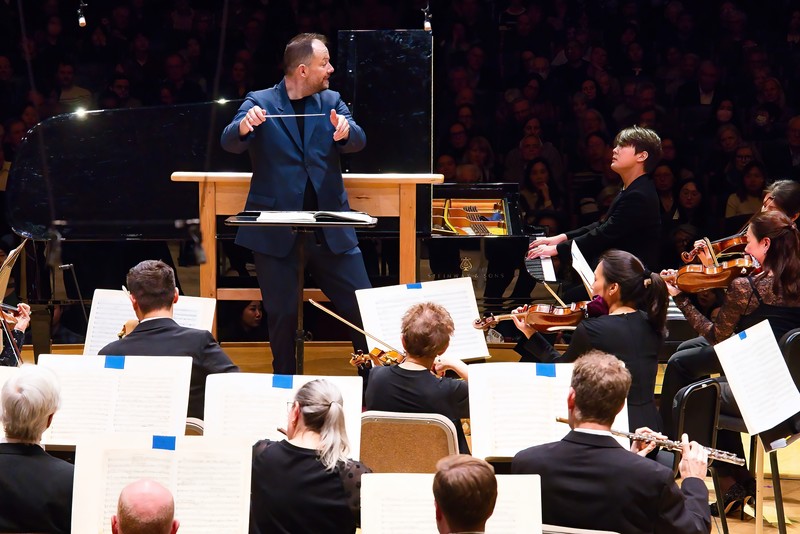
Photo courtesy of Hilary Scott
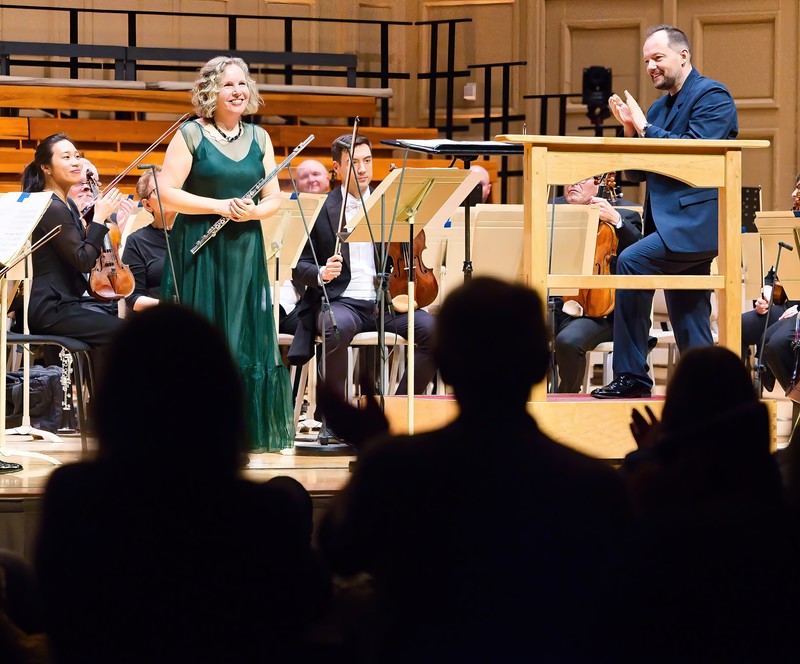
Photo courtesy of Hilary Scott
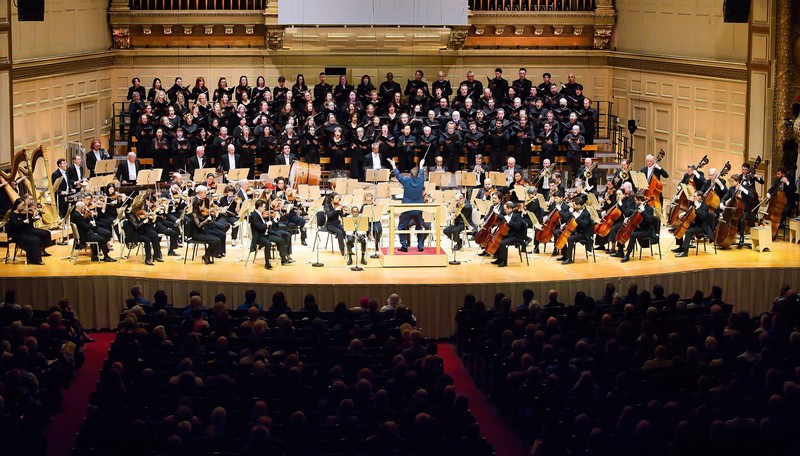
Photo courtesy of Hilary Scott
Loggins-Hull’s Rhapsody on a Theme by Joni, Bernstein’s Chichester Psalms, Tchaikovsky’s Piano Concerto No. 1 in B-flat minor
Boston Symphony Orchestra
Featuring Seong-Jin Cho on piano, Lorna McGhee on flute, Edward Njuguna as boy soprano, and the Tanglewood Festival Chorus
Conducted by Andris Nelsons
Symphony Hall
Jan. 15 – Jan. 17, 2026
On Saturday, Jan. 17, the Boston Symphony Orchestra (BSO) performed Loggins-Hull’s Rhapsody on a Theme by Joni with flutist Lorna McGhee, Bernstein’s Chichester Psalms with the Tanglewood Festival Chorus and Edward Njuguna as boy soprano, and Tchaikovsky’s Piano Concerto No. 1 in B-flat minor with renowned pianist Seong-Jin Cho.
The night’s concert was a part of the BSO’s “E Pluribus Unum: From Many, One” series celebrating the 250th anniversary of American democracy. One aim of this month-long festival is to honor American music. Conductor Andris Nelsons, now in his 12th season as music director of the BSO, expressed his enthusiasm for the initiative, sharing in a projected video and a brief speech between pieces that the BSO seeks to explore ideas that continue to shape America through distinct voices and viewpoints. He stressed that no single musical style or philosophical view defines America; rather, artists and art provide unique and valuable perspectives on the nation’s development and culture.
Before the concert began, composer Allison Loggins-Hull joined the stage to introduce Rhapsody on a Theme by Joni, describing the work as episodic, fantastical, and rich with emotional contrast. Commissioned by The Knights, the BSO, and the Seattle Symphony Orchestra, the piece drew its inspiration from Joni Mitchell’s song “My Old Man” from the album Blue. Loggins-Hull explained that the rhapsody contained numerous musical references, which was immediately apparent in her virtuosic writing that nodded to traditional flute repertoire.
Throughout the performance, Loggins-Hull’s composition is deeply engaged with Mitchell’s original melodic idiosyncrasies. Even as the music moved through rapid arpeggios, tremolos, and sudden changes of color, Loggins-Hull maintained Mitchell’s melody.
BSO principal flutist Lorna McGhee, making her solo debut with the orchestra, delivered a high level of brilliance and sensitivity. Her playing demonstrated technical accuracy and expressive warmth, revealing the flute’s full range of color with apparent ease. Her solo cadenza was beautiful and flawlessly executed despite unconventional techniques, after which the BSO reentered with care. Bright violin harmonics and strong support from the basses complemented the solo line without overwhelming it, and the triangle’s presence consistently followed the flute throughout.
The Tanglewood Festival Chorus joined the BSO under guest choral conductor Jean-Sébastien Vallée to perform Leonard Bernstein’s Chichester Psalms, with sixth-grader Edward Njuguna featured as boy soprano. Commissioned by the Very Rev. Walter Hussey, Dean of Chichester Cathedral in 1965, the work emerged at a moment of personal and artistic crisis for Bernstein, who had been struggling to compose during a sabbatical from the New York Philharmonic. Written originally for an all-male chorus with boys singing the treble parts, Chichester Psalms proved to be a creative turning point, rescuing Bernstein from an experimental atonal path he had found artistically unconvincing.
The first movement immediately began with Psalms 108 and 100. The Tanglewood Festival Chorus proclaimed the opening in bold unison, highlighting Bernstein’s angular rising seventh as Symphony Hall clearly displayed the Hebrew text “Urah, hanevel, v’chinor” (“Awake, psaltery and harp”) on a screen above the orchestra. The absence of woodwinds drew attention to the bright percussion section. The Chorus accurately executed the jaunty 7/4 setting of Psalm 100, which alternates between exuberant shouts and more lyrical passages. The rhythmic irregularity of this section was inspired by the natural scansion of the Hebrew language and Bernstein’s fascination with the number seven. Despite moments of forceful dissonance and driving percussion, the movement closed with tranquility as the final sustained harmony recalled the opening fanfare.
The BSO’s performance of the second and third movements remained magnificent. The serene setting of Psalm 23 unfolded as a lullaby, introduced by Njuguna’s pure, accurately tuned solo over harp accompaniment and later expanded with warmth by strings and chorus. The calmness, however, was violently disrupted by Psalm 2, sung fiercely by the men’s resonant voices in music borrowed from the foreboding opening of West Side Story. The final movement began with a strained version of the opening fanfare, which shifted to a more peaceful melody, while the solo cello’s tone remained rich and extremely memorable throughout. As the chorus took up the melody, the ensemble achieved an almost angelic blend, culminating in the quiet affirmation of Psalm 133 and a unified “Amen.”
After intermission, the BSO performed Pyotr Ilyich Tchaikovsky’s Piano Concerto No. 1 in B-flat minor, Op. 23, featuring pianist Seong-Jin Cho. The concerto’s Boston roots lent the performance a special resonance, as its first performance in 1875 took place in the city’s Music Hall, now the Orpheum Theatre. From the opening movement, Cho’s playing demonstrated the qualities for which he was celebrated worldwide — clarity, control, and a natural sense of proportion. The iconic opening sounded expansive, with solid orchestral unisons that established the sweeping drama of Tchaikovsky’s symphonic writing. When the piano entered, it cut cleanly through the orchestra without ever sounding muddy, even in dense passages of fast octaves. Cho shaped the music with a compelling sense of push and pull, combining forceful articulation with moments of relaxed staccato. The precision of his execution was striking, particularly in rapid passagework. In addition, the BSO, particularly woodwinds that maintained balance even in higher registers, provided sensitive support that framed Cho’s lyricism.
The second movement contrasted well with the first, opening with an accurate and poised flute solo. Cho’s hushed, delicate entrance followed. A rich cello solo added warmth, and the duet between piano and winds conveyed a playful, youthful energy. In the final movement, Cho’s rhythmic stability drove the music forward with infectious excitement. The orchestra matched his energy with crisp fanfares and tight rhythms, bringing the concerto to a thrilling close. As an encore, Cho played the Chopin Waltz No. 7, providing a gentle contrast to Tchaikovsky’s extroverted grandeur. His encore supported his truly genius performance that reaffirmed the concerto’s triumphal tone.