The Handel and Haydn Society delivers a convincing version of Handel’s ‘Messiah’
Lauren Snouffer, Amery Amereau, and Ben Bliss return to H+H; Nicholas Newton makes his debut





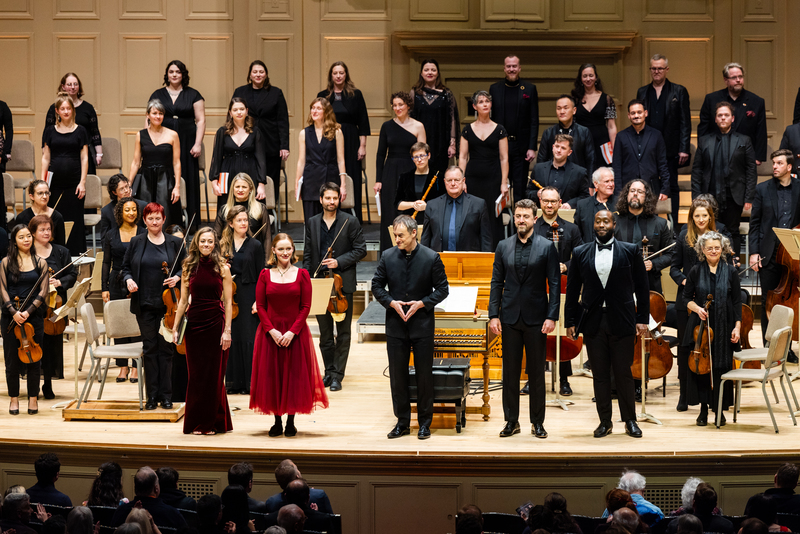
Photo courtesy of H+H Marketing
★★★★½
Handel’s Messiah, HWV 56
Handel and Haydn Society
Conducted by Jonathan Cohen
Featuring soprano Lauren Snouffer, mezzo-soprano Amery Amereau, tenor Ben Bliss, and bass-baritone Nicholas Newton
Boston Symphony Hall
Nov. 28–30, 2025
This Thanksgiving break, the Handel and Haydn Society continued its annual tradition of performing Handel’s Messiah, arguably the composer’s most famous oratorio. It is an atypical oratorio because it does not have named characters [1], and the storyline is more devotional compared to Handel’s other Old Testament-based oratorios such as Saul. Coincidentally, both oratorios have Charles Jennens as the librettist. The structure of Handel’s Messiah follows the liturgical year: Advent and Christmas narrate Christ’s birth; Lent to Pentecost recounts the Passion and Resurrection; and Part III turns toward eschatology.
The score calls for a small orchestra of strings, oboes, trumpets, timpani, and basso continuo. This production consisted only of 28 players and the conductor, which is smaller than the norm — possibly resembling what was available at the oratorio’s original premiere. Though this choice is understandable, it likely does not reflect Handel’s intentions with scale and the orchestration. Messiah was a popular oratorio from its premiere, and there is plentiful evidence suggesting that Handel envisaged a more expansive orchestral and vocal force; his version from 1754 added two horns, and performances organized by his colleagues in the 1780s advertised 250 — and even 800 — players, with the score adding trombones this time.
After a French overture, tenor Ben Bliss opened Part I by immediately captivating the audience with his bright projection in “Ev’ry valley shall be exalted,” handling difficult melismas with ease. His vocal timbre was on the pointier side, but this detail did not take away from his performance. Meanwhile, mezzo-soprano Amery Amereau took the alto role with a voice that was firm but tender, shining in her aria “O thou that tellest good tidings to Zion.” Nevertheless, I found the casting unconventional, as the alto role is more suited for a contralto [2] or a countertenor from its vocal ranges [3]. Despite Amereau’s best efforts and great vocal expression, the part’s awkward range posed challenges in volume and projection, most evidently in the soprano and alto duet towards the end of the first act.
The chorus was on top form, perfectly delivering the very difficult “He shall purify.” Bass-baritone Nicholas Newton had electrifying energy, matching Bliss’s volume and projection all around. Newton brought every unstable chromaticism (darkness) and major chord (light) to life in his aria “The people that walked in darkness.” Soprano Lauren Snouffer appeared last among the soloists. A quick succession of her recits and arias, intermixed with the chorus, convincingly retold the story of Jesus’s birth. One could only feel exaltation when the chorus sang “Glory to God at the highest!”
Part II depicts the Passion. The chorus shined the brightest in the first half of Part II, singing the first chorus and three back-to-back movements. The most impressive of these was “All we like sheep have gone astray,” which starts innocuously, yet is technically difficult. The mood later shifted suddenly when the chorus sang “The Lord hath laid on him the iniquity of us all,” where sorrow and sacrifice pervades unexpectedly. The 10-minute alto aria “He was despised” revealed Amereau’s impressive stamina and was her sonorous best.
The second half of Part II is a back and forth between arias and choruses. Snouffer, Bliss, and Newton all remained consistent, carrying on with their commanding voices from Part I. Bliss’s pointier voice served him well in “Thou shalt break them with a rod of iron,” flawlessly capturing the atmosphere of what was his most passionate aria. The chorus had its best moments in this part with their precisely coordinated performance of “Let us break their bonds asunder.” The famous “Hallelujah” chorus was enjoyable; as a nice touch, the soloists also joined in.
Part III — the shortest of the three, at around 30 minutes — covers the glorification of Christ and the resurrection of Jesus. It features the impressive and famous bass aria “The trumpet shall sound,” which also has a trumpet solo. [4] Newton and trumpeter Steven Marquardt, in perfect balance, delivered the aria with finesse. Snouffer’s aria “I know that my redeemer liveth” was also very touching, with well-noted ascending figures when she sang, “For now is Christ risen.” The final chorus, with the full orchestra tutti, closed the oratorio with acclamation.
Overall, the performance was convincing and executed nicely. H+H’s effort to recreate Handel’s premiere was very successful, which drew a well-deserved enthusiastic reaction from the audience.
Footnotes:
[1] This was to protect Handel himself against the charge of blasphemy.
[2] Handel clearly intended this role for a contralto. Not only was Susannah Maria Cibber a well-known contralto, but some alto parts were also transcribed lower to accommodate for her vocal range.
[3] Since Amereau had performed this role with H+H for the 2022–23 season, this casting was clearly intentional.
[4] This trumpet solo is quite difficult for the valveless natural trumpet. Future transcriptions (e.g. Mozart’s) considerably simplified or omitted the trumpet parts as it was considered a lost art by the 1780s.