Decades-long effort of HIV-positive transplantation surgery achieves landmark first lung transplant
Surgeons at NYU Langone performed the world’s first HIV-positive lung transplantation surgery in June 2026





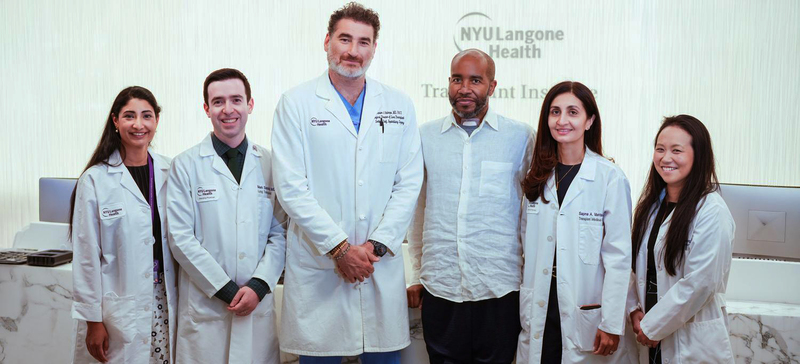
Photo courtesy of NYU Langone
In June 2026, a team of surgeons at NYU Langone transplanted lungs from an HIV-positive donor into an HIV-positive recipient. The procedure, performed on patient Bertrand Nelson alongside a liver transplant, marked the final major milestone in a movement that began with a 1988 federal law that had made it illegal to use organs from HIV-positive donors at all.
In Nov. 2024, transplant surgeon Dr. Dorry Segev was stunned by a string of unanticipated messages. “I opened my email to pictures from people, unsolicited, posing with their license," he recalled. That was the month HIV-positive kidney and liver transplants moved from research protocol to routine clinical practice; people living with HIV could legally check the organ donor box when they renewed their driver’s license. The pictures were sent to him because for over a decade, he had been one of the people fighting to make that small box available to them at all.
The National Organ Transplant Act prohibited HIV+ transplantation
The law was the main obstacle preventing HIV-positive donors from supplying organs to the HIV-positive patients who needed them. In 1988, at the height of the AIDS panic, Congress amended the National Organ Transplant Act (NOTA) to criminalize the recovery and transplantation of organs from donors with HIV. By contrast, Hepatitis C-related transplantation was not restricted by the government like HIV was. Transplant teams routinely gave hepatitis C-positive organs to other patients and then treat the hepatitis afterward.
Segev described limitations Congress had in medical discussions such as this one. As he described, “transplant medicine really moves at its own pace, separate from Congress.” Congress, Segev noted, doesn’t perform surgeries. HIV was the only disease they made an extensive law for, suggesting just how frightening the disease looked in the 1980s.
That fear was not necessarily baseless. Former director of the National Institute of Allergy and Infectious Diseases Dr. Anthony Fauci, who began treating some of the first patients with the then-unnamed disease in 1981, remembered a period when there was little a physician could offer beyond comfort.
“For the multiple years in the beginning of the HIV/AIDS pandemic, I wasn’t healing anybody,” he shared at the 2026 American Lung Cancer Screening Initiative Summit. “The thing that you need to do is to care for and comfort the patient.”
Effective therapy didn’t arrive until 1996, finally making HIV a medical condition rather than a death sentence with medicine.
Bench to bill
Long before American law caught up with science, Dr. Elmi Muller was already performing HIV-to-HIV kidney transplants in Cape Town, South Africa, where dialysis access was scarce and organs from HIV-positive donors were routinely discarded.
“One day, [Muller] said, ‘I’m sick of throwing away these organs,’” Segev shared.
Immediate backlash followed, with the medical board trying to pull her license, the hospital trying to fire her, and even people attempting to have her arrested. She persisted, publishing her early results and proving, for the first time anywhere, that the practice was safe.
“She really paved the way for the U.S. effort,” said Dr. Christine Durand, a transplant infectious disease physician who has led many research projects on HIV transplantation in America since.
Muller’s data gave American transplant surgeons evidence that HIV-positive transplantation could be successful, but getting Congress to act was far from simple. Segev and a research fellow, Brian Boyarsky, worked to produce information that could illuminate the potential of HIV-positive transplantations. For example, they spent years mining hospital admission records to estimate how many potential HIV-positive donors existed nationally, and they calculated how much money these donors would save the Medicare program.
They introduced the HIV Organ Policy Equity (HOPE) Act in Feb. 2013, and it was signed into law by President Obama that November. Segev has since taken to calling the process “bench to bill,” a twist on the familiar bench to bedside.
The HIV Medicine Association (HIVMA) became one of their campaign’s central partners. According to HIVMA’s Andrea Weddle, “HIVMA was actively engaged in advocacy to advance the HOPE Act, including organizing congressional briefings with community partners to educate policymakers on the history behind the ban on organ donations by people with HIV and how the science advanced since.” HIVMA also coordinated meetings with congressional officers and expanded the HOPE Act’s support among HIV and allied organizations.
Putting research into clinical practice
The first HIV-to-HIV kidney and liver transplants from a deceased donor took place at Johns Hopkins in 2016. However, proving the practice was safe enough for everyday clinical care took years of further research. In the earliest years of HIV-to-HIV transplantation, Durand explained, “transplant providers were likely overly cautious with immunosuppression,” worried that patients with HIV would be especially vulnerable to infection after surgery. This fear turned out to be unfounded. Durand led an NIH-funded study that found that kidney transplants between HIV-positive donors and recipients performed just as well as transplants without HIV involved at all. Her team also discovered an unexpected upside: screening tens of thousands of donors a year surfaces a small number of false positives, or organs that had previously been discarded for lack of time to confirm results. Under HOPE Act protocols, those organs can be used.
One problem was that older HIV medications interacted badly with the drugs used to prevent organ rejection. Luckily, newer antiretrovirals have largely resolved that issue. What remains, she said, was a smaller, harder question of whether chronic HIV infection itself causes subtle immune dysregulation that nudges rejection risk upward. This question is the subject of an ongoing clinical trial her team is running now.
Lung transplantation, at last
The fight for HIV-positive transplantations recently reached its furthest point in June 2026, when surgeons at New York University (NYU) Langone performed the world’s first lung transplant between an HIV-positive donor and an HIV-positive recipient. The surgery was a technical milestone, and it is the latest step in a much longer journey in transplantation medicine.
According to Durand, lungs presented no new medical hurdle beyond the need for closer screening to rule out underlying infection in donor lungs. What they actually required was time; specifically, the time needed for the research infrastructure that had already been built around kidney and liver transplants to gradually extend outward to other organs, one at a time. That time finally arrived in June 2026, when NYU Langone's team completed the first HIV-to-HIV lung transplant. Betrand Nelson was the recipient of a HIV-positive lung and liver transplant in a surgery supported by members of the NYU Langone Transplant Institute care team Dr. Raiya Sarwar, Dr. Mark A. Sonnick, Dr. Karim J. Halazun, Dr. Sapna Mehta, and Dr. Stephanie H. Chang.
For Segev, the progression from a 1988 law written out of fear to a 2026 surgery built on decades of data was gratifying. “Science can inform policy,” he asserted after his own team’s early transplants. “Anyone can impact policy if there is something that is important to you... don’t let people talk you out of your mission.”
Or, in Fauci's simpler framing, after 45 years of treating a disease that once killed nearly everyone who had it, people living with HIV today “live normal lengths of lives.” A lung transplant, this time, is just one more way of achieving that.