AMD CEO Lisa Su urges graduates to chase hard problems in 2026 MIT Commencement address
Su: “Run toward the hardest problems and trust your engineer’s instinct. That’s how you make your luck”





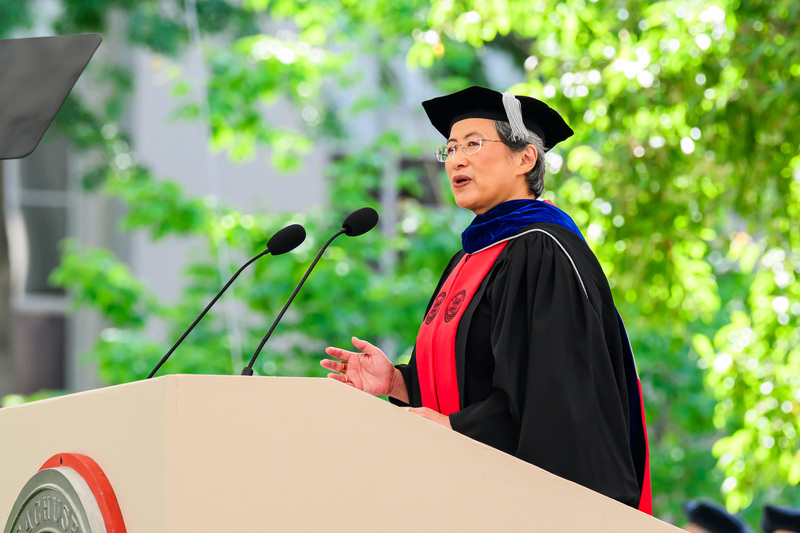
Photo courtesy of Gretchen Ertl
On Thursday, May 28, MIT graduates gathered on Killian Court to participate in the annual OneMIT Commencement Ceremony. This year, the Institute awarded diplomas to 1,165 undergraduates and 2,817 graduate students. The guest speaker was Lisa T. Su ’90 SM ’91 PhD ’94, the CEO of Advanced Micro Devices (AMD), a major chip design firm.
The ceremony opened at Killian Court at 3 p.m. with the Class of 1976 alumni parade, MIT Corporation Chair Mark P. Gorenberg ’76’s opening remarks, and an invocation delivered by Institute Chaplain Thea Keith-Lucas. After the a cappella group Chorollaries’s rendition of the national anthem and two school songs “In Praise of MIT” and “Take Me Back to Tech,” 2026 Commencement speaker Su arrived on stage.
Overall, the AMD CEO advised graduates to pursue the hardest problems and collectively use AI responsibly. Reflecting on her time at MIT, from taking introductory circuits and electronics to repeating countless fabrication experiments during her PhD, Su appreciated how the Institute taught her to solve difficult problems and think like an engineer.
A turning point, Su highlighted, was her UROP experience in X-ray lithography, which sparked a deep interest in semiconductors. Although most of her experiments didn’t work, she was fascinated by the technological power of these small and delicate wafers.
Her interest in semiconductors led her to pursue a PhD in electrical engineering at MIT under Professor Dimitri Antoniadis. Su credits her PhD experience for teaching her how to apply MIT’s motto of mens et manus, meaning “mind and hand,” in her research and professional career.
After receiving her PhD, Su joined IBM at age 25. A piece of advice that Su strongly remembers from her IBM mentor was to “run toward the hardest problems.” Su explained to graduates that the hardest problems offered valuable lessons about one’s capabilities.
She cited becoming CEO of AMD as an example, sharing that she was interested in reshaping and transforming the troubled company, even though some of her mentors thought the CEO position was risky.
“But for me, this was my dream job,” Su said.
To pivot the company towards success, Su made a long-term bet on high-performance computing, as she saw great potential in this field. When Su became chief executive of AMD in 2014, the company’s market capitalization was under $3 billion. Today, it is valued at more than $750 billion.
Su then transitioned to the topic of recent advances in AI. For Su, what makes AI unlike past technology trends like the internet is its capacity to accelerate “discovery in every field.” However, her positive remarks on AI elicited a few noticeable jeers from the audience, mirroring similar reactions for other commencement speakers discussing AI like former Google CEO Eric Schmidt.
Although Su is optimistic about AI, she underscored the importance of people being responsible for AI’s impact and future. She emphasized that everyone is responsible for AI technologies because they require people’s “sense of purpose” and judgment.
Su concluded her speech with gratitude, stating that she has been “very lucky” in her career. Still, she added that while luck is a factor in success, “the best people find ways to make their luck.”
“Run toward the hardest [problems]. And trust your engineer’s instinct. That is how you make your luck,” she concluded.
In contrast to Su’s inspirational speech, the two student speakers, Graduate Student Council (GSC) president Teddy Warner and undergraduate Class of 2026 president Heba Hussein, grounded the graduates with a sober reflection on the pressures facing higher education and the wider world.
Warner, who served as the GSC’s 71st and 72nd president, congratulated graduates on joining MIT's network of more than 150,000 alumni and on contributions spanning science, technology, business, and the arts, as well as teaching, public policy, and service. He did not shy from the difficulties of recent years, citing threats to research funding, the “increasing automation of thought,” and harm to the rights of international students seeking to study in the US without fear of unlawful detainment.
“We have the responsibility to generate, disseminate, and preserve knowledge in service of the world’s greatest challenges,” Warner said, stressing that such problems cannot be solved without global cooperation. He urged the class to apply the cooperative, interdisciplinary skills honed at MIT toward positive change.
The recent challenges Warner cited, such as federal research funding cuts and the targeting of international students, have also been highlighted by the MIT Graduate Student Union (GSU). Earlier in the day, the GSU held a rally outside Lobby 7 at 1 p.m., demanding the MIT administration to stop delaying contract negotiations. Over a hundred people attended the rally, holding picket signs and chanting phrases like “MIT workers won’t wait” and “MIT works because we do.”
Hussein, who led the undergraduate class for four years, centered her remarks around a personal story. Through MIT’s Global Teaching Labs program, she had spent time in India teaching students in rural communities while also visiting family members displaced from Sudan. The experience, she said, captured a tension familiar to many of her classmates: holding “competing realities at once: excitement about the possibilities ahead and concern about the challenges facing the world around us.”
Even so, Hussein said that the Class of 2026 never stopped showing care for one another, whether through staying up to help friends debug code at 2 a.m., turning out for community events during the most overwhelming weeks, or lighting up the dance floor at freshman formal so thoroughly that the speakers caught on fire. She closed by urging graduates to carry that care forward: “For our work, for each other, and for the people far beyond MIT whose lives are connected by what we choose to do.”
After Hussein delivered her salute, MIT President Sally Kornbluth closed out the ceremony by giving her charge to the graduates, spotlighting two values she said defined the Institute: excellence and curiosity. Kornbluth also warned that a decline in federal support for basic science threatened future discoveries. Opening with what she called “a serious case of humility,” Kornbluth said she had drawn her speech from the collective wisdom of alumni, nearly all of whom credit their MIT experience as life-changing. She tied the Institute’s culture of merit to its lack of legacy or donor admissions — a commitment, she said, to “potential over pedigree.” Furthermore, she framed excellence as self-discipline, not self-regard, quoting Walt Whitman on the willingness to surrender ideas when evidence runs against them.
Curiosity, which Kornbluth called the Institute’s “intellectual rocket fuel,” is the path to the breakthroughs that turn deadly cancers into treatable conditions, advance fusion energy, and improve food production. “Science is curiosity on a mission,” she said, but cautioned that the payoff from basic research can take decades and that US investment in such work is now in sharp decline, a trend she warned would choke off future cures and shrink the supply of future scientists. Kornbluth closed on a third value beyond the two on the banners in Lobby 7: “the commitment to always act ethically, with integrity, and with consideration for our fellow human beings.”