Award-winning author Celeste Ng discusses ‘Everything I Never Told You’ at MIT
The bestselling debut novel explores family secrets, conflicts, and ties






Photo courtesy of Penguin Books
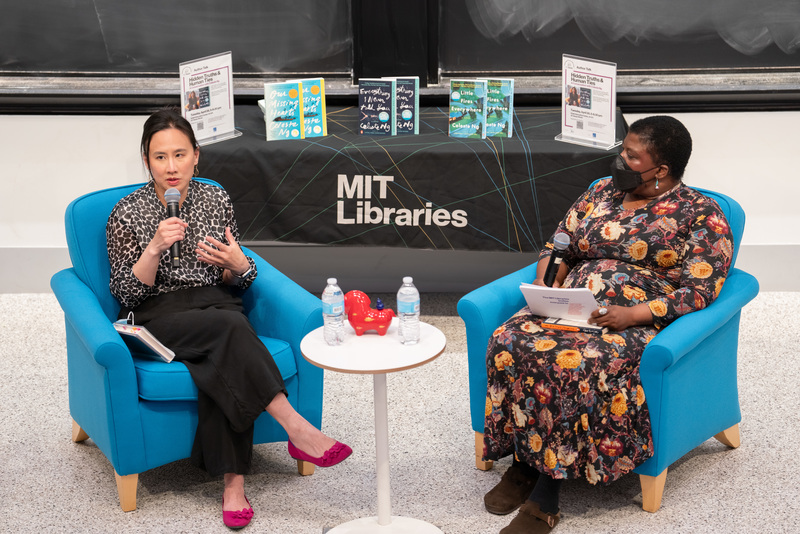
Photo courtesy of Bryce Vickmark
Celeste Ng
Everything I Never Told You
EG&G Education Center (34-101), MIT
April 28, 2026
On April 28, award-winning author Celeste Ng discussed her debut novel, Everything I Never Told You, at an MIT Libraries community event titled “Hidden Truths & Human Ties.” Associate Professor of Literature Sandy Alexandre moderated the discussion. MIT Reads, an MIT Libraries program that aims to foster community book discussion, selected Everything I Never Told You as the book for spring 2026.
Ng is the author of three bestselling novels — Everything I Never Told You, Little Fires Everywhere, and Our Missing Hearts. Her accolades include the Pushcart Prize and the Guggenheim Fellowship. Ng grew up in Pittsburgh, Pennsylvania and Shaker Heights, Ohio. She majored in English at Harvard and received an MFA from the University of Michigan.
Everything I Never Told You is about the multiracial Asian/white family of James and Marilyn Lee in 1970s small-town Ohio. When teenage daughter Lydia’s body is suddenly found in the local lake, her unexpected death causes the family to unravel, as they each grieve differently and struggle to understand one another. The novel explores many complex themes that center around family conflict, including secrets and generational differences.
Ng began by reading a passage from the novel about the pressures Lydia feels from her mother’s high academic expectations. Marilyn wants Lydia to become a doctor, as she herself never became one. Lydia’s parents view her as a high achiever, but in reality, Lydia is struggling: she does well in college-level biology because she cheats off of her classmate, and she is close to failing high school physics.
The passage was filled with engaging, vivid details about Lydia’s struggle to comprehend physics and biology, from the daunting unknown variables in her physics homework to memorizing random biology concepts. This narrative makes her a relatable and sympathetic character for the audience. Although it is clear from the passage that Lydia is unhappy, she chooses to keep quiet and let her secrets grow instead. The other family members also remain silent, ultimately fracturing family dynamics.
Since the book focuses on family tensions and conflict, its story has reportedly encouraged many children and parents to better understand one another through conversations, even if they may be difficult. For Ng, this is one of her favorite things to hear at a book event.
“I really feel like this is a huge honor to have that [impact] and is something that I try not to take lightly,” Ng said.
When Ng wrote the book, she did not enter with the mindset of having a “thesis” or message for readers about the family. Instead, she used an investigative approach, asking many questions about their situation throughout the writing process; it wasn’t until the end of the book that all the pieces came together for her.
From the writing process, Ng came to realize that the book’s central question is whether somebody can truly understand someone else’s experiences, and vice versa. She shared that her family related to this question; her parents immigrated from Hong Kong, but she was born and raised in the U.S. These cultural and generational differences made Ng wonder how much she could explain her experiences to her parents, such as growing up in a place where very few people besides her family looked like her.
“They knew we had that [experience], but I don’t think they knew exactly what it was like, because they haven’t experienced it,” Ng said.
Ng believes that the main piece of advice in the book is that even though it may be difficult for one to explain their past and experiences to someone, it is still “worth trying” instead of just “giving up.” However, Ng recognized that the main barrier to having open conversations is that people don’t want to share certain things about themselves. Although many of these unsaid experiences are secrets, Ng stated that some things simply end up not entering the conversation.
“You have this idea that the closer you are to someone, the more you know everything about them,” Ng said. “I don’t know if that’s always true.”
In regards to the family’s secretive nature, Ng attributes this dynamic to cultural clashes that not only include racial and ethnic differences, but also generational differences. She acknowledged how these differences can pose parenting challenges.
“I don’t actually know anyone who is growing up in the exact same culture [as someone else], right? The world changes,” Ng said.
Despite this gap, Ng hopes that families can find a point in the middle where there is some mutual understanding, instead of letting differences persist and cause friction in relationships.
To foster dialogue across differences in families, Ng shared that it helps to encourage others to listen. She commented on how people tend to focus more on talking in conversations instead of listening, which she argues is also important. In addition, Ng encouraged the audience to enter a conversation with the “willingness to sit in uncertainty” and not be focused so much on making progress, since progress in conversations is “slow work” and requires time.
While progress can feel incremental, Ng underscored the importance of persisting in hard conversations. “The work of it is in staying in that conversation and keeping on having these conversations again and again,” she said.