An unrigorous investigation into food chain consistency
Is Blank Street consistent? Let’s find out!





Alor Sahoo–The Tech
Alor Sahoo–The Tech
The inspiration
A while back, I applied for something and wrote the following essay (details tweaked):
Prompt: You get $6,767 to do something that isn’t meant to make profit. What would you do with it and why?
I’m a Beli power-user (top 1% in SF this January, mind you) but it has a structural weakness. This restaurant-focused social media platform has a feedback loop: you click on a restaurant, see the most popular dish with “n” recommendations, order it because it’s popular, and post a Beli review with the picture. The next person sees that same dish with “n+1” recommendations and is even more likely to order it. This incentivizes people to play it safe within a restaurant, especially lone diners who can’t order “family style” and try everything out.
My $6,767 would go towards the unscalable alternative: an elusive, diverse network of food critics who are focused on culinary coverage instead of parroting existing consensus. Contributors order both the iconic staples and the less popular items, the ones that look out of place. They’d write up unpretentious field notes: Who was this dish for? Is it a hidden gem? Is everything good, or just the staples? Is the food worse when it’s crowded, or near closing?
When a platform like Beli amplifies only certain dishes, it risks flattening entire cuisines into a few “best dishes” in people’s minds. Rather than ranking restaurants against each other for rankings’ sake, this project would create a publicly available, dish-by-dish counter-archive that treats restaurants as independent systems. Some are more fault-tolerant, with quality distributed across a menu. Others concentrate their reputation into a single mind-blowing dish. People deserve to know which restaurants are which.
A summary and further thoughts
When we talk about the quality of a restaurant, we almost always mean how it is on average. The mean or median. For example, on Beli, if your friends have been to a specific place, it’ll show you a composite “Friend Score,” but it won’t directly display any measure of spread. No range. No interquartile range. No standard deviation. Have we forgotten descriptive statistics? I understand that they don’t want to clog up their interface, but still.
Of course, if your friends haven’t been to said restaurant, you’re slightly more screwed. Part of the answer, I argue, is simply collecting more data: multiple people, multiple times of day, ordering multiple things each time. I want to be able to search for good hash browns near me. I want to be able to search for restaurants that have good non-spicy options. I want to be able to find places that are gluten-friendly without being totally gluten-free. And I want to be able to do all of that without having to be plugged into the world of “foodtok” and food review newsletters.
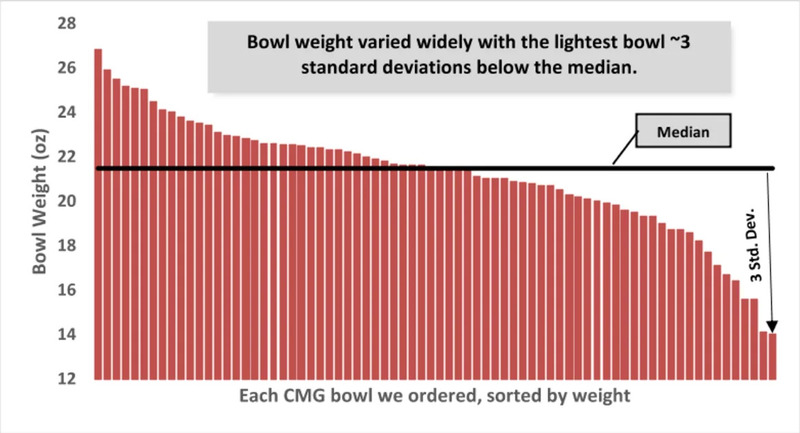
In the world of food quality data, my hero is Zachary Fadem, who went to a bunch of Chipotles in Manhattan to prove that there was substantial variance in weight (controlling for everything else). See Exhibit 1.
I’m not going to pretend that Chipotle, of all things, is the gourmet cuisine that people research on Beli beforehand. Still, there’s something weirdly impressive about going to Chipotle over and over and over again. In my infinite boredom, I thought about what the Boston version of this would be. Would it be to go to Dunkin’ repeatedly? Or a bunch of Tattes? Maybe Flour? And order the same thing over and over again? And not get bored?
I eventually settled on Blank Street. It’s consistent enough, and there’s a decent number of them throughout Boston, New York, London, and so on. Plus, I really wanted to get matcha instead of something solid. Chipotle bowls are so heterogeneous — matcha is simple. If you weigh it, you know exactly what you’re going to get. And so, after randomly tweeting about it and roping in a friend, we embarked on our journey. The process was simple: bring a cocktail shaker and a scale. Go to a bunch of Blank Streets. Filter out the ice. Weigh out the matcha. Rinse and repeat.
Some minor issues
Weighing matcha in front of baristas seemed strange; therefore, we had to conduct our incredibly niche and strange measuring outside the café, including:
At a table at Harvard’s Smith Campus Center
On a slab of cement (?) outside the Charles/MGH T station
On another slab of cement (or bench) outside North Station
We also spilled some matcha and had to rinse out our cocktail shaker many times. The wind also threw off some of our measurements. Plus, we can’t be completely sure if there was any variation in matcha concentration, since I didn’t bring a spectrophotometer. Maybe next time. Unfortunately, by matcha #4 or so, we got a bit tired of iced matcha in general.
The results
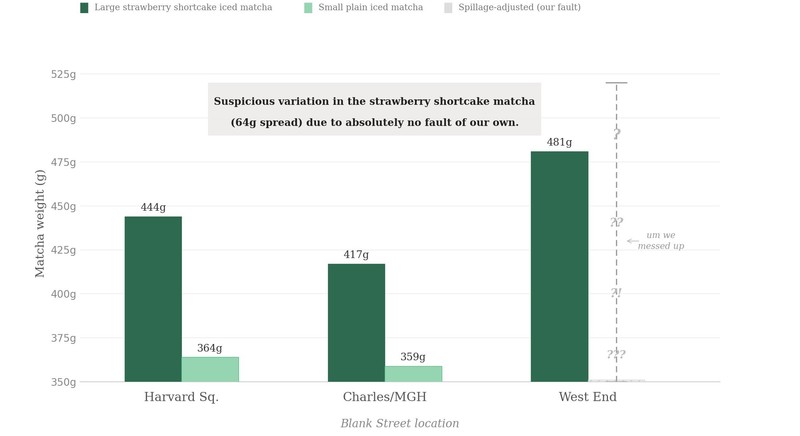
Here, I’ve graphed the results of our five data points. See the (other) Exhibit 1.
What’s the point of this? Your sample size is way too small!
The results are kind of obvious: simple, plain matchas are more consistent than complex, flavored ones. Larges are almost always better than smalls, dollar per gram. Some baristas (very, very slightly) overpour and some (very, very slightly) underpour.
But more importantly, I got to simultaneously catch up with friends and matchamaxx. What’s not to love?