Jordan Harrison’s ‘The Antiquities’: What do we leave behind?
A museum of human history, curated by the machines that outlived us





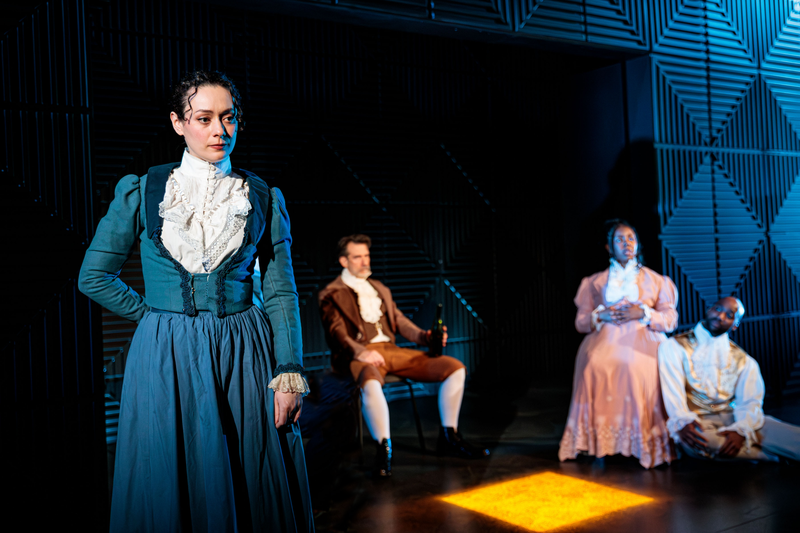
Photo courtesy of Benjamin Rose Photography
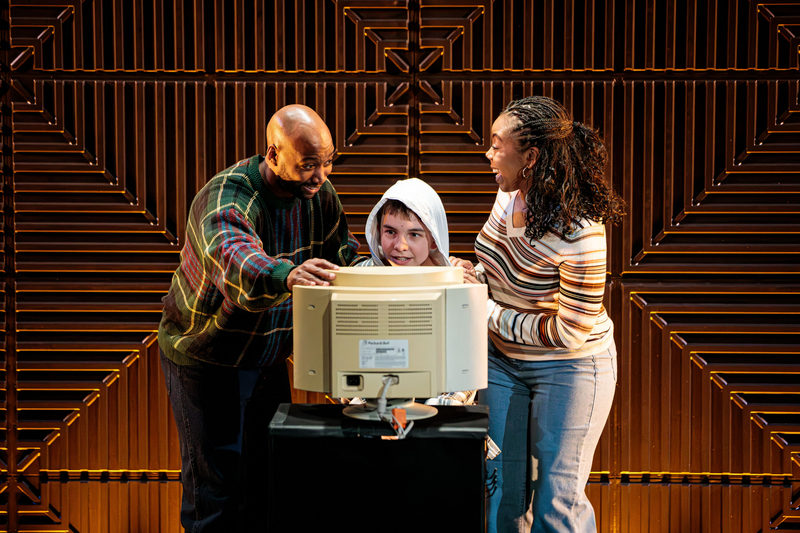
Photo courtesy of Benjamin Rose Photography
Jordan Harrison’s The Antiquities
Directed by Alen Lonati
SpeakEasy Stage
March 6–28, 2026
Jordan Harrison’s The Antiquities, performed at SpeakEasy Stage’s Roberts Studio Theatre from March 6 to 28, is unsettling: humanity is extinct, and what remains of us is a museum. Two humanoid AI curators, Woman 1 (Alison Russo) and Woman 2 (Kelsey Fonise), welcome the audience to the Museum of Late Human Antiquities and invite us to imagine that we have been given bodies for the duration of the tour.
The play moves through more than a dozen vignettes spanning from 1816 to 2240, then reverses course back to the beginning. The structure is deliberately disorienting. It feels less like a narrative, and more like an excavation, like wandering around a museum where no exhibit connects to the next except by the common thread of humanity. Scenes include a campfire gathering where Mary Shelley conceives of her famous Gothic novel Frankenstein; a factory worker losing a finger to a machine in 1910; a family crowded around a computer in 1994, thrilling at the sound of dial-up internet; a writer in the near future agreeing to have a chip implanted in her brain, because the alternative (irrelevance) seems worse.
Harrison draws a line from Mary Shelley’s creature to the chip in the writer’s skull, and the logic holds. But the leap from “AI replaces writers’ jobs" to "humanity is extinct by 2240” requires the play to skip over a lot of middle ground. The 2023 exhibit, in which a recently fired employee signs an NDA to conceal the dangers of an AI system, lands with genuine unease. The 2076 exhibit, where an unmodified woman is killed by a modified child who declares that “the smart ones embraced the improvements,” tips into the kind of clean dystopian parable that feels borrowed from a dozen science fiction films. The threat is real enough without the tidiness.
That said, the ensemble of nine actors, playing over 40 characters across the vignettes, handle the high demands of the script with neat efficiency. Russo is a consistent anchor — her turn as a grieving mother in the 1987 AIDS-era exhibit, unable to sleep and watching a Betamax tape with her young son, is the production’s most emotionally resonant scene, specific and unhurried in a show that is often neither.
The script’s sharpest moments are its most mundane: a bottle of shampoo pulled from a refrigerator and drunk like water, the AI curators fumbling their artifacts in small ways that suggest reconstruction rather than memory. The museum cannot know what it felt like to be human — it can only guess at the objects and the gestures.
The design supports the concept without pushing it. Christopher and Justin Swader’s tiled set and Amanda Fallon’s cool, sepia-toned lighting establish the museum’s clinical atmosphere effectively. Anna Drummond’s sound design is strongest in the historical exhibits, where dial-up tones and the specific noise of crickets at night do immediate work. However, the electronic droning that scores the transitions between scenes is less interesting; the sound signals “futuristic unease” in a way the production has already earned through other means.
At one hour and 40 minutes without intermission, the reverse-chronological second half occasionally retreads ground already covered. Harrison is not interested in an off-ramp; in this world, extinction is a given. The play’s final scene earns the weight it asks for: back at the 1816 campfire, the characters are present and unguarded, aware of the beauty of the particular night they are in, and Claire Clairmont is expecting a child. The AI narrator wonders aloud whether displaying these objects trivializes the suffering of the people they belonged to. It is the right question to end on, and Harrison had a good sense not to answer it.