Pianist Víkingur Ólafsson makes his solo debut at Boston’s Symphony Hall on March 20
The soloist played pieces by Beethoven, Bach, and Schubert in the keys of E major and minor





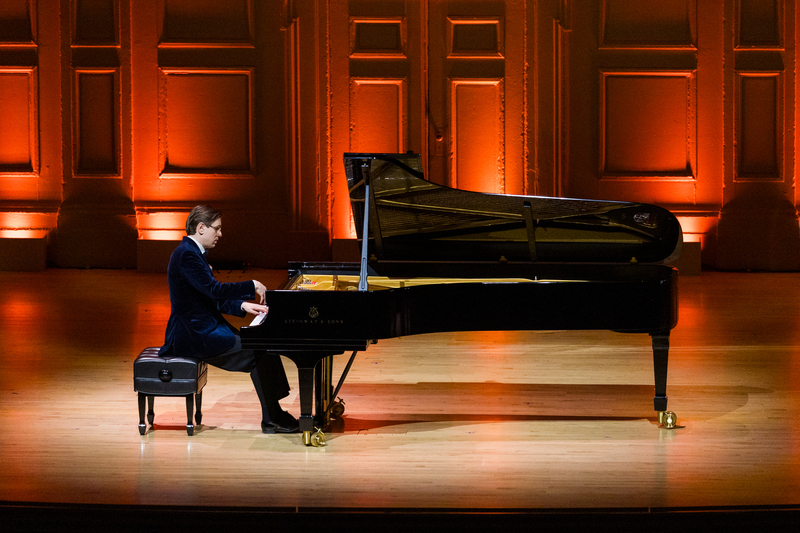
Photo courtesy of Robert Torres
Opus 109: Beethoven, Bach, Schubert
Vivo Performing Arts
Víkingur Ólafsson, piano
Boston Symphony Hall
March 20, 2026
On March 20, acclaimed pianist Víkingur Ólafsson made his solo debut at Boston’s Symphony Hall. Last year, Ólafsson performed a stunning piano duet with Yuja Wang at the same venue. The title for this performance was “Opus 109,” reflecting Beethoven’s Piano Sonata No. 30 in E Major, Op. 109, the last piece in the program. Besides Op. 109, Ólafsson also played a selection of pieces from Bach, Schubert, and Beethoven. Although the repertoire had distinct musical styles, all pieces were in the keys of E major or minor.
Ólafsson began with Bach’s Prelude in E Major from The Well-Tempered Clavier, a short piece with light staccatos full of joie de vivre. An easygoing opening was balanced well with the minor melodies in the middle, adding complexity and contrast to the piece’s emotions. Ólafsson’s control of tempo was exquisite; he slowed down at times that were appropriate, resulting in a performance of short, smooth twists and turns.
Following the Prelude was Beethoven’s Sonata No. 27 in E minor, Op. 90, a special sonata for its two movements that feel like an emotional rollercoaster ride. In the first movement, Ólafsson played with great intensity, evoking scenes of rolling, crashing waves in a tumultuous storm most notably in the latter half. On the other hand, the second movement was happy and animated, interspersed with sections of dreamy, gentle passages that came from Ólafsson’s delicate touch.
Ólafsson then returned to Bach, this time playing Bach’s Partita No. 6 in E minor — a suite of dance movements for a solo instrument. The Partita was a kaleidoscope of dances, each one special for its rhythm and melody. The piece began with the “Toccata,” an elegant, courtly dance filled with embellishments that Ólafsson finely navigated. However, his playing at times felt a bit too deliberate and forceful, causing the melody to feel heavy.
Meanwhile, Ólafsson’s dextrous, nimble fingers shone in “Corrente”: he produced a melody that depicted a person dancing on their tiptoes, with frequent small jumps that felt like a game of hide-and-seek. He also executed the syncopation well, allowing the movement’s polyphonic texture to clearly shine. The complex layering of the voices was also encapsulated in the “Tempo di Gavotta” that had sprightly passages accentuated with staccato notes and quick flourishes, which conjured images of a galloping horse.
After taking the audience through a series of dances in the Partita, Ólafsson played Schubert’s Piano Sonata in E minor. The first movement (“Moderato”) began with a quiet, poignant melody that underwent significant transformations throughout, from a playful melody to an agitated passage, followed by a calm ending. Ólafsson not only effectively brought out the major dynamic contrasts in the movement, but also elegantly through the nuanced voicing.
The second movement (“Allegretto”) had a romantic opening that became passionate and energetic through the flowing cadenzas in the development. In the end, the piece returned to its original blissful theme, with the sustained alternating notes from the left hand that provided continuous steady energy in the background.
The recital concluded with Op. 109, the program’s centerpiece. Each of the three movements burst with different colors. The first movement (“Vivace ma non troppo — Adagio espressivo”) brimmed with joy. The descending notes in the cadenza began like tinkling chimes and then evolved to sound like church bells that rang with jubilation. In contrast, the quick and declarative chords in the second movement (“Prestissimo”) was like a militant march.
The last movement of Op. 109 (“Andante molto cantabile ed espressivo”) featured striking contrasts. The movement began with a slow, meditative passage that felt incredibly light. This spell was broken in the middle with an intense and virtuosic passage that Ólafsson executed like a perpetual motion machine with unstoppable energy. In the end, however, the movement returned to its original, restful state, restoring the dreamlike effect again.
After the audience gave a standing ovation for Ólafsson’s continuous performance, he closed the performance not with two, but four encores. He first played an arrangement of “Air on a G String” by composer György Kurtág, a beautiful piece that felt as light as a feather. Then, he played Rameau’s Le Rappel des Oiseaux, a light and quick piece filled with crystal-clear embellishments reminiscent of the sound of birds chirping.
Following Le Rappel des Oiseaux was “The Arts and The Hours,” a transcription based on Rameau’s last opera, Les Boréades. The piece felt like a mirror, as if the melodies reflected off of each other. This mirror-like quality also opened the piece to introspection and contemplation, with a tinge of nostalgia. Ólafsson’s final encore was Philip Glass’s Etude No. 6, a very brisk piece with repetitive notes and chords that conveyed a heightened sense of urgency, as if time was ticking and running out.
Overall, Ólafsson did an excellent job taking the audience through an engaging musical journey, from the delightful contrapuntal melodies in Bach’s Partita to the wide-ranging passages in Beethoven’s Op. 109. From this program, it is clear how each of the composers’ works are related to one another despite coming from different musical eras.