Brahms at his loneliest
Herbert Blomstedt guest conducts the BSO with an all-Brahms programme





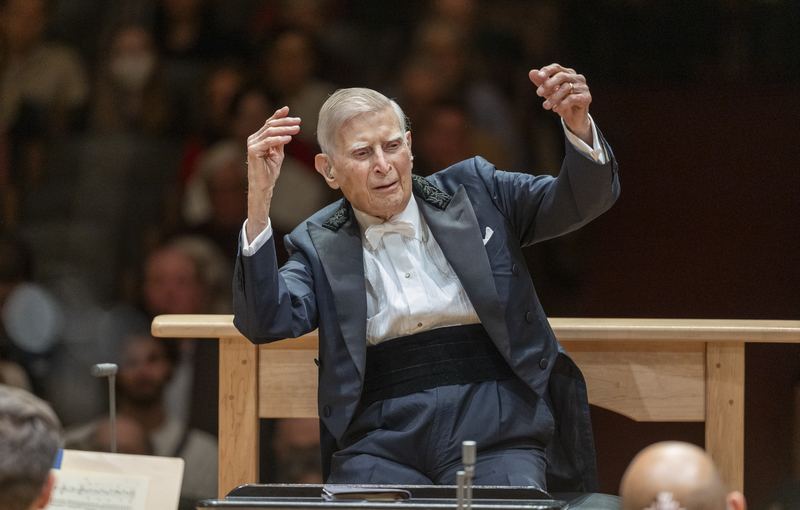
Photo courtesy of Michael J. Lutch and the Boston Symphony Orchestra
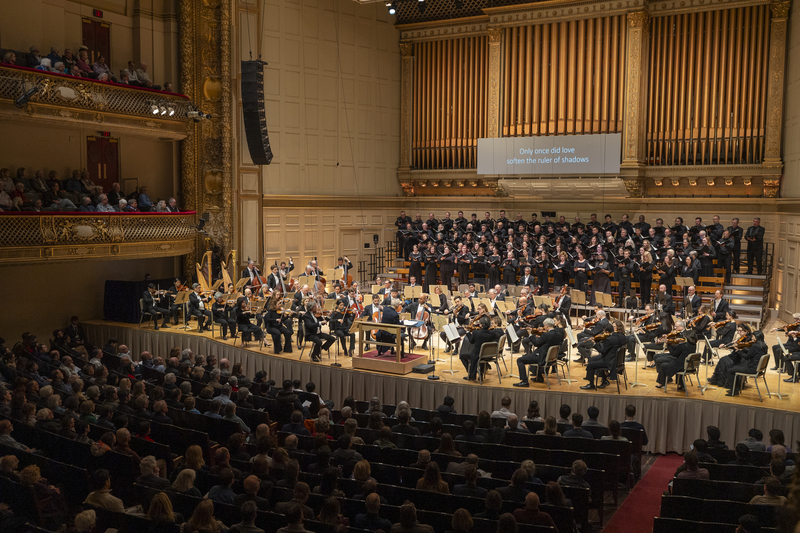
Photo courtesy of Michael J. Lutch and the Boston Symphony Orchestra
Brahms’s Schicksalslied, Op. 54, Nänie, Op. 82, Symphony No. 4 in E minor, Op. 98
Boston Symphony Orchestra
Conducted by Herbert Blomstedt
Featuring the Tanglewood Festival Chorus
Boston Symphony Hall
March 7, 2026
Looking across the career of Johannes Brahms, one sees him first firmly and confidently establishing himself as a force to be reckoned with. As the years went by, he grew more meditative and autumnal. The works on this program present Brahms at his most introspective. The music is unmistakably his: a brusque, middle-aged German bürger, smelling of cigars and dressed in tweed, walking through the streets of Vienna on a cold, cloudy day. Blomstedt clearly wanted the audience to fully immerse themselves in Brahms’s soliloquy. The Boston Symphony Orchestra’s (BSO) performance on March 7 was by no means the most precise; however, the emotional delivery of the program ultimately made the evening compelling.
The night opened with Schicksalslied. Blomstedt drew out the full potential of the orchestral prelude, with the drums appropriately balanced as if one were gazing toward the great adventures lying ahead. Despite a few muddled entrances, the orchestra soon recovered and adequately portrayed the serene, heavenly breeze described in Hölderlin’s poem, playing with tenderness. Then came the storm: a sense of panic, as the fear of being forsaken drove the music forward. Despite Blomstedt’s minimal conducting gestures, the orchestra and choir responded with clarity. As the orchestral prelude returned, this time in an even purer C major, the apotheosis felt complete, with Blomstedt almost preaching from the podium. The finesse of the dynamics was on point, with excellent contrast between the first two sections and a discernible difference in calmness between the two orchestral passages.
The lesser-known Nänie is more direct in its theme, being an elegy for Brahms’s friend Anselm Feuerbach. In the stanza describing how every beauty must die, the main theme is hauntingly beautiful. (It reminds me of Bach’s chorale Alle Menschen müssen sterben (BWV 262), which shares the same key.) Blomstedt brought out this theme, especially the high notes, to the fullest. The balance of the chorus was excellent, with the imitative sections performed with well-judged dynamics. The Thetis theme was delivered with passion, achieving a natural sense of storytelling that conveyed the profound sadness Brahms must have felt. The piece ends on the penultimate line, that a lament on the lips of loved ones is glorious, sung with the utmost grace and consolation, moving anyone who listens to it.
Despite somewhat imprecise German diction and issues with the supertitles, the Tanglewood Festival Chorus, prepared by Lisa Wong, performed admirably. Less admirable was the ill-judged clapping that occurred throughout the night. Eventually, Blomstedt had to hush the audience to prevent applause between movements in the second half of the concert.
Brahms’s last symphony is uniquely dark among his symphonic output, and it was surprising that Blomstedt began the first movement at a more relaxed tempo than in his recordings. The orchestra was still not at its most precise, with the first violins coming in just a little too early at times, alongside intonation errors in exposed sections from the trumpets. However, Blomstedt’s interpretation ultimately redeemed the performance. Starting from such a relaxed tempo, could the tension at the end of the movement still be convincing? Blomstedt’s solution was a modest increase in tempo at the climax. The music then sounded like a tragic march toward an unstoppable force of destiny, foreshadowing the terrible fate that awaits.
The second movement gives us a brief, though uneasy, respite from the struggles we have witnessed. Blomstedt chose to emphasize the tension this time, giving particular weight to the minor-key sections. The beautiful second theme was a delight to hear. It reminded me of a hero, wounded but finding solace, slowly regaining strength to continue his adventures: a signal of hope, though not without uncertainty. The orchestra played the triumphant third movement with vigor and excitement and was noticeably sharper than before. It did not feel like a bacchanal, as many interpret it, given the giocoso description Brahms assigned. Rather than a festival, Blomstedt’s interpretation suggested an assertion that the struggle could be won, especially toward the end.
And finally, tragedy fully strikes. The Passacaglia theme in the winds and brass was initially controlled, which made the message even clearer, further accentuated as the variations unfolded. The flute solo and the woodwind and horn melodies that followed were particularly beautiful, with Blomstedt offering us a glimpse of the serenity we had heard in the first half of the night. Perhaps the hero could still prevail and return in glory. Alas, that was not what fate had planned. As the E minor theme returned, the tension built gradually until the timpani roared in, though it remained measured. Blomstedt also chose not to raise the tempo too much. The tragic outburst and the full release of the music’s potential comes only when we reach the coda. The hero is lost, vanquished, and in despair. It is remarkable that Blomstedt achieved this music-drama not through overt expression, but through great restraint. One additional comment concerns Blomstedt’s use of “traditional” seating, with the violins placed antiphonally. This allowed the counterpoint to emerge more vividly
After the concert, a sense of uneasiness lingered. One wonders why Blomstedt chose such an unrelentingly tragic program — surely not because he plans to retire (a brief look at his calendar would suggest otherwise). At least to this reviewer, the evening offered a deeper sympathy for Brahms as a person. Beneath the immense craftsmanship and brilliant music lies the true Brahms: an immensely successful yet profoundly lonely man, who stoically concealed his inner struggles and chose to endure them in solitude.