MIT holds 52nd annual MLK celebration luncheon on Feb. 11
Dean of Engineering Paula Hammond ’84 PhD ‘93 was the keynote speaker





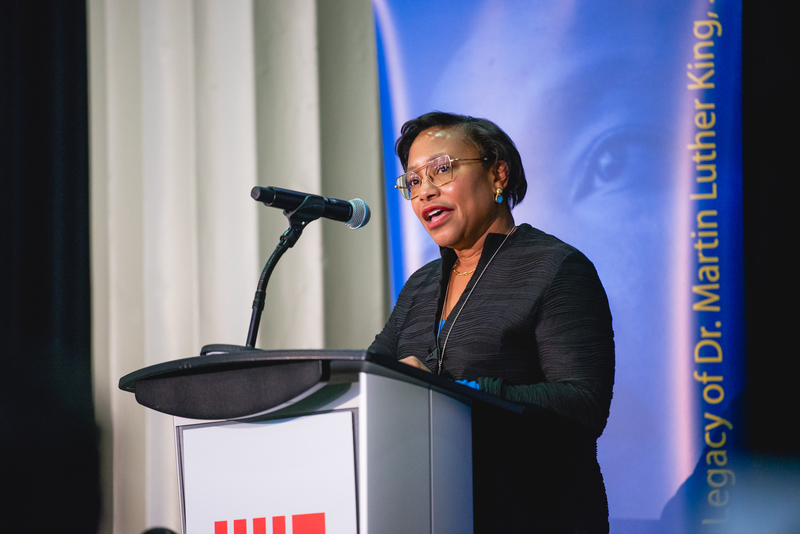
Photo courtesy of Corban Swain
On Feb. 11, over 250 people attended the 52nd annual Martin Luther King Jr. Celebration luncheon held in Walker Memorial. Organized by the MLK Celebration Planning Committee, the celebration featured President Sally Kornbluth as the host, with Dean of Engineering Paula Hammond ’84 PhD ’93 giving the keynote speech. This year’s celebration centered on Dr. King’s iconic quote from “Shattered Dreams,” a chapter from his 1963 sermon book Strength to Love: “We must accept finite disappointment, but never lose infinite hope.”
After an invocation from Reverend Thea Keith-Lucas, President Kornbluth delivered opening remarks. She began by describing the current state of affairs in the United States as “fractured, isolated, and pitted against each other.” Despite the pessimistic outlook, Kornbluth reminded the audience the importance of finding a sense of community and belonging. “The solace we all take from [the luncheon] could not be more relevant now,” Kornbluth said.
Kornbluth then introduced Dean Hammond, commending her for exemplifying MIT’s values of excellence and curiosity throughout her academic career. Kornbluth also praised Hammond for continuously striving to make MIT a warm and welcoming place. “She smiles a lot, and that’s a great way to make room for everyone,” Kornbluth said.
Emcee Michael Ewing ’27 then gave a welcome speech about accepting finite disappointment but not losing infinite hope. “It’s this idea that we can never let fleeting setbacks stop us from moving forward,” Ewing said. “Let whatever setbacks that we face strengthen our resolve, not shatter it.” He urged the audience to embrace Dr. King’s words of viewing each challenge as an opportunity for growth and hope for a brighter future.
Following Ewing’s welcome, various undergraduates and graduate students gave speeches that reflected upon the life and legacy of Dr. King. Oluwadara Deru ’26 highlighted that Dr. King’s legacy came with major costs, as he was under “constant and strategic attack.” Despite this, Deru believes that people fighting for positive change in the world gain something invaluable from these experiences. “The beauty of linkages that cannot be broken, colleagues that turn into family, freedom and wins that are only won through sustained action,” Deru said. She also implored the audience to not give up on the fight for change and continue to hold on to hope.
Ekua Beneman G, a chemistry PhD student, shared her story about the impact of the MIT Summer Research Program (MSRP) on her academic career. Beneman admitted that as an undergraduate, she was not well-informed about the PhD application process. At MSRP, however, she met David, an influential mentor who inspired her to apply to PhD programs. As a Black woman in science who actively engages in STEM outreach programs such as MITES, Beneman talked about the importance of accessibility in success. “Hope is choosing to pass forward what was once given to you at a place like MIT,” Beneman said. “Infinite hope looks like mentorship.”
Director of the Office of Graduate Education (OGE) Denzil Streete encouraged the audience to make infinite hope a daily practice through small actions that show joy and care for the community. “Care is a sudden refusal to treat people like problems to be solved instead of human beings to be supported,” Streete said. He also discussed collective action as a way to share hope with others, citing the civil rights movement as an example. Streete left the audience with a question, asking, “Would you be counted among those who work behind the scenes to provide hope in testing times?”
After the MIT Gospel Choir performed the spiritual “I Want Jesus to Walk with Me,” Hammond gave a keynote address about her supportive upbringing, the lessons she learned at MIT, and the significance of Dr. King’s quote in the context of today’s issues.
Before becoming the Dean of Engineering, Hammond was the executive vice provost and vice provost for faculty. An Institute Professor, Hammond was also the head of the Department of Chemical Engineering from 2015 to 2023, known for her innovative research in novel biomaterials, including electrostatic polymers and nanoparticles for drug delivery in cancer. Hammond received her bachelor’s degree and PhD in chemical engineering (Course 10) from MIT in 1984 and 1993, respectively, and then joined the MIT faculty in 1995.
Hammond began the address by talking about her parents, who were her role models growing up because of their emphasis on education. Hammond’s mother founded a nursing school at Wayne County Community College while her father was the director of health laboratories for the City of Detroit and was active in Detroit’s NAACP chapter. Growing up in 1970s Detroit, Hammond noted that although there was progress towards racial equality, racism still existed. She recalled her parents being frustrated about the challenges they faced at work, but they persevered, and their actions ultimately paid off. “I believe [my mother] was an early example for me of finite struggles and infinite hope,” Hammond said.
She then discussed her journey at MIT, from entering as an undergraduate student to becoming a faculty member. Hammond admitted that she felt a lot of impostor syndrome at MIT, as some members of the community made her feel like she did not belong, from “anti-affirmative action editorials in The Tech” to “misguided comments from instructors.” Hammond credits the close friendships she made in organizations like the Black Student Union and Delta Sigma Theta for helping her navigate her MIT undergraduate experience. Although Hammond experienced academic challenges, she found that she had the power to shape her trajectory for the better, such as working hard to improve her grade in difficult classes. “By the time I finished, I had grown in confidence and left MIT feeling [that] I could handle just about anything with time and energy,” Hammond said.
Hammond spoke positively about the changes MIT has experienced over the decades, including a more diverse student body and a near even gender balance. When Hammond entered MIT in 1980, only 17% of undergraduates were women, compared to 48% of the class of 2029. She also highlighted the impact of MIT’s research and discoveries on the world, from biomedical therapies to computer technologies. “MIT is moving us toward a more enabled future,” Hammond said. Hammond then transitioned to discussing Dr. King’s quote on finite disappointment and infinite hope. She elaborated upon the definition of finite, stating that the word describes “having limits or bounds” in mathematics. She used the Jim Crow era as an example of a finite era, stating that the oppressive period gradually came to an end after the rise of the civil rights movement. She praised the people who participated in the movement, as they continued to resist despite the violence and risks. “They knew that what was just and right would prevail, and that whatever finite challenges they faced, there would be a new time, a new day,” Hammond praised.
Hammond recognized numerous challenges in today’s society, from an increasing polarized country to a rise in misinformation. In light of these challenges, Hammond reiterated the definition of finite, stating that these disappointments are “limited, bounded” in time and intent. “Principles founded in fear, ignorance, or injustice ultimately fail because they do not meet the needs of a growing and prosperous nation,” Hammond said. Conversely, Hammond believes that infinite hope and faith will enable people to overcome setbacks and spur change, thus leading to a better future. She urged the audience to not let disappointments in the country “distract us from our mission.”
Hammond shared that she faced many struggles in her life, from finding research funding as a new faculty member to challenges as a senior MIT leader. While she acknowledged that some of these challenges were “self-induced,” she emphasized that all of them were finite in nature. What instead prevailed for Hammond was the concept of infinite hope. Hammond expressed gratitude for the mentors and colleagues that supported her career, as well as the students who offered valuable research insights. She also underscored the importance of inclusivity and diversity across all spectrums, from socioeconomic status to race.
Hammond ended her address by encouraging the audience to embrace infinite hope in their everyday lives. “Each of you represents a piece of Dr. King’s dream,” Hammond said. “We have a role to play in contributing to our future, and we each must embrace endless hope and continuously renew our faith in ourselves to accomplish that dream.”
A correction was made on Feb. 19, 2026: A previous version of this article misstated that the MIT Gospel Choir performed “Jesus Spoke to Me.” It has now been updated to say “I Want Jesus to Walk with Me.”