Ticked off: How Mikki Tal is using Lyme disease to transform women’s health research
Chronic illness is a disproportionately female problem, and immunoengineer Dr. Michal “Mikki” Tal took action to stop it





Grace Zhang–The Tech
By the early 2010s, Dr. Michal “Mikki” Tal was well-acquainted with immune cells and infectious diseases. Having just completed her PhD in immunology at Yale, she was beginning a postdoctoral fellowship at Stanford University when she picked up a paper by someone she only identified as a “well-respected clinician and scientist.”
The piece was about a gender skew in chronic Lyme disease. Doctors had observed that women were developing chronic Lyme at a far higher rate than their male counterparts. Tal was shocked, not just by this finding, but by what she would discover as she kept reading: “He was talking about the sex skew of chronic Lyme and used that to insinuate,” she said, that this “must be a manifestation of hysteria.”
“This was the first time I saw so plainly that the fact that I’m a woman can and would be used against me,” Tal said.
That realization changed the trajectory of her career. At the time, her work at Stanford studied how CD47, a cell-surface protein that prevents cells from being eaten, affects the clearance of cancer and infectious diseases. Since then, she switched her focus to Lyme disease, studying how Borrelia burgdorferi — the spiral-shaped bacteria behind the disease — prompts different immune responses in men and women.
B. burgdorferi is primarily transmitted by ticks. Often characterized by flu-like symptoms and a bullseye rash around the tick bite, the resultant Lyme disease normally clears after a round of antibiotics. For around 10% of people though, most of whom are women, debilitating symptoms of body aches, migraines, joint pain, brain fog, and newly identified gynecological disorders persist indefinitely.
Tal, now a principal scientist in MIT’s Department of Biological Engineering and the associate scientific director of MIT’s Center for Gynepathology Research, wanted to know why women were more at risk for chronic Lyme — and why that question hadn’t been asked in the first place.
There’s so much more to know about women’s health
Women have been largely excluded from health research for decades. These shortcomings have resulted in preventable suffering and left many unknowns about the female immune and reproductive systems.
For example, take the global medical scandal that unfolded in the late 1950s and early 1960s. After the release of thalidomide, a sedative intended to treat morning sickness, thousands of children were born with severe birth defects. While toxicity studies were conducted in animals and healthy people, the drug was never tested in its target population — pregnant women — before it hit the market.
Thalidomide was never approved in the U.S., but the nation still felt its effects. In 1977, the FDA published guidelines that advised excluding any fertile women from participating in the clinical research stages that assess safety, dosage, and efficacy: phases I and II. This meant that most women were kept out of clinical research altogether.
Though the FDA reversed this decision in 1993, its consequences persist. Many studies still underrepresent women, once again citing concerns about pregnancy risks and hormonal fluctuations. The resultant shortage of data on how various drugs and diseases affect women has often left doctors unequipped to treat their female patients, especially those with female-predominant illnesses.
In 2023, Tal launched MIT MAESTRO (Mucosal And systEmic Signatures Triggered by Responses to infectious Organisms), a clinical study to address these gaps. The study collects data from patients with chronic illnesses, specifically chronic Lyme disease long long COVID, associated with infections. Though one is caused by a bacteria and the other by a virus, Tal Research Group research specialist Paige Hansen observed that “both are female skewed, and both have a similar percentage of patients [roughly 10%] that continue to have symptoms.”
MAESTRO participants are first asked to provide their medical history and past infection experiences. Then, at MIT’s Center for Clinical and Translational Research, they receive a physical exam followed by about four hours of non-invasive tests and sample collections.
The assessments look at memory and thinking skills, vision, skin health, how well the body adjusts to sitting or standing, and joint flexibility. Researchers also collect urine, saliva, blood, throat, and vaginal swabs.
“We are measuring everything,” Hansen said.
These measurements allow scientists to search for extrinsic contributors to disease, including infectious pathogens and other microbes in the body, while also examining intrinsic contributors, like “variations within DNA, cells, and proteins” that influence an individual’s immune response, Tal explained.
Currently, chronic Lyme has neither a definitive diagnostic test nor established treatments. This flood of data could help change that: “We are going to make anonymized data sets [from the MAESTRO study] publicly available, so that scientists and doctors worldwide can probe this data for more answers,” Tal said.
The mouse that changed it all
As for their own laboratory experiments, the Tal Research Group started by studying a familiar mammalian model organism — the mouse.
Mouse research has been the gold standard for biological experimentation, not just because the animals are cost-effective and easy to breed, but also because they are genetically and physiologically similar to humans. Of course, mice aren’t humans, but they can “teach us how mammalian immune systems interact with these bacteria,” Tal said, “and then everything that we learn from this mouse model, we’re then able to take into different human [models].”
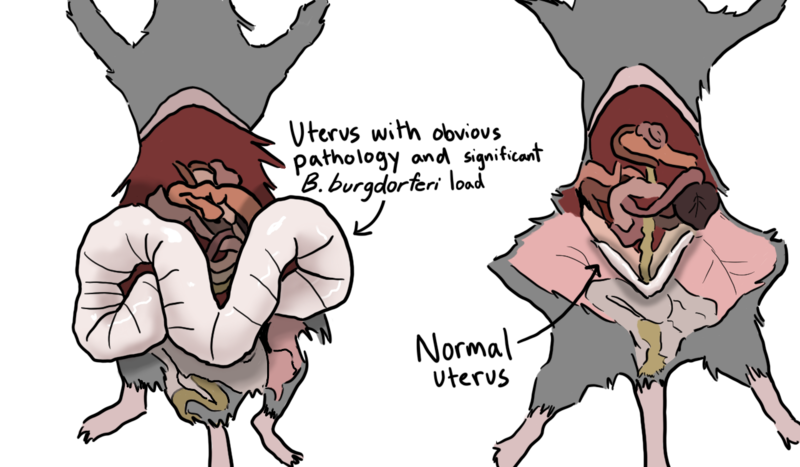
To begin, Tal and her team set up an experiment in which they injected a lethal dose of B. burgdorferi into 24 mice, half male and half female, and left them untreated for weeks without antibiotics. With these conditions, the mice were expected to develop chronic illness, but the results exceeded expectations: “I was horrified… by what we saw,” exclaimed Tal.
After allowing the infection to persist, Tal and her team noticed that Mouse 23 was a little “chunky,” and decided to take a closer look at what was happening inside her body. Mouse 23 had unexpectedly developed a significantly swollen uterus, a sign that pointed Tal and her team toward their next focus: gynecology.
“I wish I could tell you that I had this brilliant hypothesis and this was the proof I was looking for,” Tal said. “But really, it took the surprise of seeing this for it to really dawn on me how understudied gynecological conditions are, especially in the context of infectious disease.”
To further investigate the relation between Lyme and gynecological disorders, Tal repeated several experiments. More female mice were infected and left untreated for between eight weeks to fifteen months. These animals developed similar symptoms to Mouse 23, with enlarged uteruses, yellowed tissues, torsion of the uterine horns (where the fallopian tubes connect to the uterus), and fluid-filled sacs called ovarian cysts.
Tal was not quite done with her mouse model. She knew from past immunology experience that sex and age are known to influence an individual’s immune response to a pathogen. To investigate the effects of age, Tal and her team infected female mice at either fifteen weeks old (considered young for a mouse) or one year old (considered old); then, after nine weeks of infection, they euthanized them. Some of the young mice did not show any noticeable uterine pathology, while all of the older mice did, with some showing more severe symptoms than the younger ones. With these results, the next step was to investigate whether humans experienced the same gynepathology.
To do so, the researchers collected epidemiological data from clinical surveys and electronic health records of real women. Working with Hansen and current Tal Research Group postdoc Dr. Guido Pisani (OB/Gyn), Tal discovered that B. burgdorferi infection causes several gynecologic pathologies in humans — like Mouse 23’s enlarged uterus — and increases the risk for heavy or prolonged menstrual bleeding, miscarriage, uterine fibroids, and endometriosis. These conditions can mean years of chronic pain, severe anemia, infertility, and, for some patients, major surgery. What’s more, the human data revealed the same age-linked trend observed in mice.
While approved treatments and diagnostics are yet to come, Tal believes these recently published findings can be a light in the lives of many women who have been struggling with chronic Lyme disease. “I know that everything that we can do, every piece of information we can give them… helps them on their journey,” Tal said. “This helps them feel seen, and this helps them understand their illness, and this helps them navigate their care in ways that could be the difference between hope and despair.”
Researchers, listen up!
Beyond the laboratory, Tal is calling on the clinical research community to take action.
In 2017, while still a postdoc at Stanford, she attended a talk by Johns Hopkins University professor and immunologist Sabra Klein. Klein shared that women are more likely to report adverse reactions to the flu vaccine. While many doctors attribute this to a reporting bias, Klein discovered that women were being given “twice the dose that they need…the minimum protective dose for men.”
Tal refused to let vaccine companies get away with a “one-size-fits-all dose” at the expense of women. Inspired by Klein, she spoke to leading scientists at a major pharmaceutical company and asked if they would test a female vaccine dose. Her proposal was shot down. The company insisted that they would only test a female dose if the FDA mandated it, claiming they lack the money to analyze the data based on sex. Undeterred, Tal took it upon herself to raise awareness for this issue.
On Jan. 19, 2022, researchers from around the world gathered at MIT’s Stata Center to hear Professor Klein speak. It was the first talk in a series of discussions and seminars called SeXX and Immunity, an initiative started by Tal.
Tal hopes that the group will encourage researchers to join her in exploring the unanswered questions about women’s health and how biological sex affects the immune system: “Every single immune cell in your body has estrogen receptors, progesterone receptors, androgen [testosterone] receptors. So what do these… hormones do? How does that change your immune system? Why do women live longer but sicker lives?”
Despite her success so far, there are still many unanswered questions for Tal. Her research, as well as her initiatives SeXX and Immunity and MAESTRO, remain necessary to address the decades-long omission of women in health research.
“There have been a lot of decisions made by people who got to decide what funding priorities need to be that did not give as much importance to women’s health or gynecology,” Tal said. “My research is actively taking a stand against that.”