‘The Atlantic’ discusses America’s upcoming 250th anniversary
WBUR CitySpace hosts a conversation between Meghna Chakrabarti, Jeffery Goldberg, and Jake Auchincloss





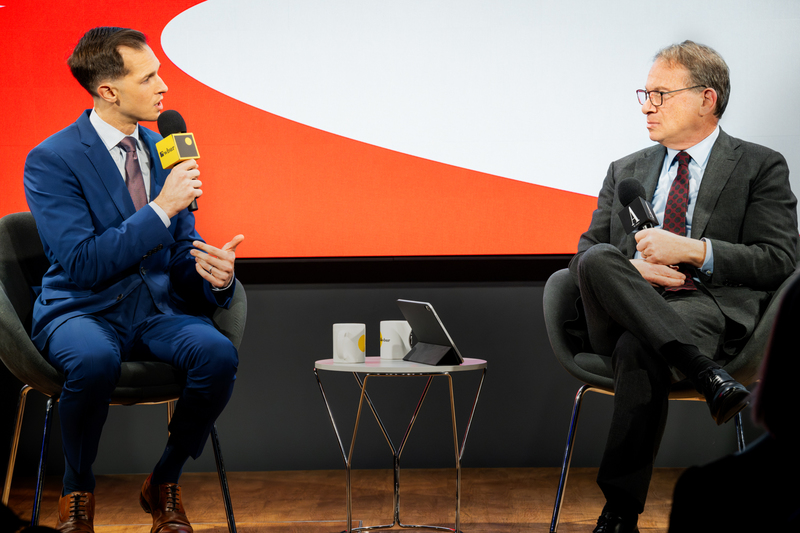
PHOTO COURTESY OF LIZ LINDER
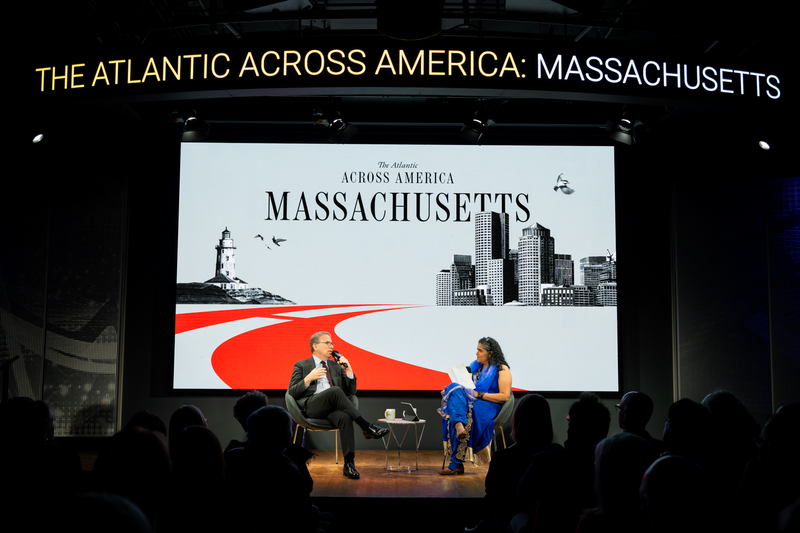
PHOTO COURTESY OF LIZ LINDER
On Tuesday, Dec. 2 at WBUR CitySpace, Jeffrey Goldberg, editor-in-chief of The Atlantic, and Meghna Chakrabarti, host of NPR’s On Point, held a conversation about the United States’ 250th anniversary. They were celebrating The Atlantic’s release of “The Unfinished Revolution,” a series of articles examining the history and lessons of America’s founding era. Following their conversation was an interview with U.S. Representative Jake Auchincloss (D-MA) regarding his thoughts on America as it is and what it can or will be. The event was ticketed and open to the public; around 100 people were in attendance.
Over the next three years, The Atlantic will host events in all 50 states in a series called The Atlantic Across America, bringing journalists to communities across the country to discuss topical issues and ideas.
Goldberg first discussed the longevity of The Atlantic and what might have kept it alive over the last 168 years since its founding in 1857. He attributes the publication’s success to “a lot of luck,” joking that the owners “were too stubborn to let it die.” When Chakrabarti asked him whether he believes the U.S. would make it to its 500th anniversary, he stated that the question is too open to answer, noting that “empires rise and empires fall.”
Goldberg then discussed the difference between his experience of the 200th anniversary of the U.S. and this forthcoming 250th anniversary. For Goldberg, this time period feels more uncertain. “We don’t have a Republican party that’s putting forth ideas into the discourse,” he stated, explaining that this factor has prevented substantive Republican pushback, unlike other events like the Watergate scandal. He went on to talk about rising American discontent in response to the uncertain political and economic environment, citing rising food and gas prices while President Trump is no longer holding rallies to energize supporters; Goldberg expressed that this combination would lead to increased dissatisfaction with Trump among his voters.
Chakrabarti probed Goldberg's thoughts regarding the recent strikes on boats the U.S. military alleges carried drugs. He expressed discomfort regarding the lack of reporting about the rationale for the strikes, and called for transparency. “There has always been an understanding that we have to, to some degree, explain our actions,” he said, comparing the current Pentagon to those under previous administrations. Goldberg continued to go over the differences between the America of the past and its present state. “What George Washington did is the central responsibility of any president, which is to stop being president when it’s time to go,” Goldberg said, adding afterwards that he meant this in a nonpartisan way.
After Chakrabarti’s talk with Goldberg, Goldberg interviewed Jake Auchincloss for the remainder of the event. Goldberg started by asking Auchincloss how he defines patriotism. In response, Auchincloss quoted Vice President JD Vance’s declaration that people will not fight for an idea, but for their homeland, which he felt was a catalyst in the MAGA campaign. Auchincloss believes that Vance’s idea of “blood and soil populism” is wrong, and that Americans will fight for ideas.
Regarding his military background, Auchincloss explained that his motivation for joining the Marine Corps after college came from his grandfather, who had joined the Marines in his own youth while studying engineering. He connected this to Vance’s words once more, reemphasizing the importance of fighting for ideas over homeland. He also thought that the “blood and soil nationalism” which he felt that Vance expressed would be “the shibboleth for the MAGA movement.”
Auchincloss continued to discuss present-day issues with the Democratic Party. He stated that Democrats should move towards ideas expressed in Ezra Klein and Derek Thompson’s Abundance, which argues that America is suffering from self-inflicted scarcity caused by excessive regulation that hampers technological progress. Auchincloss stated that “the country that builds and invents faster wins the 21st century,” naming China as the country doing so in the present day. He maintained that “you don’t need to subsidize more things on the demand side”, as he believes there is more of a need for supply.
Afterwards, Goldberg questioned Auchincloss regarding Ben Rhodes’ piece in The New York Times on the Democrats’ stance on the Israeli-Palestinian conflict, asking him what he believed caused Democrats to lean towards pro-Palestinian sentiment. Auchincloss stated that the Democrats’ stance is due to a “flood the zone problem,” referencing a term Steve Bannon coined for a strategy involving overwhelming the media with a barrage of information to control the political narrative. Auchincloss believes the solution is to “get a handle” on social media to prevent it from influencing politics.
Auchincloss also opined against identity politics, saying that such discussions have led politicians to “lose the median voter.” When Goldberg asked Auchincloss what Zohran Mamdani’s victory in New York City might mean for the Democratic Party, his response included a shout-out to Majority Democrats, a group he chairs. “These mayors [of the Majority Democrats] are ones I look to for the future of the Democratic Party,” Auchincloss said, explaining that they have years of experience and had delivered on public safety.
Goldberg then asked Auchincloss about his analysis of the Venezuela campaign and if he believes Pete Hegseth may have committed a war crime. Auchincloss stated that although this is possible, this distracts from the bigger picture of Hegseth’s involvement in Venezuela being “blood for oil 2.0,” reminding the audience of the Iraq War and its consequences. He affirmed his belief in a “strong and lethal” military, stating that the way to maximize the efficacy of the military is to have Congress “[take] back its war powers.”
Auchincloss then suggested having the Democratic Party offer “our own vision of the good life” for the people. He reiterated previously expressed stances, including support for 50-year mortgages, permitting reform, and speaking against the invasion of Venezuela. Then, the discussion transitioned to the regulation of social media. “The three most powerful gatekeepers of news media and information in the world today are Mark Zuckerberg, Elon Musk, and the Chinese Communist Party,” Auchincloss said. He continued to talk about TikTok and the issues the app poses because of its ownership outside of the US, stating that he had just introduced a package of bills to address issues such as teenage social media usage and the inability to sue social media corporations for defamatory content.
Finally, Auchincloss shared his thoughts on the gender gap in voting. He believes the way to solve Gen Z’s large voting gap is to tell young men they are needed in the country. “Go to work, go to the trade school, join a local union, join the military,” Auchincloss urged.