Undergraduate Association unanimously votes to replace former president Enoch Ellis ’26 as SGFC representative
The former UA president spent $298.06 on coffee chats without the UA’s approval





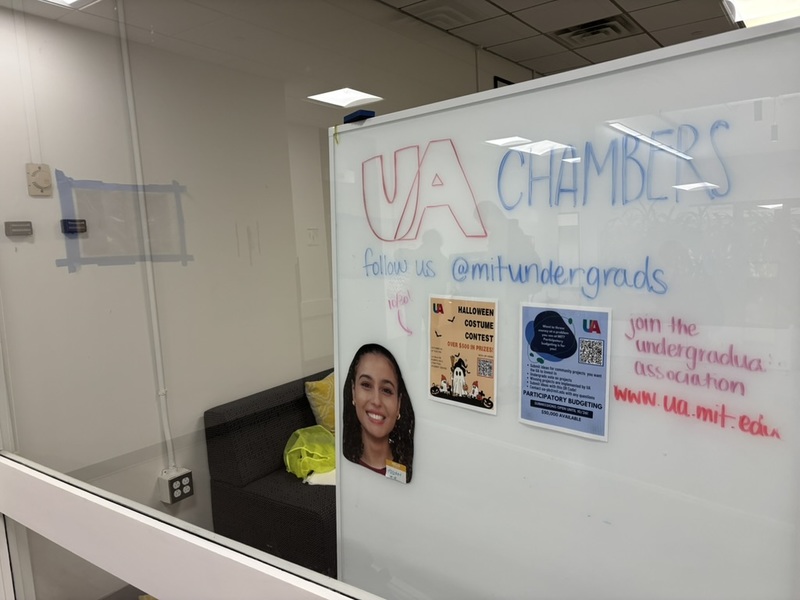
Vivian Hir–The Tech
On Dec. 3, 2025, the MIT Undergraduate Association (UA) led by UA President Alice Hall ’26 convened to discuss former UA President Enoch Ellis ’26’s unapproved use of UA funds for “coffee chats.” UA Treasurer George Obongo ’27 presented the case at the meeting.
In the meeting, Obongo stated that Ellis, who is also the former UA representative from the MIT Student Group Funding Council (SGFC), had spent $298.06 of UA funds on informal coffee chats over the fall 2025 semester. According to data obtained by The Tech, Ellis completed a total of ten transactions, each ranging from around $15 to $50, which amounts to an average of around $30 per coffee chat. The line-by-line breakdown of each Request for Payment (RFP) amount is unclear; according to Obongo, who was also treasurer during Ellis’s presidency, these amounts were consistent with the RFPs Ellis submitted for coffee chats under his presidency. Last school year, Ellis went on about 20 coffee chats throughout the fall semester, spending an average of $27 each time.
Conversely, Hall stated that she has never spent more than $10 per person ($20) on a chat. In her opinion, coffee (or boba) chats are meant to facilitate and enhance conversations that increase the UA’s positive impact that “would not otherwise happen.” Hall credits ideas proposed in these chats for contributing to many UA initiatives and agenda items for meetings with the chancellor’s team.
Hall added that she didn’t find out about the apparent misuse of funds until she recently met with Obongo to review expenses. To her, the biggest disappointment was that student money had been spent in a way that was not approved by their representatives. Because the chats were organized by someone not in a UA leadership position, Hall wrote, they could not “enact change to benefit students.”
Obongo was not the only person to receive the RFPs. Besides the treasurer, the other UA financial signatories are Hall, UA Vice President Mariam Abdelbarr ’27, and each of the committee co-chairs, to whom the RFPs are evenly distributed. Obongo stated that he does not regularly review RFPs sent to committees’ cost objects and does not expect chairs to send RFPs to him. Obongo first knew of the coffee chat situation in September, when a co-chair of a UA committee forwarded Ellis’s initial RFPs to Hall for approval. These RFPs used a UA committee cost object that was separate from the Officer cost object. Hall did not approve of them, and assumed it would end there.
According to Obongo, Ellis asked him to use the Officer cost object to submit RFPs in September after his first rejection. Based on the meeting notes, it is unclear as to why Ellis sought funding from the UA, given that the SGFC has a $10,000 discretionary fund. At this time, Obongo knew that Ellis was not a member of the UA officer team; however, given that he was the former President and “had a strong relationship with Alice [Hall],” Obongo assumed that he had permission from Hall. Furthermore, Ellis knew the bylaws, so Obongo did not expect him to try to “run a scheme” by him.
When Obongo went over expenses with Hall in November, he was “mortified” to learn that Ellis had not received prior confirmation from Hall before asking him. He felt like he had disappointed the officer team and “betrayed the MIT undergraduates — whom the [UA officer team] serves within our roles.” In Obongo’s opinion, he has been very diligent to ensure the UA is “advocating [for], protecting, and improving the lives of students,” so unknowingly compromising this responsibility hurt him “very personally.”
Financial lessons moving forward
To rectify the issue, the UA approved the motion to formally recommend Mary Mango, Financial Assistant of Student Organizations, Leadership and Engagement Office (SOLE) to audit Ellis and the coffee chat RFPs. Additionally, Hall and Abdelbarr told the UA Council they would cover the expenses. However, from the UA meeting notes, there was a motion to move $298.06 from UA reserves to cover Enoch’s misuse of funds. Jackson Hamilton, UA Chief of Staff, voted against the motion “on principle,” stating that the undergraduate student body should not have to pay for “one person’s unauthorized spending.”
With regard to plans to prevent future misuse of UA funds, Hall emphasized that all UA financial signatories should be aware of their responsibility and know to raise any concerns about suspicious RFPs. She stated that this specific situation arose from Ellis’s “unique familiarity with UA processes” because of his former presidency, including having overseen Obongo. In addition, Obongo mentioned the positive rapport established under Ellis’s presidency, which, according to Hall, led to less caution than the RFP approval process normally requires and allowed Ellis to “present requests in ways that were harder to flag as unusual.”
Hall’s priority is to foster “a culture of engagement, transparency, and student prioritization,” and encourage more students to get involved to prevent situations like this from occurring again. In Hall’s opinion, sharing incidents with the UA Council enables “immediate student awareness” and prompts necessary action from student representatives. She also emphasized that any questionable expense needs to be brought to her for approval. Furthermore, Hall is looking into ways to clarify in writing how certain parts of the UA budget should be spent to prevent future incidents of misuse.
Hall is also advocating for all SGFC representatives to no longer be permitted to approve their own RFPs. She is working with SOLE and current SGFC members to ensure a more detailed breakdown of their operational budget is mandatory going forward. On Tuesday, Dec. 9, Hall sent an email to the MIT undergraduate body stating that the UA is currently finding a replacement UA representative for the SGFC. Applications will close on Tuesday, Dec. 16.
Kiera Reed ’27, the Association of Student Activities (ASA) representative in SGFC, agrees with Hall’s plan. She hopes to advocate for dual sign-offs on all RFPs and to adopt a new SGFC constitution that clarifies spending using the operating budget. Reed also pointed out the low oversight of the SGFC and concerns that any SGFC member could reimburse “SGFC operating expenses” by directly contacting Mango instead of going through a treasurer. Reed is also concerned about the $10k operating budget SGFC gets, as she believes it is “far more than [SGFC] could ever reasonably need.”
For the UA, Obongo personally aims to bring all matters, including “RFPs, Transfers, [and] Budget changes” to both Hall and Abdelbarr to keep everyone informed. He also wants to amend the current transition documents to include an initiative that clarifies matters regarding the budget, like line items, which are “usually fairly ambiguous until spoken about between the treasurer and current officer team,” that were not done this year. “My oversight was an upset,” Obongo admitted, “and a lesson about proper communication, trust, and reliability.”
Ellis files complaint to UA Judicial Board
On Dec. 4, 2025, Ellis submitted a complaint to the UA Judicial Review Board regarding his removal as the SGFC UA representative. Ellis argued that the UA violated standard procedure in replacing its delegates in the SGFC, citing “constitutional voting thresholds” and “due-process requirements.”
Ellis believes he acted with the President’s approval in both setting up coffee chats and getting treasurer approval of the RFPs. In his opinion, the entire issue is, “at most, a good-faith disagreement about lines of authority” between Hall and Obongo. Ellis explicitly denounced labeling the situation as “embezzlement or theft” or “circumvention of financial controls.”
According to Ellis, he had an “undisputed” conversation with Hall about expanding the coffee chats program and thus “reasonably interpreted” her response as supportive, causing him to submit RFPs through proper channels, receive Treasurer approval, and contact SOLE when questions arose. “‘Cause’ cannot include reasonable misunderstandings about authority,” Ellis wrote, “or every management disagreement becomes grounds for removal.”
Ellis emphasized how the UA’s motion to replace him as their SGFC representative violated “multiple mandatory procedures.” He highlighted that only 10 votes were cast; the UA Constitution requires a supermajority of 14–16 votes. Furthermore, he claimed that the Council violated the mandatory notice requirement before voting, citing Article V, Section D (4) in the Bylaws of the UA Council. Ellis did not attend the UA Council meeting on Dec. 3 since he expected it to be a discussion of a vote to transfer $300 from reserves to the UA instead of his removal from the SGFC. Ellis later wrote that the UA cannot “use [his] absence as an excuse for denying [him] due process.”
Subsequently, Ellis referred to Article II(B)(10)(f), which prohibits the Council from voting until the Board first determines whether the stated grounds constitute “malfeasance, misuse of power, or other constitutional removal standards.” He also called out the meeting notes for displaying a “lack of preparedness and constitutional standard,” such as relying on speculation regarding “alleged past conduct and SGFC funds.”
Furthermore, Ellis challenged the alleged grounds “Improper Use of UA Funds” as factually incorrect; however, this section in his complaint was deemed “frivolous” by the Board in the “interest of time and clarity” and was redacted.
Ellis requested the Board prohibit the UA Council and UA President from enforcing the Dec. 3 removal vote until it completes its review. He also asked for the Board to issue a “binding clarification” of constitutional standards for removal and grant a procedural reversal based on “insufficient votes and denial of due process.” Lastly, Ellis aims for the Board to order the UA Council to amend the records of the Dec. 3 meeting, vote, and all discussion pertaining to “improper use of funds.”
The Judicial Review Board has set a deadline of Dec. 11 to submit evidence and is scheduling oral arguments for the next two weeks.
As of publication, Ellis has not responded to The Tech’s request for comment.
Vivian Hir ’25, MEng ’26 contributed to reporting for this article.