Paper folding blends math, art, and science at OrigaMIT 2025
Highlights of the convention included special guests, classes, and, of course, intricate origami





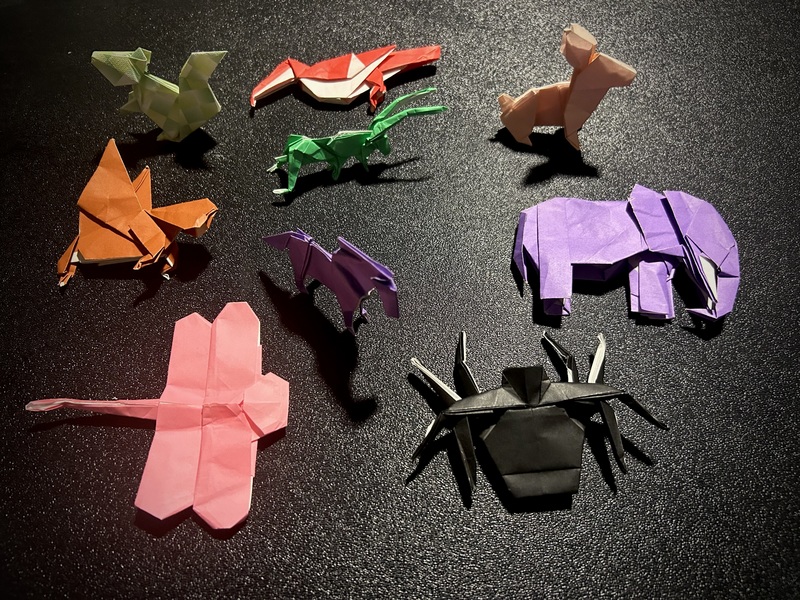
PHOTO PROVIDED BY ELIZABETH LI
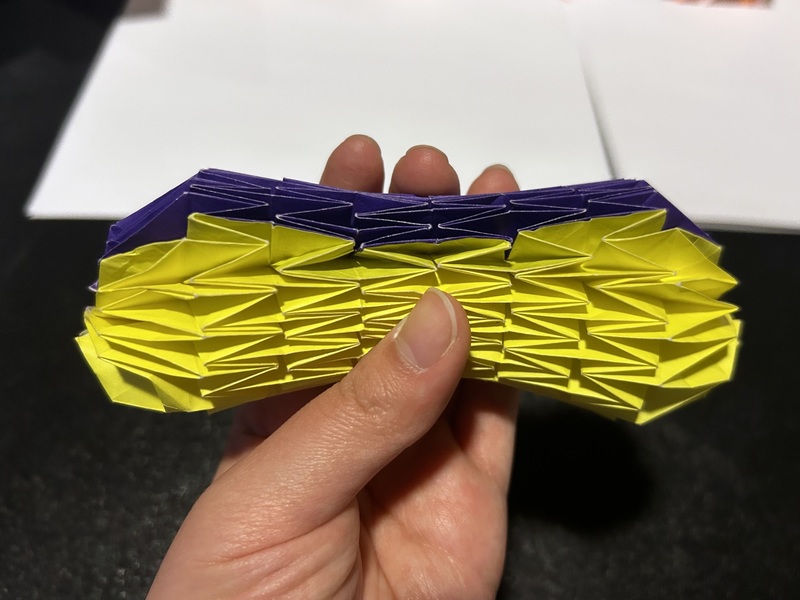
Photo provided by elizabeth li
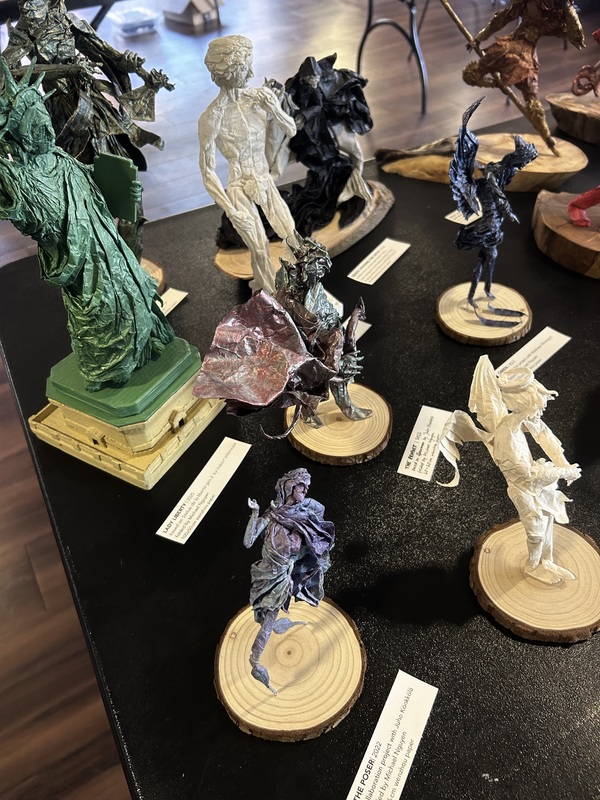
Photo Provided by elizabeth li
Elizabeth Li–The Tech
On Saturday, Nov. 15, the 2025 Annual OrigaMIT convention took place at the Stratton Student Center. For a modest entry fee of five dollars, the OrigaMIT convention lets MIT students access a wealth of origami displays, featuring works from both the permanent MIT Origami Club collection and new designs, including figural sculptures, mechanical contraptions, and origami artworks with personal significance, by visiting guests. One piece was an engagement gift folded by Annie Pidel made from letters designed by Taichiro Hasegawa.
The convention also featured an assortment of classes for every level and every folding style. Many speakers presented their own original designs, such as Neel Dalela’s graph plots of linear, quadratic, and cubic functions to Eric Joisel’s lifelike rat. Experiencing all of these classes may only be possible with space-time manipulation.
While the convention has been a MIT tradition since its inception in 2011, many of the attendees were not affiliated with MIT. Though most came from the greater Boston area, a few flew in for the event. For many, OrigaMIT is not only an event to learn about origami, but also an opportunity to meet new people.
Guest speaker shares process
Another exciting part of the convention is the special guests. American origami artist John Montroll gave a brief overview of his design process. He invented the Dog and Insect bases, while also pioneering the single-square, no cuts, no glue approach that is canon today.
For Montroll, the nuance of origami design comes from working around reasonable limitations. “You can do anything if you can cut or glue multiple sheets of paper together, which is not as interesting,” Montroll said.
Montroll also aims to be concise and efficient in his designs. From a grasshopper in 27 steps to a horse in 21 steps to an elephant in 38 steps, many of his works achieve the level of form and detail often only seen in designs with around 100 steps. Montroll believes that his pursuit of minimal elegance makes his approach unique.
Many of Montroll’s designs are built on an origami base, which is a standard, structural skeleton on which details and features can be added. He uses geometry and algebra to design where each crease goes, and in practice, finds the smallest amount of folds that achieves each length. In his spare time, he designed a computer program called Pearl that produces the shortest sequence of folds to estimate irrational lengths with high precision, simplifying necessary steps.
Although math is relevant in Montroll’s designs, equations are not as essential as the special way of thinking about how to transform a square sheet of paper into a desired image. “When you’re folding, you’re experiencing something that you couldn’t otherwise,” he said. “It’s magic.”
Origami as a rich art
While many lean into the mathematical and algorithmic construction of origami, others see these scientific tools as a springboard to artistic expression. Berlin-based communication designer and origami artist Michael Nguyen visited Boston for the first time this year to share his figural works.
Nguyen recalls being first introduced to origami in middle school. “How do you make something so intricate and complex from a simple piece of paper without cutting or tearing it? It was mind boggling,” he said.
It was much later in his life during the COVID-19 pandemic in 2020 that Nguyen rediscovered origami by challenging himself to fold more complicated models. With his experience with figure drawing classes and his background in graphics design, photography, videography, and animation, Nguyen approached origami from a sculptural perspective.
“I was always intrigued by the human form. It’s interesting because in complex origami, people are hesitant to attempt human art design,” Nguyen said. “It’s really easy to mess up and for the proportions to get uncanny.”
Nguyen believes that shaping paper into humanoid figures can convey stories distinctively rich in emotion, culture, mythology, and faith, from the hunched back of defensiveness to the upright posture of confidence to the fluid movement of flamboyance. “For me, I like creating drama and poetry,” he said.
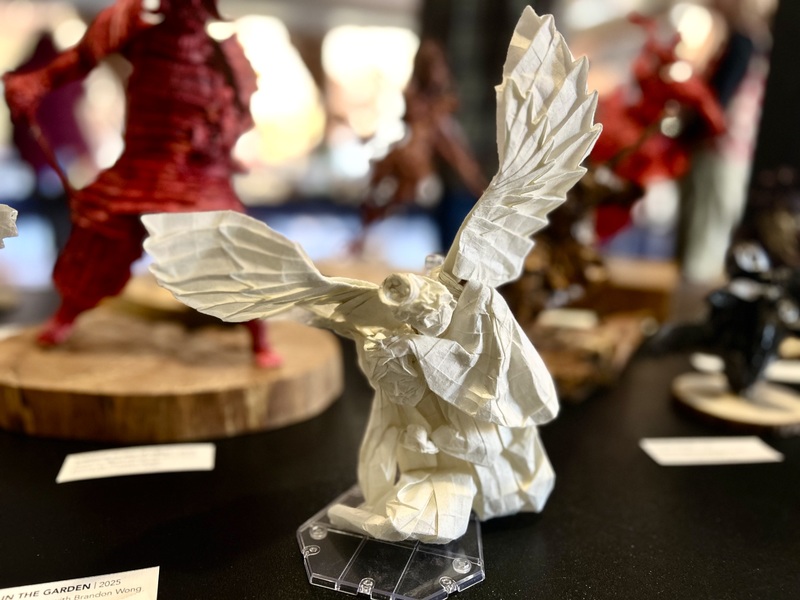
One of Nguyen’s most recent designs was made in collaboration with former Origami Club president Brandon Wong ’25. As Christians, they chose to depict a scene from the life of Jesus known as Agony in the Garden. For Nguyen, the powerful contrast between the reassuring strength of spirituality and the anguish or acceptance of humanity is what makes this work multi-faceted and more layered than a piece of paper. In regards to his philosophy on the subject matter and technique, Nguyen said, “I like to push boundaries and figure out what I can create to get people talking, even if it is something controversial that makes people think, ‘Is this origami?’”
Finally, Nguyen talked about his experience at OrigaMIT. Having been invited by Wong on Discord out of the blue, Nguyen thought, “Why not? It doesn’t happen everyday when you get to go to MIT of all places to teach and meet a lot of really smart people.”
Regardless of whether you are an origami enthusiast or a lifelong professional, the OrigaMIT convention, with its wealth of available activities, was an exceptional way to spend a Saturday.