MIT Facilities seeks to enhance campus green space, sustainability as it looks towards future
McDermott Court is anticipated to be restored next spring





Samuel Yuan–The Tech
Reflecting on MIT’s move from Boston to Cambridge in 1916, Professor of Architecture Mark Jarzombek PhD ’86 said that the Institute “welcomed the gritty, industrial landscape that was its back door,” unlike other universities who “wanted to be in beautiful landscapes.”
But the area around MIT is defined by a different kind of industry these days: Leadership in Energy and Environmental Design (LEED)-certified glass office towers for technology companies now reside where factories, parking lots, and smoke stacks used to be. In turn, the Institute, in line with the City of Cambridge’s climate priorities, has been adapting its own campus to fit this trend, too.
Over the past few years, MIT has actively tried to “strengthen the campus tree canopy” and improve sustainability while still being “cost-conscious,” shared Monica Lee, Communications Director for Campus Services and Stewardship, in an email statement to The Tech.
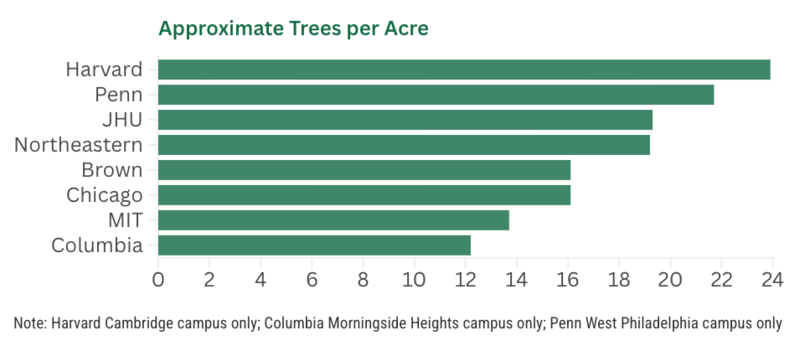
Still, there remains work to be done. Based on The Tech’s calculations, in terms of trees and green space on campus, MIT still lags behind other Boston-area schools with urban campuses. In particular, while MIT has around 13.7 trees per acre, Northeastern and Harvard have around 19.2 and 23.9, respectively.
Recently finished work
When students walk through Amherst Alley to return to their dorms after a long day of classes, they might not pay much attention to the new trees planted in recent years, which include maples, birches, and honey locusts.
But Lee noted that these new trees, in the Alley and elsewhere, are important for reducing the “urban heat island effect” in the summer, controlling stormwater, and campus beautification. These new trees are just some of the easily missed recent efforts campus stewards are taking to improve sustainability.
“Recent construction projects have also included new high-performance landscapes, including green roofs, permeable pavements, and bioretention systems,” Lee wrote, referring to new buildings such as the Schwarzman College of Computing (Building 45) and the Edward and Joyce Linde Music Building (Building W18). “When installing new plantings, we improve the below-grade conditions and soils to ensure long-term health,” she said.
Lee added that, as part of the Tina and Hamid Moghadam Building (Building 55) construction (underneath the Green Building) completed in 2023, “impermeable hardscape was redesigned to provide a new treed and sunken rain garden.”
Upcoming construction
Given the mounting financial pressures on the Institute and efforts to rebalance budgets, Lee stated that new efforts to improve campus greenery would require a “cost-conscious approach.”
In particular, Lee noted that when considering improvements to green spaces, the Offices of Campus Planning and Facilities, which steward the spaces, were looking carefully for opportunities to integrate upgrades as part of existing or underway projects.
Current green spaces slated for reopening soon include the Julie Fassett Garden near Baker House and McDermott Court adjacent to the Green Building.
Lee wrote that Fassett Garden was renovated in spring 2025 and will fully reopen once a utility project concludes soon. She also wrote that the work to restore and reopen McDermott Court is anticipated for spring 2026.
Beyond these green spaces, Lee added that MIT Grounds Services is prepared to convert “all blowers to electric” by early 2026 and that most of their equipment is already electric.
MIT’s Office of Sustainability has set ambitious goals for the campus too. The Office aims for the Institute to achieve net-zero carbon emissions by 2026 and eliminate direct emissions by 2050. In addition, the office seeks to convert campus shuttle buses to zero-emissions buses by 2026. They even want to “employ AI strategies to reduce building energy consumption.”
Despite MIT’s signature gray brutalist buildings, administrators are bullish about transforming campus to be more sustainable for the future. Joe Higgins, Vice President for Campus Services and Stewardship, told The Tech that he believes green spaces would benefit both the campus and the city.
“We prioritize creating green spaces that are designed to be inviting for the broader community, help create a sense of calm and reduce stress, and cool our urban environment,” said Higgins. “As part of the City of Cambridge, we also work to further the city’s goals to create a stronger urban forest.”
When longtime grounds manager Norman Magnuson retired after a 48-year career at the Institute in 2022, he told MIT News that Grounds Services at MIT went from an “afterthought” to an integrated department over the course of his career.
Magnuson said that when he first started, Grounds Services “worked with whatever extra budget money there was,” but it became truly professionalized when he retired.