Academic misconduct cases double between 2019–2020 and 2024–2025 school years
Increase may come from online learning during the pandemic and rise of LLM usage in education





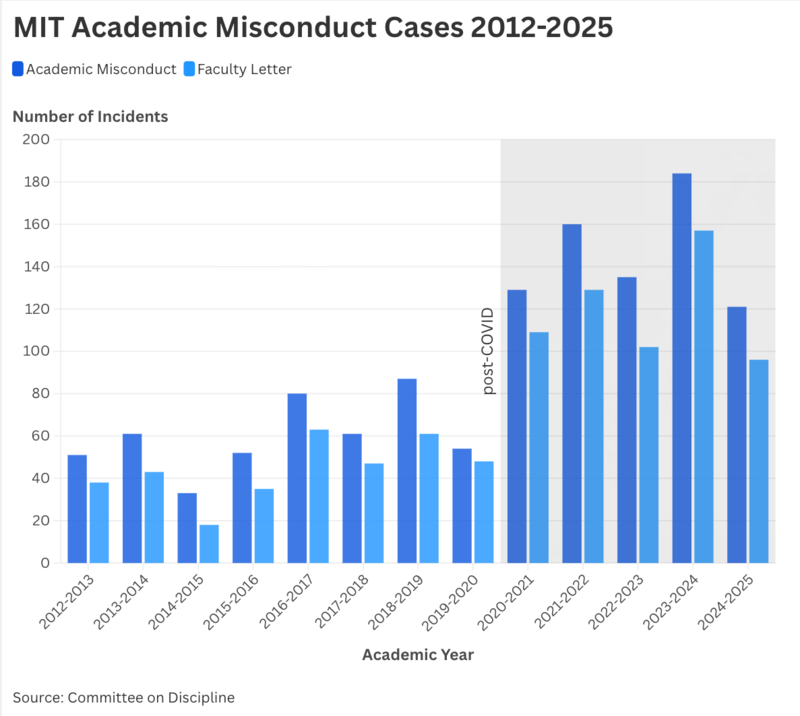
According to the Committee on Discipline (COD) annual reports, academic misconduct cases have significantly increased since the COVID-19 pandemic. However, this number sharply decreased in the past year from a peak of 184 cases in 2023–2024 to 121 in 2024–2025, comprising a 34.2% decline. This trend was also reflected in the number of faculty letters to file, which are warnings from instructors regarding cases of academic misconduct in their courses.
Before the COVID-19 pandemic (from 2012 to 2020), academic misconduct cases peaked at 60 annually. From 2019–2020 to 2020–2021, however, the number of cases more than doubled from 54 to 129, further increasing to 160 in 2021–2022. Although cases dropped to 135 in 2022–2023, in the following year, the number climbed to 184, the highest in the past decade.
According to the MIT Mind and Hand Book, academic misconduct includes cheating, plagiarism, unauthorized collaboration, and other instances of academic dishonesty. If an instructor believes that a student has committed academic misconduct, they can address the violation through three options: academic action within class, a faculty letter to file, or a COD complaint.
An academic action is a consequence suitable for the violation, such as a failing grade or resubmission of the assignment for a lower grade. Faculty letters to file require a student to respond within three days and is the least serious sanction. On the other hand, a COD complaint is a formal report alleging that a student has violated MIT policy. An instructor can choose more than one option out of the three, such as an academic action within class and a faculty letter to file.
The observed increase in academic misconduct cases is not unique to MIT. Multiple universities have seen higher instances of academic misconduct cases since the pandemic. In a 2021 NPR article, reports of academic misconduct increased significantly during the pandemic, from an increase of over 50% at the Ohio State University to an increase of more than 100% at the University of Georgia. Reasons for higher reports of misconduct included unauthorized collaboration through channels like group chats and access to unauthorized resources like the internet during an exam.
More recently, however, the rise in LLM usage has led to a major increase in cheating across all academic disciplines, from writing essays for humanities classes to generating code for programming classes. Meanwhile, professors across the country are having difficulty detecting AI usage in assignments.
Mathew Shepard, the Senior Associate Dean for the Office of Student Conduct and Community Standards (OSCCS), believes that the noticeable increase in academic misconduct cases during and after the pandemic may come from “lingering pandemic-related issues,” including take-home exams and online collaboration. Shepard also stated that the use of LLM tools like ChatGPT has led to “new avenues for policy violations.” However, he believes their rise has caused faculty to have “heightened awareness of academic integrity concerns,” which may have resulted in higher reporting rates.
Shepard underscored that MIT’s academic integrity policies do not allow the “unauthorized or inappropriate use of generative AI,” citing that such violations can fall under the definition of cheating because of an “unfair advantage” when completing assignments. He emphasized that if an instructor prohibits the use of generative AI on an assignment, using such tools might be considered academic misconduct. “We encourage students to ask for clear guidance from their instructors before using these tools,” Shepard said.