Hundreds of students attend second annual UROP mixer
The event connects undergraduates with research mentors and projects





Caden Betz–The Tech
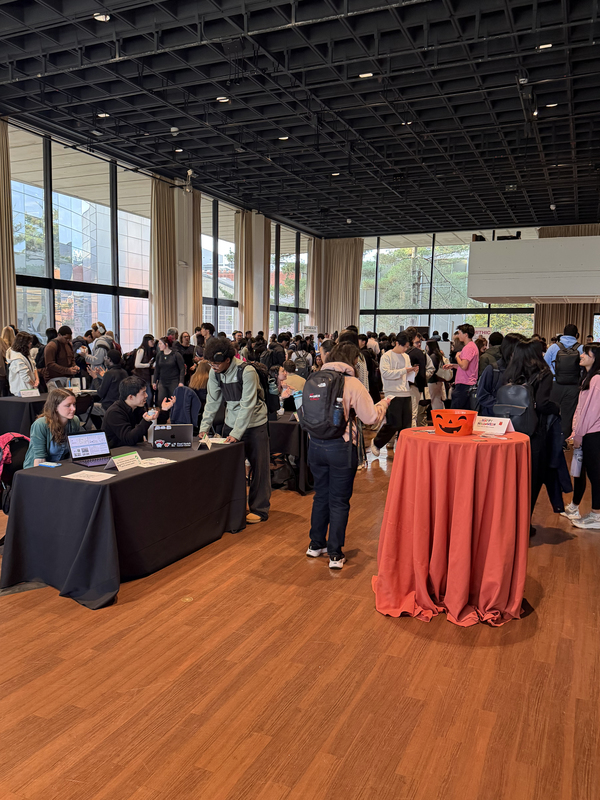
Hundreds of students, faculty, and research mentors gathered in the Statton Student Center on Wednesday, Oct. 28 for the 2026 Institute-wide UROP mixer. Presented by the Provost’s and Chancellor’s offices, the event gave students the opportunity to explore their research passions and UROP mentors a pathway to recruit members for their projects.
According to a list provided to attendees at the entrance, 138 groups attended the event. In addition to research groups, Institute programs like MISTI also had booths. Organizers provided boba, candy, and other treats, and students also received MIT tote bags.
This is the second year of the mixer’s existence. The event was slightly different compared to last year, one key change being that all presenters were at the mixer at the same time, rather than being separated into two cohorts.
The mixer attracted labs from a wide variety of fields, with categories including Life Sciences; Biotech & Health; AI & Machine Learning; Robotics; Climate, Energy, & Environment; Physics & Math; and Arts, Communications, & Media. UROPs were organized within the building by category.
Fourth-year PhD student Katharina Krstic is working on making hydrogen energy technology cheaper by creating more stable and conductive membranes. She was excited by how enthusiastic the attendees were and enjoyed the opportunity to be able to share her research. In her words, the mixer is a “great piece of infrastructure to train the next generation of scientists and help research be accelerated.”
Postdoc Jane Lodwick is researching a secretion system that is assembled by an intracellular bacteria. “I like the format that they’re doing this year,” Lodwick said, explaining that this year’s mixer was more dynamic than the last.
The mixer was especially beneficial for groups looking to recruit undergraduate students with specific skills. Moshe Poliak, a fifth-year PhD student in Brain and Cognitive Sciences (Course 9), is researching if people formulate sentences the same way in different languages. The mixer provided him with a way to “attract students who speak in a language that’s not English, who will be able to join the project, learn how to do research, how to conduct psychology studies, and also contribute their expertise to their language.”
The mixer provided a wide-ranging showcase of projects for undergrads, particularly first-years and people with no UROP experience. Kyra McPherson ’30 was interested in a bioengineering project, and she said, overall, “there’s a lot of good stuff.”
Kyle Zheng ’30 spoke with mentors about research regarding international politics and supply chains. He wants to do a UROP over IAP, so being able to speak directly with the team members was a unique advantage the mixer provided. He noted that “the website online that was sent out was pretty organized where it showed different terms that a specific UROP was being offered.”
Ahmad Zawahreh ’30 was able to find a UROP related to climate systems that he said he would follow up with. He hadn’t heard of the project before the mixer.
While many were able to find projects that aligned with their interests, not every student found a project that spoke to them. There were a few attendees who said they didn’t see a UROP in their intended field. Nina Shadrin ’30 was looking for a lab working in either particle physics or artistic design but couldn’t find any. “I feel like I’m gonna have a better time looking online, personally,” she said.
Associate Dean for Experiential Learning and Director of UROP Kate Weishaar noted that while the mixer had many opportunities for students, it was far from a full representation of what MIT has to offer.
“The mixer is just a fraction of the many UROPs that are available. So look on ELX, cold email faculty and grad students, and talk to your friends about all the cool work they’re doing because there’s so much out there,” Weishaar said. She also encouraged students who talked to mentors at the mixer to follow up on their conversations with an email.
The vast majority of MIT students participate in UROPs, according to the Office of the Provost. Given the powerful demand for UROPs, for IAP and spring 2027, the Provost’s Office has committed to funding up to 500 new paid UROPS.
“This event truly embodies mens et manus — students eager to make discoveries, advance foundational research, and tackle real-world challenges,” Provost Anantha Chandrakasan said. “UROPs are an invaluable part of the MIT undergraduate experience.”