Multicultural Greek Council gains seat on UA Council
Though under the FSILG umbrella, the MGC previously lacked UA representation





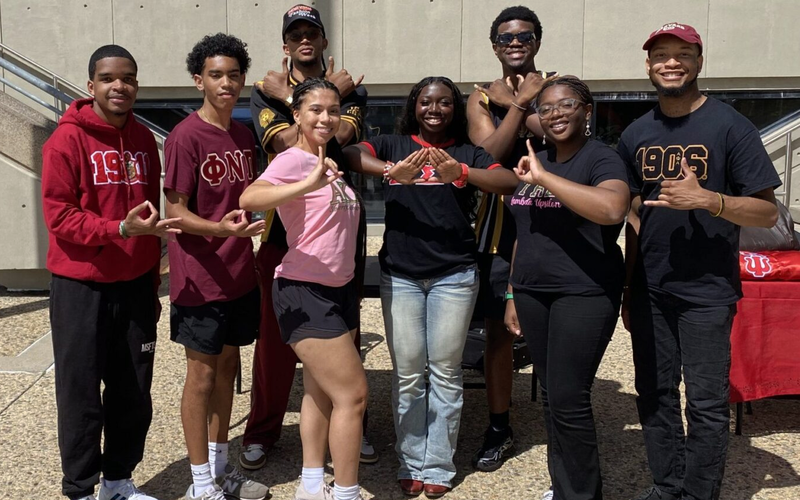
Photo courtesy of Peyton Bryant
The Undergraduate Association (UA) Council voted to grant the Multicultural Greek Council (MGC) a voting seat at their meeting on Oct. 21.
The UA Council serves as the legislative branch of the Undergraduate Association. According to their website, the council “votes on proposals for funding, approves appointees, amends the bylaws, and makes decisions on behalf of the undergraduate body.”
With the addition of an MGC voting member, there are now 20 representatives on the UA Council. The others include 11 dormitory representatives, four Interfraternity Council (IFC) representatives, three Panhellenic Association (Panhel) representatives, one Living Group Council (LGC) representative, and one off-campus representative.
The MGC is a council of eight historically Black and Latinx Greek-lettered organizations. Members of these organizations include students from MIT and other schools in the Cambridge and Boston area, like Wellesley College and Harvard University.
At MIT, although the MGC exists under the umbrella of Fraternities, Sororities, and Independent Living Groups (FSILG), it is independent from IFC, Panhel, and LGC. Thus, while the MGC must go through the same administrative processes as other FSILGs, it previously had no representation in the UA. The other groups did, which prompted the MGC to submit a petition for a seat on the UA Council.
The MGC was invited to speak at a UA council meeting, and it was represented by MIT senior Peyton Bryant ’27, executive board member of the Lambda Nu chapter of Alpha Kappa Alpha. Despite having a small population, the MGC, Bryant said, represents a “distinct constituency” with a unique set of needs, which necessitates voting power.
While concerns were raised about how MGC member organizations include students from other schools, Bryant confirmed that representatives on the UA Council would always be MIT students. She added that most programming, although sometimes serving students from beyond the Institute, ultimately occurs on campus and is MIT-led.
In an interview after the unanimous vote, Bryant emphasized the MGC’s commitment to service.
“All eight organizations try to contribute positively to the MIT community. Even if you do not belong to the cultural community, you can engage with our public events,” Bryant said.