Amidst financial pressures, MIT’s endowment rises in 2026 fiscal year
MIT endowment rises 6.7% to $29.2 billion, but changes in federal policy for the next fiscal year already decreased the Institute budget





Hana Sousa–The Tech
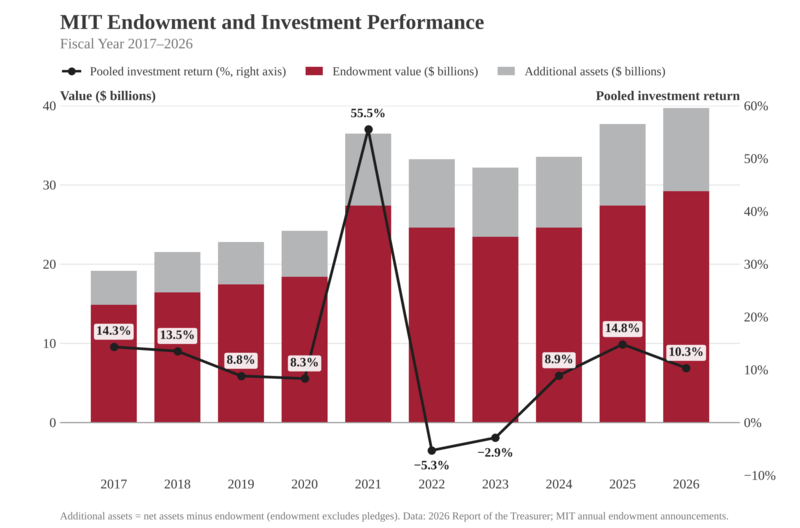
The MIT endowment grew by 6.7% (now totaling $29.2 billion excluding pledges), according to the Report of Treasurer released by the Office of the Vice President for Finance at MIT on Oct. 2. The report also mentions a 10.3% return on endowment return for the 2026 fiscal year that ended on June 30, which is below the 15.5% median return for U.S. college and university endowments last year, as reported by Cambridge Associates.
The numbers
The MIT endowment, which is among the top ten largest in the U.S., is central to the Institute operations: distributions of investment income and gains, principally from MIT’s endowment, provided about 40% of total campus revenues in 2026. About 80% of these funds are restricted to specific purposes, such as professorships, scholarships, fellowships, and research.
In a statement to The Tech, the MIT Executive Vice President and Treasurer Glen Shor, who authored the Treasurer Report, said that “even with robust philanthropic support and fiscal rigor, federal policy changes threaten” MIT’s ability to sustain the impact and affordability for which the Institute is known.
Philanthropic contributions totaled $715.1 million, $110.8 million above the prior five-year average. Much of that support, together with endowment returns, goes to financial aid.
In the 2025–2026 academic year, MIT financial aid policy for undergraduates was updated so that families with annual incomes below $200,000 pay no tuition, while those with income below $100,000 pay no tuition, room, or board. As a result, 88% of the Class of 2026 graduated debt-free.
This new policy decreased the undergraduate net degree tuition revenue by $4.0 million, or 3.5%. However, there are no plans to “retreat on MIT’s financial aid policies,” Shor said, affirming MIT’s commitment to “foundational investments in their students” despite significant budget challenges.
Financial pressures
In July 2025, the Trump Administration announced a raise on the endowment tax rate from 1.4% to 8% for universities with endowments exceeding $2 million per student. In anticipation of this increase that will take effect on the 2027 fiscal year, MIT has adopted a three-part strategy to reduce $300 million in costs: increasing revenue, reducing costs, and “rebalancing.” Consequently, this year’s expenses grew well below the 3.4% U.S. inflation rate. Salary and wage costs rose 0.9%, or $19.7 million, to $2.11 billion, while spending on supplies and services rose 0.6%, or $8.6 million, to $1.37 billion.
In September 2026, MIT announced changes to retirement income benefits. Currently, 401(k) contributions are matched by MIT up to 5%. After Jan. 1, 2027, the maximum 401(k) contribution will be 3%. Since these contributions are pulled from the campus budget, this decrease will alleviate the pressures on it. From a separate pension fund, MIT will provide an Enhanced Pension Benefit that corresponds to 2.5% of eligible pay. The new contribution rates will add up to a minimum of 10.5% of eligible pay.
According to Shor, MIT is currently implementing the budget solutions outlined in this strategy, while also hosting additional presentations to faculty, students, and staff at the time. He stated that “most will be completed by fiscal 2027, while others will — as planned — be carried out on a longer timeline.”
Major losses on campus, such as the recent reorganization of the MIT Libraries, staff layoffs in different departments across campus, and a 20% drop on new graduate student enrollment, were not cited on the 2026 Treasurer Report. Asked about the Libraries adjustment, Shor explained that the document is a “high-level account of Institute financial performance in a given fiscal year,” and doesn’t describe “all fiscal dynamics occurring or planned during that year”. He added that “there are no plans for further reductions to the Library services.”
A different perspective
The MIT Graduate Student Union (GSU) has emerged as a vocal opponent to the budget changes. GSU Financial Secretary Jo Hall G believes that these decisions reflect the administration’s priority to “protect the Institute’s maximum possible growth” over the needs of the workers that keep the Institute running.
They argue that the Treasurer Report’s rhetoric gives the impression that the current financial situation is satisfactory, but under new tax rates, “MIT will be hard-pressed to make ends meet.”
“This is simply untrue,” Hall said. “MIT has already demonstrated this year that they can post nine-figure growth while treating the expected loss of income from the new tax as part of its FY2026 financial assessment.”
According to the Office of the Executive Vice President and Treasurer, 80% of MIT endowment and its resulting income are restricted by state regulations and donor restrictions. About half of the endowment is in donor-restricted funds, which are regulated by the Uniform Prudent Management of Institutional Funds Act. This requires that MIT does not spend more money than the inflation-adjusted original amount and manage the funds transparently.
Hall also acknowledges the negative impacts of the new federal policies, but said that it “is deeply frustrating to hear MIT complain about hundred-million dollar impacts to their billion-dollar yearly profits while closing libraries and deadlocking its workers at the bargaining table.”
Peers outpace MIT
The endowment and other assets are managed by the MIT Investment Management Company (MITIMCo), whose main goal is to generate high long-term investment returns for MIT. MIT’s 10.3% endowment return this year trailed those of peers that have reported so far, including Stanford (31.7%), Harvard (27.1%), Penn (27.4%), and Princeton (23.7%). MIT also fell short of the 15.5% preliminary median for U.S. college and university endowments reported by Cambridge Associates. These high investment return figures were the largest since 2021, carried by gains from technology companies such as SpaceX and bets on artificial intelligence. As of time of publication, MITIMCo has not responded to The Tech’s request for comment.