Lived experience meets MIT research
MIT’s Menstruation Science Day, featuring a screening of “End of the Cycle,” highlights the push to bridge patient stories with endometriosis research





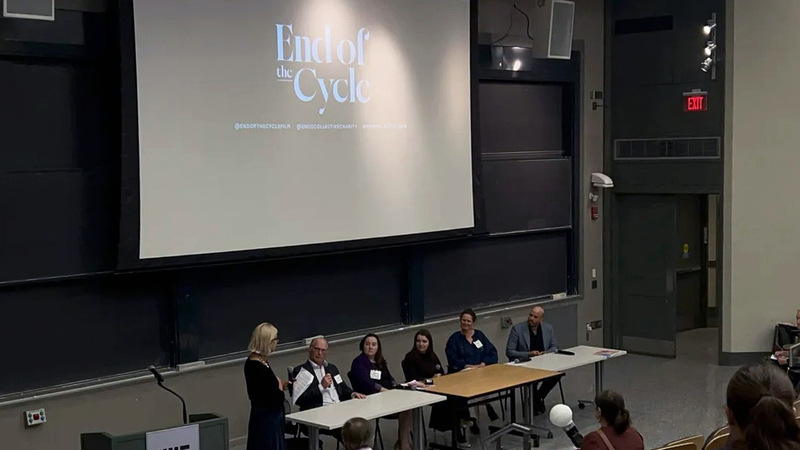
Photo courtesy of Lauren Adler
Samantha “Sammy” Jaye Lang was 17 years old when she was diagnosed with endometriosis. The disease is characterized by the growth of uterine tissue outside of the uterus, systemically impacting the whole body and often manifesting as pelvic pain and heavy menstrual periods. Now 23, despite having undergone two surgeries in an attempt to provide some relief for her condition, the pain resulting from endometriosis has continued to be so severe that she has been on medical leave from college.
Sadly, Lang’s story is not uncommon. Endometriosis affects at least 10% of women (~190 million worldwide) without a cure currently available. Alongside her family, she founded The Endometriosis Collective, a non-profit organization whose mission is “to help find better treatments and ultimately a cure — so that millions of women can live healthy, full, and productive lives.”
Historically, much of basic science and translational biomedical research has prioritized areas with the most scientific capital, shaping the social power dynamics that dictate which questions are deemed “worthy” of investigation. Neglected research on gynecological conditions has long left generations of women struggling with painful conditions without diagnosis or treatments available to them. However, the MIT Center for Gynepathology Research (CGR) is flipping the script. In collaboration with patients, physicians, researchers, and MIT community members, CGR’s mission centers on scientific discovery and translational research grounded in patients’ lived experiences.
CGR’s efforts were on full display at Menstruation Science Day on Sept. 30, one of several events the center has organized after announcing the $10 million Fairbairn Menstruation Science Fund in July 2025 to support continued progress in women’s health research at MIT.
The event’s centerpiece was the 2026 feature-length documentary “End of the Cycle”, co-directed by Lang while she was away from school. The film combines patient narratives with historical context and advances in research and clinical medicine to raise awareness of the condition and support research, treatment, and advocacy. It highlights a variety of personal stories from individuals living with endometriosis, including comedian Amy Schumer, Olympic medalist Brittany Brown, dancer Julianne Hough, actresses Janel Parrish and Fọlákẹ́ Olówòfóyèkù, and Lang herself.
A long journey to care
The patient experiences described in the film all highlight one of the painful realities of living with endometriosis: the long path to receiving an official diagnosis. A 2024 review found it takes an average of 5 to 12 years to get an endometriosis diagnosis, a waiting period in which the severity of the condition often worsens as the disease progresses. Many patients with endometriosis face medical dismissal and often feel limited by their options for care.
Unfortunately, progress is often slow because the research is severely underfunded. In 2020, only 1% of all global research and development funding in biopharmacy was allocated to cover all non-cancerous women’s health conditions, including contraception, fertility, maternal health, menopause, and gynecology. That’s a single dollar out of every $100.
This movement to spread awareness of endometriosis is having a noticeable effect. The Vice Chair of Gynecology at Newton-Wellesley Hospital, Dr. Stephanie N. Morris ’96, reports increased awareness and more young patients in their teen or young adult years presenting to her clinic for care.
“[Younger women] finding answers to what’s causing their symptoms is very empowering,” Morris said on the panel following the film screening. ”You don’t have to go through decades of being gaslit and feeling like it’s all in [your] head, and that has a huge impact on people’s ability to function.”
As awareness of the condition increases and more patients seek medical care, Morris pointed out how it can create a challenging dynamic: “It’s great that we’re seeing people earlier, but it’s really hard to provide evidence-based answers of what to do,” she explained. This echoed the evening’s focus on the urgent need to advance research into endometriosis and other women’s health conditions.
Limited treatment options
Drug discovery also plays a substantial role in how the medical field approaches endometriosis. Dr. Stephen Palmer, a reproductive biologist and Celmatix’s current Chief Scientific Officer, is focused on drug discovery for reproductive disorders. He first became interested in pharmacological therapeutics for endometriosis when his wife was diagnosed with the disease.
There are many misconceptions about endometriosis. While some people think it only affects the reproductive system and is hormonal in nature, in reality, it’s a systemic inflammatory disease that can impact the whole body and is linked to higher risks of developing other conditions such as cancer, rheumatoid arthritis, and cardiovascular disease. Drugs for endometriosis have historically been endocrine-based, despite the growing understanding that endometriosis is a challenge of reproductive immunology.
Palmer recalled that when he first began working on drug discovery for endometriosis, experts warned that the disease was the “graveyard of drug discovery” within the study of inflammatory diseases. This metaphor describes the phenomenon in which pharmaceuticals for endometriosis were composed of the “leftover” drugs that were previously tested and failed for other inflammatory conditions, such as multiple sclerosis or rheumatoid arthritis.
Palmer does believe the industry is moving in the right direction. “Every other week there’s another drug coming forward,” he said. He imagines a future with multiple pharmaceutical treatment options, allowing patient stratification by disease stage and individual biology so treatments can provide the most personalized care possible.
Through collaboration with researchers across MIT, CGR can facilitate cross-departmental collaboration, allowing researchers to apply their expertise to endometriosis research in innovative, interdisciplinary ways. The center is led by Professor Linda Griffith and focuses on three primary areas in women’s gynecological health: how endometriosis and adenomyosis — endometriosis occurring within the uterus’s muscle layer (myometrium) — affect patients, differences in patients’ responses to treatment options, and the clinical challenge that many patients do not respond to currently available therapies for these conditions.
However, it cannot address every aspect of this complex issue on its own. Other contributors include Associate Professor of Biology Eliezer Calo Ph.D. ’11, whose research focuses on fundamental cellular biology. Calo’s lab collaborates with CGR to understand the nucleolus — a structure within the nucleus that makes and assembles ribosomes — in endometrial cells.
“This is where MIT is so special,” Griffith said. “You can have somebody from [electrical engineering and computer science], biological engineering, and then pulling in one of the world-leading cell biologists all around this clinical mystery that affects 10%, at least, of the people in our community.”
The issue is deeply personal for many within the research community, driving their work, advocacy, and programming for events such as Menstruation Science Day. Griffith herself has been diagnosed with endometriosis. Her own experiences, along with the many personal stories she hears from MIT community members and women emailing from across the world, remind her of the magnitude and importance of the work she is helping move forward.