I was a lighthouse keeper this summer
A reflection on a summer of dead jellyfish, endless sea horizons, and small talk





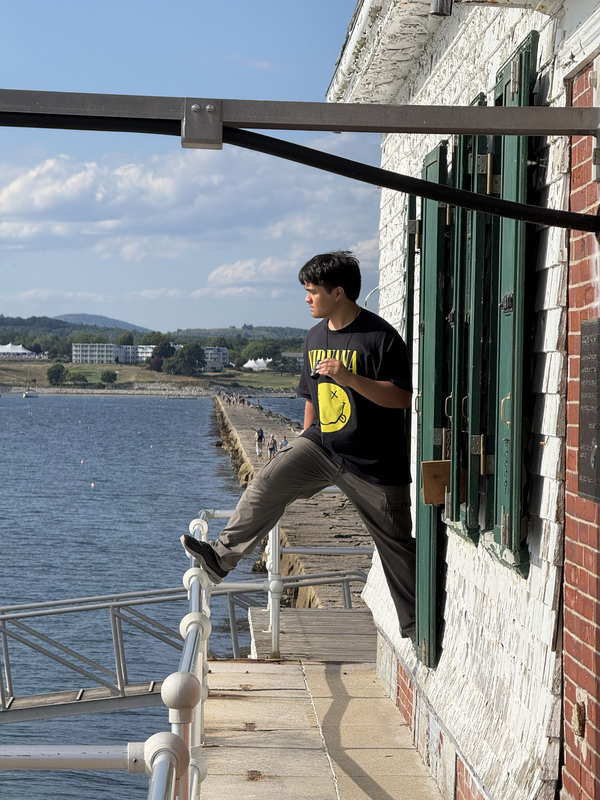
Jojo Placides–The Tech
The Rockland Breakwater Lighthouse is a lighthouse that sits comfortably at the end of a seven-eighths-of-a-mile granite path. Built in 1902, the lighthouse is pretty much the centerpiece of Rockland Harbor at Maine’s southern coast. If you’re a resident of the small coastal city of Rockland, whether you like it or not, you’ve probably seen the paradoxical yet peaceful sight of an old-timey house in the middle of an ocean.
This summer, I had the unique opportunity to become its keeper.
My responsibilities at the lighthouse were to open it to the public and welcome visitors in. Now, I can hear you ask: “Do you control the light yourself?”
No, I don’t. That thing has been automated since 1965.
“So Jojo, what do you even… do? At the lighthouse?”
I told stories. Over and over.
Almost every day at around 2 p.m., I would show up sweaty and a bit tired after the almost-mile long walk on flat-ish rocks. I unlocked the two rusty locks and opened the heavy metal door. My station was in what was once the living room of the lighthouse. Before I fully opened the lighthouse to the public, I took ten minutes to try to open the windows with my trusty screwdriver and nail, using them like a chisel. I slid the metal bar that locks the window and pushed the window open. Though opening the windows was a pain, the breeze of wind that walked in and the sunlight that filled the dimly-lit room were the things I lived for.
Most people in Rockland have never seen the inside of the lighthouse before. They walk in with awe on their faces as they admire the surprisingly well kept 124-year-old lighthouse and its windows that look out into the endless sea horizon. Even if they’ve walked up and down the breakwater hundreds of times throughout their lives, they’ll testify that they’ve never seen the lighthouse open. I heard this a lot, and I lived for it. I lived for the wonder on their faces as they explored this real life easter egg they’ve just unlocked.
However, welcoming people into the lighthouse was much like reading from a script over and over. As they walked into the living room, I would open with the same words. “Hey! I’m the keeper, so try not to break everything… then again everything here breaks on its own…” and then I looked up to a conveniently placed crack in the ceiling. Almost all of them laughed at this joke for some reason. I’ve never really found it funny at all.
Still, I carried on the conversation.
“First time here?”
They nodded.
“In the breakwater?” To clarify if they meant first time in the lighthouse or first time in the breakwater. And usually, they say it was their first time in Maine and say wherever they came from, whether as near as Maryland or as far as Japan (and even the Philippines, where I’m from!).
At this point in the conversation, I liked to try to sneak in some advertisements for the nonprofit of lighthouse volunteers that I’m part of.
“You picked a lucky day!”, I would exclaim if they said that it was their first time here. “This lighthouse is rarely open; even the residents of Rockland have never seen it open before. Now, we’re a nonprofit group of volunteers, trying to keep the lighthouse open more often. If you could chip in, that could be great. We use these funds to try to fix the tower and the light itself, which I’m sure you’re here for.”
Then came the words I’ve said so many times: “All 22 steps to the tower are too rusty to be stepped on. If anyone steps on them, pwoof! There goes the entire structure.”
The history of the breakwater
When visitors asked me about the history of the place, I would say a five-minute spiel that I’d practically rehearsed a hundred times. Sometimes they called their kids from the other rooms to listen to my well-worn story. When they gathered to listen to my tale, my mouth pretty much went on autopilot.
And there it began, the history of the lighthouse, told through repeated conversations and somewhat-rehearsed quips.
“Did you know that in the 1850s, in order to get to Boston and New York, you had to go through Rockland first?” It’s a small factoid I would insert into my spiel about the breakwater’s history to illustrate its purpose. Like every story I’ve ever told, this one was unconfirmed — I just made it up to illustrate a point.
“Rockland gets battered regularly by waves and winds,” I continued, pointing towards the vague direction of the northeast, even if I didn’t know nor ever checked where the true northeast was located.
Dangerous northeastern storms (“nor’easters,” as they are called) would crash into the harbor and damage precious shipping equipment. Steamers would end up decrepit. Sloops would have their parts strewn across the floor. It wasn’t until the Great Storm of 1878, which struck Rockland Harbor on Jan. 10, 1878, that Congress appropriated some funds for the construction of a breakwater.
See, this was my contribution to the breakwater’s history. For years, town historians had tried to find the exact storm that drove city residents to push their U.S. Representatives and Congress to create appropriations for funds for the breakwater. In Congress’s archives, I found a transcript of a speech of then-Maine representative Thompson Murch, who brought up the destruction of a steamer called the Ulysses to justify appropriations for the breakwater.
Using a Python script to scrape through the archives of Rockland’s old newspaper, The Rockland Gazette, for any mention of a “Ulysses,” I found a newspaper article dated January 1878 about the “Great Storm.” Reading that title, I knew I found what I, and many others, have been looking for all these years.
I summarized all of this to the visitors, “I found this little tidbit of history myself: there was a great big storm in 1878 that convinced Congress to finally build the damn thing.” Construction took around 20 years, starting from 1880. Stone sloops used wooden cranes to lift heavy granite stones into the seabed.
“Do you know what a sloop is?” I asked the tourists in front of me. Around eight times out of ten, they didn’t know. “Here’s your fun fact of the day: a sloop is basically a sailboat with a big crane to lift the stones into the water.” Of course, I didn’t know exactly what a sloop is. I knew it was a type of sailboat, but the fact that they had a “big crane” was completely made up by me. In reality, a sloop is a sailboat with one primary mast and two main sails, but saying that they were ones that had a big crane to differentiate them from other sailboats was a lot easier to explain to the kids.
These granite stones that the sloops moved came all the way from Vinalhaven (mostly Long Cove in Vinalhaven), North Haven, and Hurricane Island. It took around 20 years to complete the breakwater. This meant that men were tirelessly (or even tirefully) carrying stones into the breakwater from 1880 to 1899.
“It took them 20 years not because it was hard to make — no, not at all!” Here came one of my quips. “It took them 20 years because Congress was so slow in appropriating the funds each year. So what do you know: Congress was so slow then, Congress is slow now.” It’s true, though!
When construction was complete, the breakwater, although protecting the harbor from harsh nor’easters, still posed a massive navigational hazard. In foggy days or dark nights, ships would crash into the breakwater even in the presence of temporary lights or fog horns. “Of course,” I added, “that was before they had GPS.”
People lived inside until 1965, when the light itself was automated. “So everything here has been frozen in time since then. Everything, from the irregular stairs to the heating systems to the refrigerator and rotary phone, has been in here since the ’60s.” The guests looked around and saw the rotary phones or the rusty mechanisms of the wooden windows. I usually directed them upstairs after that.
If they were impressed by my storytelling abilities, my raw, unfiltered humor, or my charisma (or, to be honest, probably the lighthouse), they dropped some dollar bills into the donation jar. Sometimes, they said they’d like to donate, but left their wallet in the car. To which I routinely thought to myself: “Man, it would be really good to have some sort of Venmo option,” because after a month, we still somehow didn’t have one.
Frequently asked questions
I got a lot of questions about whether I stayed inside the lighthouse overnight. Perhaps this was the most frequent question I get. “No,” I said. “The heating’s bad and the water hasn’t run since 1965. If I were to stay here overnight, I’d have to prepare as if I were out camping!”
I usually used this as an excuse to yap about the heating systems of the house. I would point to my left: a weird brick hole in the wall covered by a grate. “That’s the first heating system, built into the house in its original construction in 1902. This leads to a coal brick furnace downstairs in the basement.” Then I pointed to the radiator on my right: “That’s the second, installed in the 1950s. None of these work anymore.”
However, I just made some of this information up. I don’t know for certain if the brick hole in the wall was ever the heating system. But it’s a lot easier to explain it that way because what else could the darn thing be? Oh, and the radiator being from the 1950s was also made up; it looked like it came from the 1950s.
Another question I got a lot was if the water went over the breakwater? After all, the surface of the ocean at high tide sometimes threatened to break through and envelop the path of granite. “Yes, it has happened!” I would reply. I pointed them to a panel with pictures of the breakwater that has ocean water above it. “Those super tides usually come in mid-August… which is right around this time of year, actually! If that happened to me right now… whoooo-boy, let’s just say I’d have to swim home.”
We had a stamp that leaves a pretty nice image of the breakwater lighthouse. If there were kids, I’d rip some sheets of paper from the sign-in notebook and hand them those pieces of paper. “You can get a stamp; they’re free!” I exclaimed. “Some people here get rocks and stamp them. Maybe you could even catch a fish or a lobster and stamp those instead!”
` The visitors then ascended to the bedroom upstairs. There’s nothing much, just another poster about the history of the lighthouse and a bed. However, the windows are the main attraction, due to their view of the sea and breakwater from the second floor. For some reason, seeing the endless blue through a window straight out of the ’50s is just really aesthetic. When they came back downstairs, I would ask, “Good upstairs?” I’d usually get a couple of compliments about the views.
Many asked me about the airbed upstairs, assuming I actually did stay here overnight. “There was a massive winter storm that tore the shingles off the roof in January of 2024,” I would reply. “Somebody had to sleep here for multiple nights in order to fix the roof and walls that were damaged.” Of course, none of this was confirmed. All of it was pure speculation on my part.
Then the visitors would leave the lighthouse, do one trip around it, maybe spend some time on the bench, before going back to the breakwater and heading home. “But Jojo, you just made some of this information up!”, you might protest. “The sloops? Northeast? The heating systems? The reason for the beds?” What I learned from telling the stories a billion times is that it doesn’t have to be completely true, just sensational and simple enough to maintain their attention.
But this set of lines that I said every time a visitor ambles in wasn’t set in stone. The whole rehearsed conversation was more like a well-worn path, subject to change depending on how well things went. In fact, I went through a couple of variations that didn’t go well. On my first day, I welcomed somebody by asking where they were from.
“Pennsylvania,” they answered.
“Damn, drove all this way here just to see a lighthouse?” I asked. They then turned to their friends and said quietly, “I don’t like that.”
Yeeeouch.
An observation about small talk — and a theory I’ve had in my mind for a while now — is that small talk is really all about the repertoire of stories that you tell people. When I first came to MIT and went through the arduous process of Orientation 2025, there would be a set of things I’d tell people. Common conversation subjects included name, major, and where I’m from. But within that set, I included some quirky stories about me: about how, for example, I was chased in Chinatown at 3 a.m., or how I almost got removed from my valedictorian spot by my vice principal over prom. They’re… well… quirky. But they make people laugh, and it leads to a good first impression. Being a lighthouse keeper, I realized that that is exactly what small talk is: a predetermined repertoire of stories and quips that I’ve rehearsed with others. In small talk, you have to build a bridge between yourself and a person you met 30 seconds ago and barely know. It’s better to come prepared with the tools and materials to make that bridge.
Being a lighthouse keeper was like being a non-playable character (NPC) at times, repeating a script over and over. In my third week of doing this, I grew tired of it, so after I opened the lighthouse and its windows, I went outside and sat on the rocks and listened peacefully to the music of Santo & Johnny and The Long Faces. I’d sit at the rocks for hours at a time, admiring the view afar using the binoculars one of the other keepers gave me. Once I spotted a dead lion’s mane jellyfish floating in the waters!
Though these conversations are repeated and rehearsed, I absolutely loved all the interactions I had with travellers from around the world as well as the residents, who thanked me for opening the lighthouse for them after decades of coming to the breakwater. I lived for the reactions they have to my corny-as-hell quips. I lived for the looks of wonder that the children get when they imagine huge sloops lifting stone into the water. I lived for the stories they told about other lighthouses and places that they’ve travelled to.
Storytelling is really a medium where you transport people into another world through vivid words. Stories are how we connect.
But, perhaps most importantly, when there aren’t any visitors and the breakwater seems empty, I lived for the moments in between. Being there gave me a peace I hadn’t at all known in college. College is a whirlwind of faces, scenes, dialogue, big action, big duties, classes, teachers, dormitories, etc. But in this oh so cruel and fast world, maybe the lighthouse was the only place circlin’ all ’round the sun where time seemed to have stopped.
In a way, I had an intimate relationship with the lighthouse. Out of all the volunteers, I had spent the most hours — over 90 during the summer — inside the building. At this point, I knew every nook and cranny in that damned 124-year-old thing, from the creepy basement to the Fresnel lens caged on top of it. So it was a pain walking away on my last day — walking that full seven-eighths of a mile — one last time as the lighthouse shrunk and shrunk behind me. I felt it calling me. “Jojo! Come back!”
But O, Lighthouse, I have places to be.
When I came home from MIT for the summer, I wanted to work a job that brought me close to the ocean. I wanted to work on a schooner across from my house, which would’ve allowed me to travel the coast of Maine every day, but I got rejected. I wanted to work at a sailing tours company, which would’ve allowed me to spend each morning on a sailboat overlooking the great blue, but I got rejected. It seemed that the ocean had its doors closed on me this summer.
So I wanted to work at the lighthouse because it was my excuse to get up close with the ocean anyways. For now, I won’t be on a schooner or a sailboat or a sloop, but maybe I can rest this summer. A sailor’s dream cannot fit within a single summer. Maybe I can chase those sailor dreams later, and for now, my life could be tending to a 124-year-old lighthouse and relaxing on the rocks every afternoon. After all, I never really got this chance at MIT.