Yulia’s Dream: A better future for Ukrainian math
Professor Pavel Etingof and Dr. Slava Gerovitch co-founded the Yulia’s Dream program to support young Ukrainian mathematicians after Russia’s full-scale invasion of Ukraine. Four years later, it’s still running — and offering a glimpse into the dedication it takes to carry an intellectual community through a war-torn present





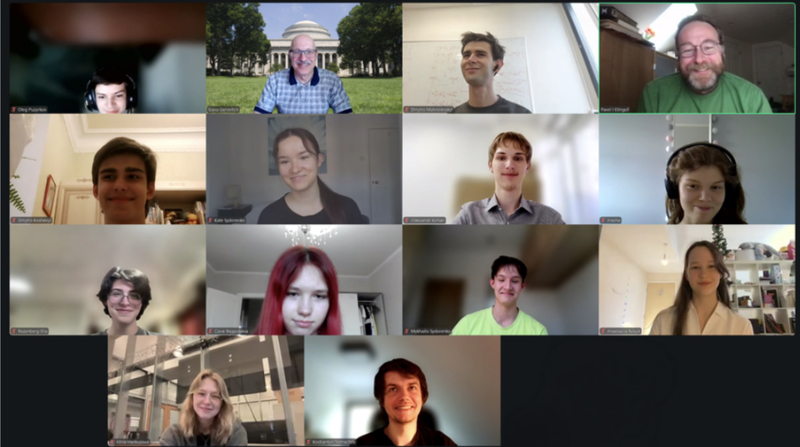
Photo courtesy of Yulia’s Dream
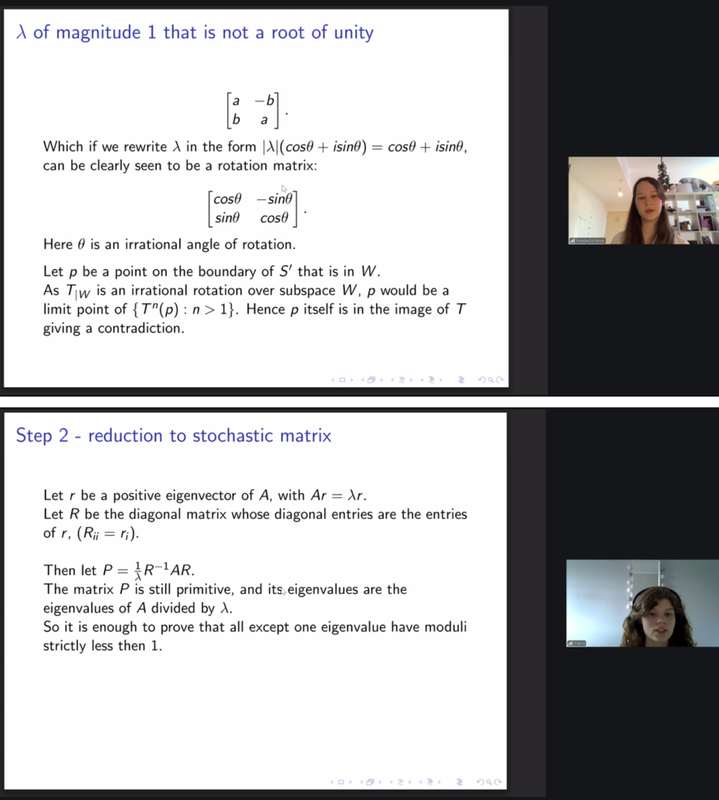
Photo courtesy of Yulia’s Dream
It takes a very special group of kids to inspire math professor Pavel Etingof to impersonate a barn animal. But as the 2026 Yulia’s Dream Conference came to a close and attendees needed to smile for a group photo, that’s exactly what he did.
The Yulia’s Dream program is an offshoot of MIT PRIMES (Program for Research in Mathematics, Engineering and Science), a year-long research or advanced reading opportunity for high school students in the United States to push their limits in math and computer science. (Disclosure: Co-author Veronika Moroz participated in two subprograms of MIT PRIMES as a high school student, but neither were Yulia’s Dream.) After Russian president Vladimir Putin launched his full-scale invasion of Ukraine in 2022, Etingof, the PRIMES Chief Research Advisor, teamed up with PRIMES program director Slava Gerovitch and UMass Amherst Visiting Professor Dmytro Matvieievskyi to create Yulia’s Dream, extending the opportunities of PRIMES to Ukraine’s high school mathematicians.
The admissions cycle begins in the fall, when students may apply by studying new material and taking an oral exam or submitting solutions to an entrance problem set. The application can be in English or in Ukrainian, and it is open to all students of Ukrainian origin, with priority given to those living in Ukraine. Over the following months, accepted students work with their mentors — typically graduate students or postdocs — on a reading or research project. In the spring, students submit papers detailing what they learned over the course of the program, and they present at the final conference in June. Projects from this year’s cohort include estimating the density of prime numbers, writing computer programs for doing algebraic geometry, and developing probability theory to understand natural selection.
“I think [Yulia’s Dream] has been very helpful in discovering more about math and having a mentor on this journey,” said program student Anastasiia Nosyk. Nosyk and her teammate Mariia Rapina studied the Perron-Frobenius Theorem, a linear algebra result with many applications in probability theory and dynamical systems, including how search engines like Google decide which websites are most relevant.
“It was really fun to explore some new math concepts that I haven’t heard about prior to the program,” Rapina reflected.
In memory of Yulia
The Yulia’s Dream program is named after Yulia Zdanovska, a brilliant young mathematician from Ukraine who perished in the first few months of the invasion. She was distributing aid in her home city of Kharkiv when a Russian missile strike killed her.
“Zdanovska herself was a math educator,” Gerovitch explained. “She participated in the Teach for Ukraine program, where she trained talented young students to pursue their mathematical dreams, and we thought that her vision was something that we could take as a guiding light for us.”
According to Gerovitch, a Moscow-born historian of mathematics whose parents are from Ukraine, the country has a “long and illustrious mathematical tradition.” For at least 70 years, big cities like Kyiv and Kharkiv have had special high schools with advanced math and physics programs. The schools are so famous that people recognize them by their numbers: Etingof and Zdanovska attended Lyceum 145 in Kyiv, while Matvieievskyi attended Lyceum 27 in Kharkiv.
“This is a specific community of students going through this training, which is not just about studying mathematics, but also about being in a community of like-minded students who are united by this passion,” Gerovitch said.
The full-scale invasion threatened to disrupt this tradition. In addition to Russian attacks on internet and electrical infrastructure and the stress of living in a war zone, the lives of many students were turned upside down as loved ones enlisted in the army and families attempted to flee the country. As a precautionary safety measure, schools also moved online.
Programs like Yulia’s Dream are just one part of a collective effort to, as Gerovitch described, “reestablish this pipeline of mathematical talent for Ukraine.” When the Kyiv School of Economics began building a math department, Etingof served on the committee that hired professors from abroad. In the fall of 2022, he also taught Real Analysis over Zoom at Kyiv University, where he took the class in 1984. In 2022, a group of mathematicians of Ukrainian origin, including Fields Medalist Maryna Viazovska, founded the International Centre for Mathematics in Ukraine (ICMU), an organization focused on supporting math research within the country. The ICMU has been based in the Kyiv School of Economics since 2024, and former Yulia’s Dream mentor Dr. Mykola Semenyakin has gone to co-organize major student programs there.
Doing what the math department does best
While Teach for Ukraine, the initiative in which Yulia was a member, seeks to bring educational opportunities to students of all backgrounds, especially those disproportionately impacted by the war, Yulia’s Dream remains a highly competitive program aligned with the mission of the PRIMES program in the United States. The admissions process is adapted to both selecting the most suitable students and accommodating unforeseeable circumstances when possible. Matvieievskyi, who works most closely with the students, discusses how they are selected to optimize the program experience.
“The most basic books in the program are still considered quite advanced for high school students, and it will be very difficult for [them] to get on with the material that we are covering if they lack the base of mathematical proofs required just to read these books,” Matvieievskyi explained. “We had to make some decisions, very difficult decisions, but they had to be made.”
Running the program over Zoom has also exacerbated these learning challenges, especially when power outages affect major metropolitan areas where most students are from.
This decision to run Yulia’s Dream as an academically advanced research program rather than something more akin to a math club or a math popularization project in Ukraine is not without its practical considerations.
“There are definitely other students in Ukraine who would benefit from help, maybe from other organizations who have more experience and resources for reaching out to a wider circle of students, but it's just a matter of our own kind of narrow focus and expertise,” Gerovitch said.
To streamline recruitment, Gerovitch and Etingof reached out to Matvieievskyi, who tapped into his network of Ukrainian mathematicians. Soon, Ukraine’s biggest math olympiad coaches were posting information about Yulia’s Dream in math forums, and the organizers’ high school math teachers were encouraging their current students to apply.
The number of applications surged in 2022, their first year, as the word spread, so much so that the program was receiving submissions from Russian-occupied regions like Kherson and Kharkiv, which have since been liberated.
One student even applied while a Russian tank was parked in his house. Because the place they were living in had become the tank’s headquarters, it was “very difficult for this family to function,” Etingof recalled.
When deciding to admit him, the organizers had to make sure he was ready for the program while taking the situation into account. “The student didn’t solve all the entrance exam problems, but we accepted him anyway,” Etingof said.
The mentors and organizers often found ways to encourage the students, offering both academic and moral support. During the first winter of the war, as Russian forces began their first annual systematic attack on the power grid to freeze Ukraine into submission, the organizers planned an online talent show. Students gathered over Zoom to sing songs and tell stories.
Even the adults got involved. “I remember with Kolya Semenyakin, who was one of the mentors and a mathematician from Ukraine, we made a movie about making mushroom pies, and we showed the movie,” Etingof said. “That was very special and heartwarming.”
These gestures are all part of the effort to further the budding careers of the students of Yulia’s Dream. Many of these students eventually receive recommendation letters from their Yulia’s Dream mentor when they apply to universities, often outside Ukraine. Some of them even continue their studies at MIT.
Those who continue their research programs into their later high school or early undergraduate careers also have the opportunity to submit their papers to conferences in the United States or Europe specialized to their mathematical branch, especially if they have interesting results.
“If a paper is accepted to a conference, we try to find funds to support the student to travel and attend,” Gerovitch shared.
Recently, Gerovitch helped two Yulia’s Dream students from 2024 find funding to present their research at the International Conference on Formal Power Series and Algebraic Combinatorics (FPSAC) at the University of Washington, Seattle.
Looking forward
Though there are many success stories, interest in the program is shifting. From the over 250 students who applied and the 48 students who were admitted when the program first started in 2022, Yulia’s Dream has seen a steady decline in applicants. For the 2025–2026 cycle, 26 applied and 13 were accepted. While the first few iterations were limited by the number of mentors available, admissions are now limited by the number of eligible applicants as project expectations became more specified over time. Moreover, a lot of families left Ukraine after the full-scale invasion, bringing their children to countries where other advanced math resources are available. While Ukrainian emigrants are still welcome to apply to Yulia’s Dream, the program is “mostly focused on the people who do not have this access” to research opportunities, Matvieiveskyi explained.
Despite the relatively small size of the program, the organizers remain enthusiastic about the future of Yulia’s Dream. “There is a lot of interest in Ukraine now for applied subjects, such as computer science, artificial intelligence, drone technology and so on,” Etingof said. “Maybe in the future, we would like to think about expanding in more applied directions.”
What hasn’t changed is the dedication of everyone involved. As the 2026 Yulia’s Dream Conference came to a close, participants gathered in the presenter window for a group photo.
“All right, so we need to come up with a word, or should we use English cheese?” Gerovitch asked.
Before they could decide on a word, Etingof started farm animal noises. He continued until all the kids were laughing and Gerovitch had gotten a good screenshot of the group. It was a scene that evoked how much Yulia’s Dream means to the people running it — and how it reflects upon the MIT math community, without whom the program would not be possible.
“There has been great response and support for our initiative in the math department, financially and otherwise,” Gerovitch said. “For academics everywhere, there is a sense that science is universal, this unified global community of scientists and mathematicians. We all feel a certain responsibility for maintaining that community, and if a part of it suffers, we need to step in and help somehow.”
A correction was made on Aug. 27, 2026: An earlier version of this article missed the word “Ukraine” in the sentence “The Yulia’s Dream program is named after Yulia Zdanovska, a brilliant young mathematician from Ukraine who perished in the first few months of the invasion.”