‘Why Not U.S.’: Building a foundation for the future of U.S. soccer
Despite a devastating loss in the Round of 16, the USMNT’s performance marked a step forward in building a sustainable future for American soccer





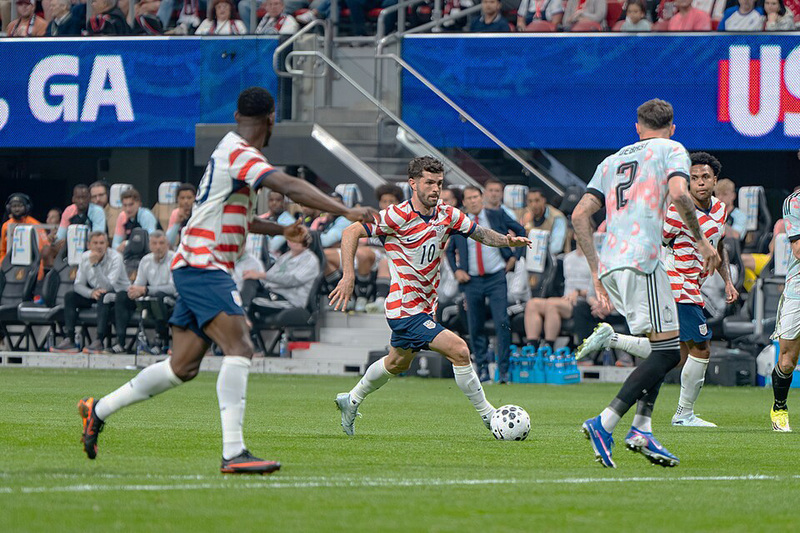
Photo from Bryan Berlin/Wikimedia Commons (CC BY-SA 4.0)
In 2017, the United States men’s national team (USMNT) hit one of the lowest points in its history. Coming off a 4-0 victory against Panama, the U.S. was looking to secure its eighth consecutive appearance in the World Cup. What followed was an improbable set of events: after a loss to Trinidad and Tobago, alongside Panama and Honduras winning their final matches, the U.S. missed the 2018 World Cup entirely. It showed that the American soccer system lacked a clear identity and a system capable of producing players that can perform at the highest level.
For decades, American sports media has been obsessed with finding the next generational superstar. It’s a tale as old as time, where a player will join a struggling team and change their trajectory overnight. This obsession can be so strong that teams in the NBA are often deliberately losing games in an effort to increase their odds of drafting the next franchise cornerstone. Once a team finds their star, the rest will eventually follow.
However, soccer is not as simple. While individual brilliance does matter, soccer is a game of 11 players, each with a very specialized role, working together for 90 minutes. A superstar forward cannot succeed by himself: he needs a strong supporting cast around him that understands how to play off of each other. More importantly, enduring success in soccer depends on what happens off the field as much as what happens on it. Scouting, youth development, coaching, and long-term planning are all critical to ensuring that the following generations can move the team forward.
Countries in South America and Europe invested heavily into professional soccer leagues and youth academies to identify and develop talents early on. The U.S. has attempted to close the gap by investing in a more structured player development system. In 2006, Major League Soccer (MLS) introduced the Homegrown Player Initiative to encourage teams to sign players directly from their development academies to their first team. In 2007, the U.S. Soccer Development Academy was formed as a league for youth academies across the MLS and the United Soccer League. After the Academy suffered a financial collapse and shut down in 2020, MLS stepped in to launch MLS Next, which now includes more than 750 teams across 151 clubs. In 2022, the first official match took place in MLS Next Pro, a third-tier men’s soccer league that offers a professional bridge into MLS first teams.
Former USMNT head coach Gregg Berhalter also played a role in this transition. From 2018 to 2023, Berhalter helped recruit dual-national players, including forward Folarin Balogun and midfielder Malik Tillman. Despite winning the CONCACAF Nations League in 2021 and advancing to the knockout stage in the 2022 World Cup, an underwhelming 2024 Copa América campaign made it clear that a change in leadership was needed.
In September 2024, U.S. Soccer announced Mauricio Pochettino as the new USMNT head coach. Pochettino boasted an impressive resumé, leading Tottenham Hotspur to the 2019 Champions League Final and managing top stars like Harry Kane, Kylian Mbappé, and Lionel Messi. However, Pochettino would be facing a completely new challenge. He was coming into a program that needed to rebuild its culture, identity, and overall system from the ground up.
Pochettino admitted how “naive” he was about the USMNT culture, pointing to a lack of urgency and togetherness within the organization. He established a no-nonsense environment, making it clear to the players that they would have to earn their roster spot. He also instilled a sense of belief throughout the team, putting up a large “Why not U.S.” poster in his office and pointing to past World Cup surprises, like South Korea’s run to the semifinals as a host nation in 2002.
His efforts seemed to be paying off in the group stages. The USMNT’s first opponent was Paraguay, a defensively disciplined team that had only conceded 10 goals in their last 18 matches. The U.S. dominated them 4-1. They next faced an Australia team, who had defeated Turkey despite having 28% possession and relied on a heavily defensive mindset using 5 players at the back. The U.S. defeated them 2-0. After resting nine of their usual starters in a 3-2 loss to Turkey, the U.S. managed to finish at the top of their group to face Bosnia and Herzegovina on July 1 in the Round of 32. While Pochettino believed himself to be “200% Argentine,” he sure didn’t forget to sing along to “Take Me Home, Country Roads” with the crowd, as a 2-0 win marked their first World Cup Knockout Stage win since 2002.
While early results showed clear progress, the Round of 16 revealed how much work still remains for the U.S. Their momentum came to a screeching halt with a 4-1 loss against Belgium on July 6, a reminder that the gap between the United States and the world’s elite is significant. Yet, the tournament has simultaneously shown how far the program has come since missing the 2018 World Cup. The USMNT had come out on top of their group, won a World Cup Knockout match for the first time in decades, and did so under an experienced manager and a stronger team culture. If these standards continue to hold up, this World Cup may be remembered less for where the team finished than for the foundation it laid for the future.