MIT BGSA’s third Juneteenth cookout draws attendees from all over
Marshall: “Juneteenth is a time to remember our struggles, but even more so, it is a time to remember how we have overcome them”





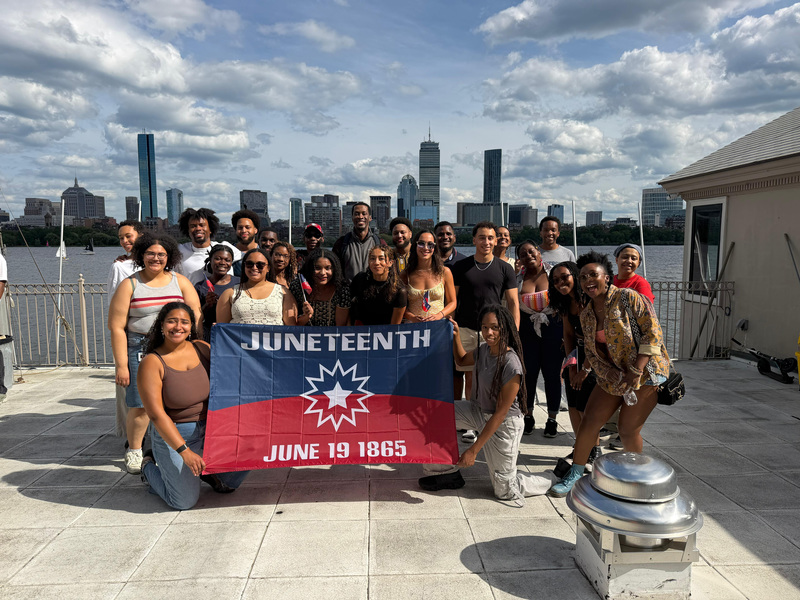
Photo courtesy of Ivan Marshall
On Friday, June 19, crowds gathered at MIT’s sailing pavilion for the Black Graduate Student Association’s (BGSA) annual Juneteenth Cookout. The most-attended year in the event’s history, the afternoon barbecue attracted more than just MIT students. Students hailing from the MIT Summer Research Program (MSRP), Interphase EDGE, and local universities all came out to celebrate the national holiday. Launched in 2024 by previous BGSA co-presidents Miles and Malik George, this year’s BGSA’s Juneteenth Cookout marks the event’s third appearance on MIT’s campus.
Officially recognized as an Institute holiday in 2021 and often referred to as the nation’s “second independence day,” Juneteenth commemorates when Union troops led by Major General Gordon Granger arrived in Galveston, Texas to inform the last of the enslaved peoples in the nation of their freedom on June 19, 1865. Importantly, this date happened two years after the Emancipation Proclamation.
On June 24, The Tech interviewed BGSA president and PhD Candidate Ivan Marshall, along with several of the cookout’s attendees, to get their thoughts on the event and the larger holiday.
Reason for the season
The cookout began at 3 p.m with grilled burgers and hotdogs accompanied with classic R&B hits such as Tamia’s Can’t Get Enough. Free miniature replicas of the official Juneteenth flag were handed out along with the food. According to Marshall, 130 people registered for the event. The presence of a free food event happening on a “gorgeous afternoon” assisted in the event’s success, Marshall guessed.
Still, many attendees said they chose this particular Juneteenth celebration over many others happening in the area because it was a unique opportunity to experience Black culture through the MIT community.
“I attended because it seemed like a great way to get to know more Black people at MIT,” said Chigozirim Ifebi, a rising senior at Caltech studying Applied and Computational Math and one of the MSRP interns who attended the cookout on Friday.
“Seeing people this Juneteenth coming together, doing line dances, doing strolls, that’s something so special to me,” Ifebi said. “It was so good to see, and something I wish existed more on my campus.”
On the other hand, other attendees from MSRP felt the event was more similar to their own experiences. Miles Walker, a rising senior studying cybersecurity at Hampton University, a Historically Black University (HBCU), felt that while coming to MIT has been a “bit of a shift,” the cookout reminded him of being back at his HBCU.
D’Andre Washington, a rising sophomore at Claflin University studying computer engineering, echoed Walker’s sentiments. Washington summarized the cookout as “a great chance to be unapologetically Black.”
Current MIT students staying on campus also shared their thoughts on the celebration.
“Juneteenth means a celebration of Black love, Black freedom, Black culture, and Black creativity,” said Ikeoluwa Sowemimo ’29, a chemistry and biology (Course 5-7) major and a Residential Facilitator (RFA) for Interphase.
For Sowemimo, the cookout was a chance to introduce the Interphase kids — all incoming MIT students — to the diverse culture on campus. “They had so much fun being in a place of joy around people that looked like them,” she said. More importantly, Sowemimo wanted to show the students they can belong at MIT.
Celebrating culture
The variety in music and movement reflected the diversity within the African diaspora. Those that braved the dance floor were met with soulful R&B in addition to energetic Afrobeats.
“My favorite part was the line dancing for sure,” Ifebi said. “There’s something about our people and line dance … we just gravitate towards each other.”
“I didn’t actually have any plans for Juneteenth,” admitted Ayomide Togun ’27, an artificial intelligence and decision making (Course 6-4) major. An invite from a friend brought him out to the cookout. “It was an amazing opportunity to see so many Africans and African Americans come together and really express joy together,” Togun said.
“This cookout was great, but unfortunately I felt like a proper ‘unc,’” said Tobi Majekodunmi, a rising 4th-year PhD student in mechanical engineering at MIT. “The undergrads were hitting line dances that I did not know and had never seen in my life.”
Looking forward
Commenting on the significance of the event, Marshall pointed out that much of MIT’s student body considers campus a second home and that the feeling of ‘home’ is difficult to cultivate without acknowledging the various “customs and celebrations” students arrive with.
Washington shared this belief, citing that Juneteenth is a holiday whose celebration is not constrained to one particular group or people. He pointed out that while the history of the holiday belongs to Black Americans, “the idea of freedom is one without an owner.”
According to Marshall, the BGSA Juneteenth Cookout will “definitely” be returning next year. “We’re already thinking of how we can share it with even more of the community,” he said.