Getting dumber, in a good way
Re-joining News in my junior year forced me to confront my ego



Levy Le–The Tech
I have an admission, and it’s humiliating. Still, I’d guess that it’s relatable to many readers here, so here goes: For a very long time, one of the things I liked most was for other people to think I was smart. Obviously, I cared about how my instructors, mentors, and supervisors viewed me; pretty reasonably, I hoped that their favorable opinions would translate into high grades. Less normal was the way that my craving for academic validation seeped into my social life.
I often found myself reveling in the rush of finding an answer faster than my friends. The first time was in the fifth-grade Math Bowl, my greasy bob flipping and Harry Potter glasses rolling off my nose as I slammed the buzzer to answer the question. Later, after spending a good chunk of my prefrosh summer vacation reviewing classical mechanics, I chased a similar high in 8.012, whose psets I proudly wrote in pen.
Even more embarrassingly, I liked to sit in a dorm lounge while my Bic pen and I worked out the nuts and bolts of momentum conservation, so other people would glance over my shoulder and think — and you’re allowed to groan as you read this part, because I definitely am as I remember it — Wow, she’s not just in the advanced version of the class, but she’s so confident in her knowledge that she’s not using a pencil? [1]
Maybe the examples I’ve given make some sense: I’m a mathematics major who thought she’d double in physics, so of course I wanted to seem good at those subjects. More generally, though, I felt a need to excel at technical classes, and more importantly, to be known as someone who excelled. On my MIT application, I’d written that I planned to take organic chemistry, not because I wanted to synthesize molecules for a living or because I hoped to pursue a career in medicine (like many of my future colleagues in The Tech), but rather because I had gotten a B in tenth-grade Advanced Chemistry and I felt I had to correct that mistake.
While I didn’t end up tackling 5.12 (Organic Chemistry I) in my junior fall, I decided to take 8.05 (Quantum II) and 18.226 (Probabilistic Methods in Combinatorics, a graduate course) without the prerequisites for either, mostly because they seemed like the sort of courses a really intelligent person would waltz through. Predictably, my understanding and I were, as the kids say, chopped and cooked. I was miserable while studying and permanently confused in the rare moments that I attended lecture.
Moreover, I found myself completely directionless regarding where the skills I was supposed to be learning — in these classes, in my research, in the technical interviews I kept bombing — were meant to lead. Nothing made sense, and when people expressed their shock that I was taking Quantum II without Quantum I, the secretly-hoped-for balm, i.e. an insinuation that I’d have to be sooooo smart to be doing that, didn’t do much.
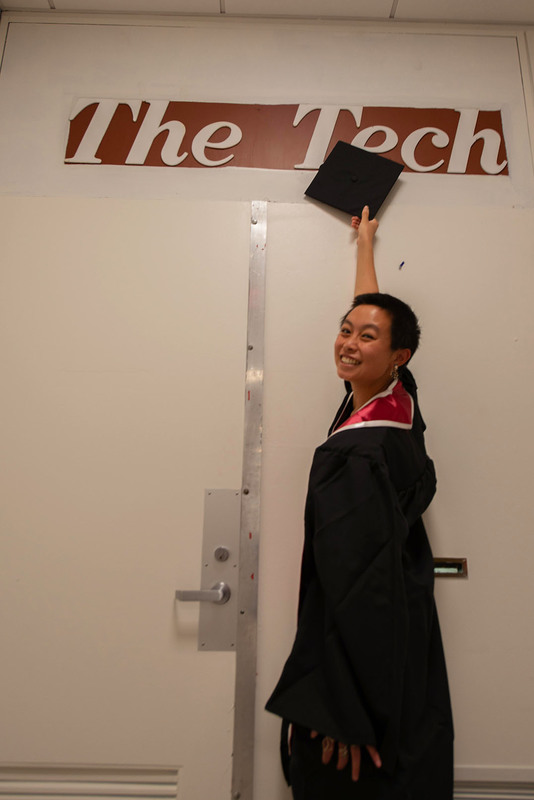
It was in this state that I re-joined The Tech. Yes, re-joined: I’d started in Copy as a freshman but dropped after I decided I needed to devote more time to my classes. This time, somewhat unsure as to who else was in the club, how much of a time commitment it would be, or even what a college newspaper reported on — but knowing that I needed to do something that wasn’t about being cracked and technical and smart — I landed in News.
That department, it turns out, is a good place for someone with a lot of questions. Your job as a reporter isn’t to be clever. Frankly, it’s better if your interviewees think you’re dumb; they’ll walk you through their thought process more thoroughly. Conversely, if you seem too knowing, you might strike them as incurious or biased. Asking “smart,” tricky questions is important, but so is getting the who-what-where-went-why correct. While working on a piece, you empty your brain of assumptions because you need to make room for the facts. Especially if you were like me at the time, your self-image is constructed from a million guessed-at outside opinions.
Tamping down my desire to seem in the know wasn’t always easy for me. I wasn’t plugged into campus events, so I didn’t pitch my first few articles, unlike many Tech prospectives. Instead, I received assignment ideas from the editors. One of my earliest pieces concerned a unionization attempt at a nearby coffee shop. I spent the morning of the walkout reading as much as I could about the chain and the legal ramifications of unionization. Once I walked into the shop, I proceeded to ask customers highly specific questions, but not their last names. When my editors pointed out the issue, it was mortifying to realize that I hadn’t taken the time to carefully read the paper’s requirements for attributing quotes because I had assumed I would just know how to do it.
But somehow, as time went on, I was able to let go of more and more fragments of ego. Accordingly, my reporting grew stronger. My first independently pitched article came out of a talk I attended on a whim, based on a recommendation from a professor whose class I took on another. An interview arose from a visit with MIT’s Science Policy Initiative, which I joined in hopes of forcing myself to confront my intellectual weak points, to the Massachusetts State House. Even a short emerged from a “tell me more” rather than an “oh, I heard” in an informal conversation about a shut-down program.
As Associate News Editor, working with at least four other writers and editors each week reined in my needs to be smart and right. Early on, I accepted that Vivian Hir ’25, The Tech veteran supreme, knew more than me about how the paper worked. Quibbles with reporters over method or structure often resolved in a realization that the other person was correct. You make so many mistakes as a first editor that at some point, you stop caring whether the copyeditor thinks you’re even literate.
I’m proud of my work at The Tech as a reporter and editor over the past year and a half. As a department, News has covered some of the most important issues facing MIT and the globe; as an organization, we’ve tightened up our systems and strengthened our community. But, selfishly, my biggest point of pride isn’t about a single article or even the quality of the newspaper as a whole. Somewhat paradoxically, I’m most proud that The Tech has made me realize how little your pride matters. It’s fine, and even commendable, to want to be smart. But you — or at least I — will be a lot smarter, and a lot happier, if you forget about seeming that way, or even being that way, and ask dumb questions, as many as you can to as many people as possible, curiously stupid and stupidly curious and okay with being known for it.
[1] Current Sabine’s note: the class in question is a GIR, so I don’t know why I thought people would care.