Residents of predominantly Black and Latino neighborhoods are about four times more likely to get hit by a car while walking or biking in Boston
A team of researchers from Boston Emergency Medical Services and MIT Urban Studies and Planning analyzed ambulance data to give policymakers more options for targeted interventions





Veronika Moroz–The Tech
Anyone who’s ever walked around Boston or looked at a map of car crashes in Massachusetts knows that when you cross the street in urban areas, you should look both ways like your life depends on it. However, organizing pedestrian traffic injury data by victim demographics reveals a story that goes much deeper than basic road safety.
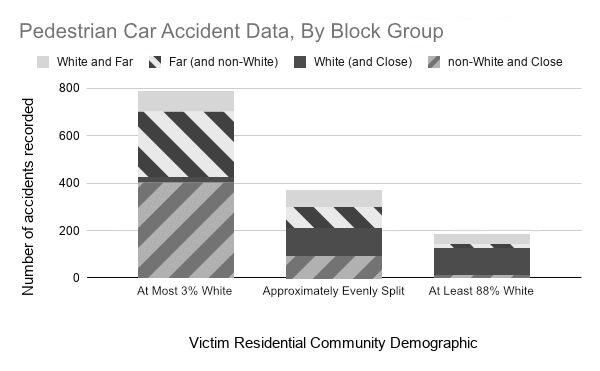
According to a paper published in Cities & Health last summer, people living in predominantly Black and Latino neighborhoods are about four times more likely to be hit by a car while walking or biking in Boston than their counterparts living in predominantly white neighborhoods. This risk of being hit by a car, which the authors of the paper call “mobility risk,” is elevated for people living in predominantly Black and Latino neighborhoods both when they’re close to home and in other parts of Boston.
“It’s not quite proving that the sun rises in the east, but it's also not too much more surprising than that great revelation,” observed civil rights and transportation journalist Robin Washington. When he lived in Boston, Washington wrote about transportation for his Roads Scholar column at the Boston Herald.
“The obvious factor is that people of color own fewer cars,” Washington said. A 2019 National Equity Atlas study found that 17% of Black households don’t own a car, compared to only 6% of white households. Black households are also more likely to be financially burdened by vehicle ownership, with Black households in poverty spending over $1,000 dollars more per car than their white peers.
Without a car, commuting can be difficult and considerably expensive, forcing those who don’t have access to public transportation to walk to work or school every day. The length of these commutes and the times they occur — including early in the morning and late at night, when it might be dark — puts walkers and bikers at a higher risk. Worse, rising housing prices in urban areas may force people to seek more affordable homes in the outskirts of the city they work in, creating a longer walking commute that increases their exposure to questionable driving.
The problem is compounded by the fact that people who can't afford to drive might need to spend a bigger fraction of their income on medical care if they do get hurt. And as cars get larger, injuries become more severe, according to Urban Studies and Planning Professor Justin Steil, one of the authors of the mobility risk paper. Larger cars “have more mass, more momentum, are slower to decelerate, and also a higher front angle, which can lead to worse damages to the core and to the head,” he explained.
As a paramedic and researcher in residence with Boston Emergency Medical Services (Boston EMS), Steil has often treated pedestrians and cyclists who’ve been hit by cars. He also has a deeply personal reason for caring about safe streets: for the past nine years, Steil has been running-commuting his daughters to school in a jogging stroller. One day, he was walking across the crosswalk with his daughter in the stroller when a car went through the red light at full speed. If he had been standing even a little bit closer, Steil recalled, it “would have killed her.” Both father and daughter emerged unscathed, but that close call serves as a painful reminder of the health risks associated with having to walk or bike long distances.
To analyze traffic accident demographics, Steil teamed up with Mark Brennan SM ’16 PD ’20 PhD ’20 and Yonah Freemark MCP ’13 SM ’13 PhD ’20, as well as Boston EMS Chief of Staff Laura Segal, now-retired Boston EMS Deputy Superintendent James Salvia, Deputy Chief of Staff Erin Serino J.D., and Boston University Professor of Emergency Medicine and Boston EMS medical director Sophia Dyer. However, the story of this particular project actually began in January 2016, when Boston EMS began putting notes on pedestrian and cyclist traffic accidents in what is now a large database.
“Imagine the first row in that dataset,” Brennan, the corresponding author of the mobility risk paper, exclaimed. “You have to really be playing a data-driven long game to think it’s worthwhile to enter that first row basically a decade ago.”
Diving into the data
When paramedics arrive at a car crash scene, they ask questions to figure out what the patient needs: What’s your name? Where do you live? Do you have any pre-existing conditions? In Boston, paramedics write up the health-relevant data in a care report, which is uploaded to the central EMS facility, where someone types the patient’s age, gender, and residential address into a free-form text box for a new entry in the traffic injury database.
Though U.S. cities have been analyzing their car crash data for years to inform transportation policy, paramedics don’t explicitly write down what patients look like, so this is the first time it’s been possible to analyze what the patient's race could be.
“This would not even be a project if it wasn't for the hard, quiet work of people over the past decade making sure that this dataset is good,” Brennan said.
Since all the residential information is entered as unstructured text data and can take on many forms with varying degrees of specificity, picking out the residential neighborhoods for thousands of complex data points took a lot of trial and error. To determine the neighborhood demographics of each approximate home address, the researchers turned to regions called block groups, which the U.S. Census defines through physical landmarks like rivers, highways, factories, and main streets.
Block groups are small (Boston alone has about 550), so when researchers zero in on one, they are looking at a community that is specific enough to make some generalizations. Brennan, who worked with undergraduate students during his PhD as a teaching assistant for several classes, offered a familiar example: “If we look at the MIT dorms and its one or two block groups, everybody in them is not going to be making much money, probably doesn’t have a car, and probably shops at Trader Joe’s,” he said.
By picking through the entries in the EMS database containing unstructured notes and medical information like patients’ residential addresses, the researchers were able to identify the block group for 19 out of every 20 pedestrian or cyclist victims of traffic incidents. They then used demographic data from the U.S. Census to piece together what the victims’ block groups looked like.
To Brennan, the size of the disparity between majority Black and Latino block groups and majority white block groups offered an inflection point. “All the health equity and public policy and social science research tells us that this issue is probably at play,” he said. “It wasn’t surprising that we found something, but [what] was surprising [was] the extent of what we found.”
Offering a new tool
According to MIT Transit Research Consortium Director and former assistant Massachusetts attorney general Jim Aloisi, the type of analysis carried out by the mobility risk researchers matches up with Boston’s push for data-driven public policy. “Under Mayor [Michelle] Wu, there’s been a focus on trying to figure out how to leverage data better,” Aloisi said, later adding, “I think MIT is playing a positive role in doing what it does best, which is cast[ing] a data-driven light on factors that society and government need to respond to.”
However, both Aloisi and Washington warn that truly addressing this problem requires more detailed research. For example, the study couldn’t explain why residents of neighborhoods home to predominantly people of color are more likely to be hit by a car. Though Steil, Brennan, Aloisi, and Washington all suspect that class dynamics and walking distance are important factors, other reasons, like quality of traffic signals or street design, might play a role as well. The paper also didn’t compare across communities of color in Boston with different levels of traffic density or driving speed. Without this information, it’s difficult to get a full picture of what makes walking so dangerous for people from these communities.
Though Brennan is now an Assistant Professor of Operations Management at Rutgers University, he and Steil have continued working on follow-up papers, including one describing the project’s impact on transportation safety in Boston.
“On the policy level, I think one of the useful aspects of [the original] paper is it shows that it’s really important to address where crashes are happening,” Brennan said, “but it also reminds us that we have other tools in the policy toolbox that could be well-suited to trying to improve health by residential neighborhood.” For instance, handing out free bicycle helmets to communities whose residents are more likely to get hit by a car while biking could prevent serious injuries.
“And to be clear, investing in streets where crashes happen is time-tested, smart, needs to happen, and does happen in Boston at really substantial levels,” Brennan explained. “This just gives policymakers another degree of freedom.”
In a follow-up paper published last month, the researchers explained how reorganizing their data highlighted that children in Boston’s poorest areas are disproportionately likely to get hit by a car while walking or biking to school. The findings helped Boston’s Department of Transportation refocus their efforts on educating students about pedestrian and bike safety, launching six projects and organizing outreach programs in seven schools.
It’s a small victory, but interventions like these are an important step towards reducing pedestrian and cyclist injuries. For Steil, this reduction is just as possible as past interventions, such as using seatbelts to make passengers safer or building better fire alarm systems to keep people safe from fires. “As we improve the infrastructure of streets for pedestrians and cyclists, hopefully, we can reduce injuries from people’s mobility,” Steil said.
Through collaboration across many city departments, detailed analysis, and data-driven interventions, mobility risk research from MIT is becoming part of the story of battling the racial disparity in traffic injuries. Though progress so far seems promising, the consequences of this research will depend on which people see it and what they do with it.