MIT Spokes cyclists bike cross-country to teach in rural America
The seven-person cohort will spend 75 days biking 4,000 miles west





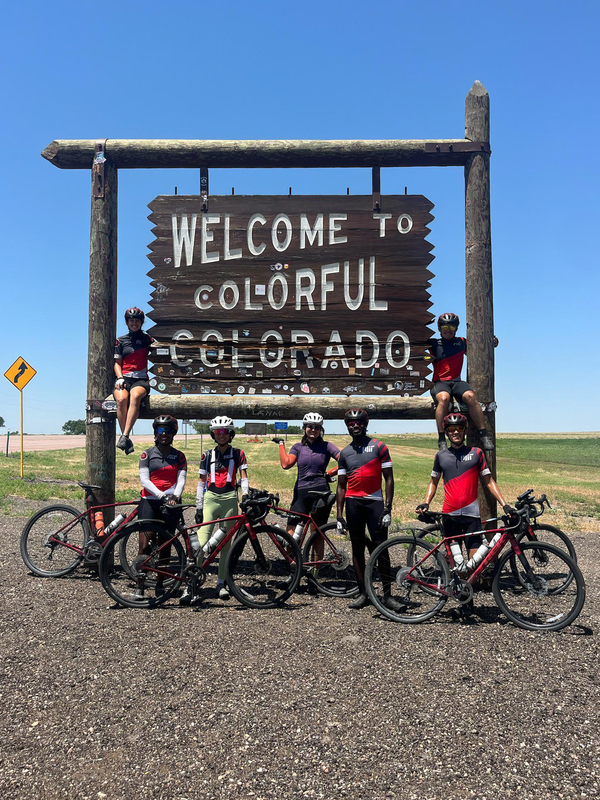
Photo courtesy of MIT Spokes
This summer, under the red rocks of Utah, you can expect to spot a group of MIT students cycling en route on a 4,000 mile trip west.
Now in their 12th year, MIT Spokes plans to once again embark on a cross-country bike trip from Washington, D.C. to San Francisco this June, stopping along the way to hold STEM workshops for children in rural America. The seven-person cohort will spend 75 days along a route that weaves through nine states and crosses the Rocky Mountains.
Sarah Schmitt ’28, a member of the 2025 Spokes team, shared that some of the highlights from last year’s trip included visiting all of Utah’s “Mighty 5” national parks and biking on Nevada’s U.S. Route 50, dubbed the “Loneliest Road in America.”
“From seeing the most amazing shooting stars in Capitol Reef to doing the same colorful hikes in Bryce Canyon I did with my family over a decade ago, it was such a treat to see landscapes I have grown up with my whole life in a whole new light,” Schmitt said.
She added that passing through Nevada, her home state, was particularly “special” because she got to “give back to her local community” and “share her old home with new friends.”
“Biking the ‘Loneliest Road in America’ with a truly wonderful team of individuals was not lonely in the slightest,” Schmitt said.
Beyond cycling, teaching is one of the main priorities for Spokes. The club’s core mission is to “bridge the gap in STEM education” among “rural, low-income, and underserved communities across the country.” According to a 2025 report from the National Academies of Sciences, Engineering, and Medicine, issues like low broadband availability and high teacher turnover in rural America create systemic challenges for students’ “technical literacy” and STEM development.
On each trip, MIT Spokes runs a series of hands-on workshops — in churches, libraries, juvenile detention centers, and summer camps across the country — on everything from electric motors to chemistry. Over the years, their outreach has allowed them to “build connections” in areas where “access is difficult.” They are also supported by Stanford Spokes, a counterpart club that bikes the opposite way from San Francisco to D.C. and also holds STEM workshops.
“Between Stanford and MIT Spokes over the last decade or so, I can confidently say that we have brought STEM to thousands of kids in small town and rural America,” Schmitt said.
Moreover, Schmitt noted that while the science demonstrations on 3D printing, chemistry, and physics were interesting for many kids, it was often Spokes members “showing interest” and “believing” in them that resulted in truly lasting curiosity.
“My most memorable student didn’t even show interest in our science, but when I noticed her doodling in her notebook during my talk, I realized she was an artist, just like me,” Schmitt recalled. “When I asked her about her drawings in between activities, and shared some of mine, her energy and engagement changed instantly.”
For Tatiana Vassiliev ’26, a member of this year’s Spokes team, the trek is both a chance to teach STEM and work on a personal milestone.
“I have been teaching STEM since middle school, and I love doing hard and awesome things. Spokes felt like the natural extension of both,” Vassiliev said. “It allowed me to expand my mission of spreading STEM education across the country, while also representing the epitome of an adventurous senior trip.”
The Spokes team also expressed that they were “excited to engage with an extremely wide range of people” through staying with different strangers matched by Warmshowers, an app that connects cyclists with hosts.
Still, despite the careful route planning, trips into the backcountry are ultimately challenging and unpredictable. During last year’s trip, Schmitt suffered anaphylaxis (a severe allergic reaction) in rural northern Nevada, over 60 miles away from the nearest hospital. She was forced to use an EpiPen for the first time and was taken to the hospital by the team’s support van.
“We had to coordinate using the van to take me to the hospital, while also supporting the biking team with no towns or resources in between the day’s start and end points,” she said. “We ended up figuring it out, but it just goes to show how flexible and creative you have to be for trips like this.”
Yet Schmitt added that “once you come around the corner, see the next bit of beautiful scenery, and meet your teammates at the end of the ride, you forget the bad parts very quickly.”
Funding for the Spokes trip — which covers renting a minivan that tracks the group, housing, workshop materials, and bicycles that “can withstand the intensity of the trip” — mainly comes from sponsors and crowdfunding. This year’s MIT crowdfund campaign has raised $16,229 from 146 donors towards a $20,000 goal so far.
On her feelings regarding the upcoming trip, Vassiliev said that she wants to prove to herself that she can do something “seriously hard.”
“Biking for 4,000 miles sounds daunting now,” Vassiliev said. “But I know that in August, I will be so proud of myself and the team for the youth we have inspired, the miles we have biked, and the memories we made.”