Bestselling author Patrick Radden Keefe presents ‘London Falling’ at WBUR CitySpace
Keefe discusses wealth, crime, and corruption in London’s underworld





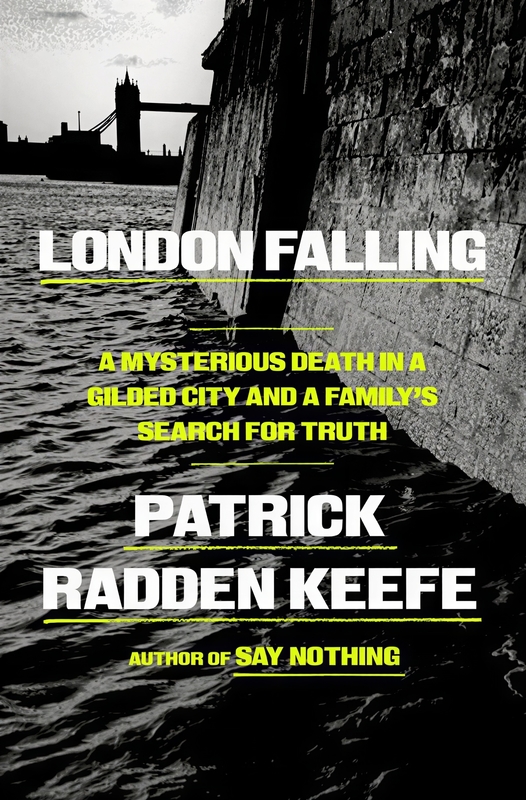
Photo courtesy of Doubleday Books

Photo courtesy of Milena Fernsler/WBUR
Patrick Radden Keefe
London Falling
WBUR CitySpace, Boston
April 21, 2026
On April 21, bestselling author Patrick Radden Keefe presented his new true-crime book London Falling at WBUR CitySpace in Boston. Todd Mundt, Senior Managing Editor of WBUR’s Here & Now, moderated the discussion. Keefe is known for his investigative reporting of crime and corruption for The New Yorker, with his experience ranging from Mexican drug cartels to Chinatown’s notorious smugglers. He is also the author of six books, including Empire of Pain and Say Nothing. Keefe has also received many awards for his work, notably the National Book Critics Circle Award for Nonfiction and the Orwell Prize for Political Writing.
London Falling is about the unexpected death of Zac Brettler, a 19-year-old who jumped off a balcony of a luxury tower near the Thames River in the early morning of Nov. 29, 2019. When his parents Rachelle and Matthew Brettler investigate his past, they learn that he had a fictitious alter ego called Zac Ismailov, a son of a Russian oligarch. Under this identity, Zac becomes acquainted with Akbar Shamji, a deceitful businessman, and Verinder Sharma, a violent gangster who goes by Indian Dave. Shamji and Sharma were at the apartment right before Zac’s death, making them prime suspects in the investigation.
Although Keefe wrote a long-form article about Zac Brettler for The New Yorker in 2024, he wanted to write a book, feeling that there was more to the story than just Zac’s death. One lingering question Keefe had from his reporting was how societal and political changes to London gave rise to Zac’s desire to become the son of a Russian oligarch. “What is it about the value system of a city where that would be the kind of motivational avatar that he [Zac] was going for?” Keefe asked. By writing a book, Keefe hoped that he could tell a “broader and deeper story” about the reinvention of London and the people of London.
From his interviews with the Brettlers and Zac’s former classmates, Keefe found that Zac’s obsession with wealth came from being surrounded by rich classmates in his private school, many of whom were the children of Russian oligarchs. Although Zac grew up in a middle-upper class family, the wealth he saw at his school far exceeded his own. He also liked telling lies about himself at school, especially ones about his family’s wealth. These aspects influenced him to create the alter ego of Zac Ismailov, which he used when he introduced himself to Mark Foley, a Chelsea Football Club manager at an art gallery event. Believing Zac Brettler to be Zac Ismailov, Foley then connected him to Shamji because Brettler wanted to invest in real estate properties. From there, Shamji introduced Bretler to Sharma.
While the book centers on the events that led to Zac’s sudden death, Keefe stated that his book is also a commentary on the long-term repercussions of London’s financial deregulation and the investor visa program. Although these policies enabled London to transform from a dying manufacturing city to a global financial center, Keefe highlighted that they have resulted in money laundering and foreign crime.
“There is a sort of element of dodginess to all this, and I think on some level, a kind of desperate awareness on the part of British authorities,” Keefe said. “What we do is service unsavory foreign money.”
In regard to the process of writing London Falling, Keefe described it as a “hairball” because of the story’s complex and complicated nature. Initially, Keefe found the process to be hard because of the “overwhelming” amount of information. Despite this, what helped him the most was devoting all his attention to crafting the story, such as with exposition and character development. One writing method that Keefe likes to employ in his work is guiding the reader through “little detours” so that the reader understands the background and characters before giving the “revelation” in the latter half of the novel.
Keefe then returned to discussing major ideas in the book, specifically the Metropolitan Police’s inattentive investigation of Zac’s death and the lack of accountability. In the end, Zac’s death was ruled as a suicide; Shamji and Sharma did not receive a sentence. However, Keefe’s detailed analysis of the evidence suggests otherwise. Keefe believes that the Metropolitan Police ruled Zac’s death as a suicide rather than murder because the case did not neatly fit in either category, making it a difficult case.
“I think there’s a bit of a sense of, ‘We’ve got [to] churn here. There’s triage,’” Keefe said. “We can’t spend too much more time trying to get to the bottom of this exotic conundrum.”
Besides talking about the book’s themes, Keefe also reflected upon his unique experience as a reporter for London Falling. One major challenge Keefe experienced when writing the book was including information that was uncomfortable for the Brettlers because some family secrets and personal details regarding Zac were in the book. Keefe’s rationale for including these parts was that he wasn’t writing the book for the Brettlers, but rather for the readers and the truth.
“I was able to persuade them that in a book that’s all about lies, it was important that if we are going to do this, we have to do it in a way that’s kind of bracingly true,” Keefe said.
Despite the difficult conversations, Keefe appreciated his collaboration with the Brettlers, calling it a “privilege” to work with them. One thing about the Brettlers that stood out to Keefe was their ability to live “full lives” despite the death of their son, as they regularly meet with family and travel together.
When Keefe asked the Brettlers how they do this, they cited the experiences of their father. Both of their fathers were Holocaust survivors who lost their entire family to the Holocaust. As teenagers, they moved to the UK to restart their lives. Keefe was deeply moved by their story, saying, “The Brettlers have this unbelievable ability to keep going and live joyously in the face of catastrophic loss.”