Sleeping cancer cells hijack the wound healing pathway to wake up
New research shows that the awakening of disseminated cancer cells is caused by inflammation in the tissue microenvironment





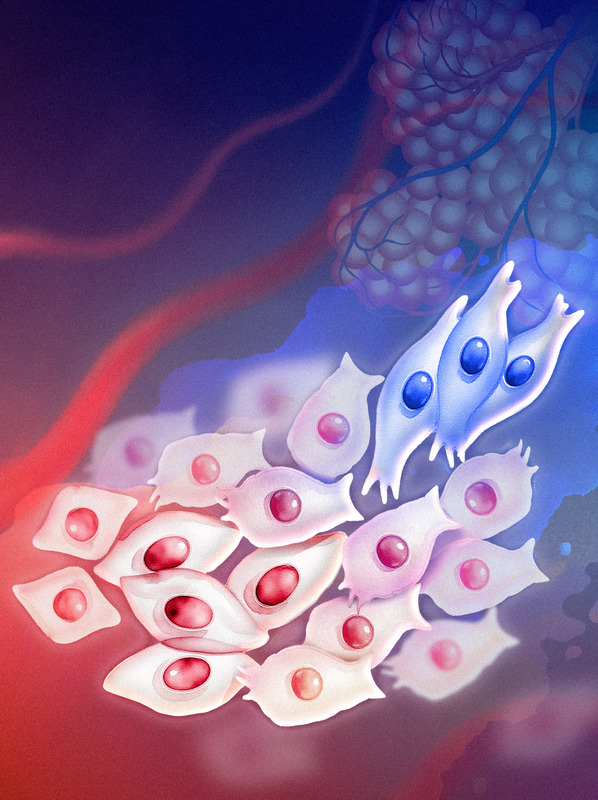
Photo courtesy of Jingwei Zhang
“The day it is easy for me to tell my patient that their cancer has come back… that is the day that I will retire,” stated Dr. Noopur Raje, an oncologist at Massachusetts General Hospital and director of its Center for Multiple Myeloma. Even after doctors have deployed aggressive treatments and surgically removed tumors, cancer often creeps its way back, months or even years after a patient has been in remission. This dreaded return, also known as metastatic relapse, is the leading cause of cancer-related deaths and an ever-looming fear for cancer patients and their families.
For the last 50 years, Robert Weinberg ’64 PhD ’69, the Daniel K. Ludwig Professor for Cancer Research at MIT and a founding member of the Whitehead Institute for Biomedical Research, has been on a mission to understand metastatic relapse enough to one day defeat it. New research from his lab identifies inflammation as the primary instigator in transitioning sleeping, metastatic cells to a rapidly growing, tumor-forming state.
Breast cancer cells exist on a spectrum of cell states, but there are three notable cell states for this study: epithelial, highly mesenchymal, and quasi-mesenchymal states. Epithelial cells are polygonal in shape and tend to stay put. However, their transition to a mesenchymal state is the origin of most metastatic tumors. The elongated shape of highly mesenchymal cells allows them to slip out of the primary tumor and disseminate into distant tissues. These cells are dormant, meaning they cannot proliferate. It’s only when they become awakened that they become a problem, rapidly dividing into new cancer cells that lead to life-threatening tumors.
Part of what makes preventing metastatic relapse so difficult is that researchers do not fully understand how it happens. The awakening of cancer cells was once thought to be a random, autonomous process. However, a study led by Jingwei Zhang, a post-doctoral fellow in Weinberg’s lab, suggests that this is not the case.
The findings show that cancer cells exploit an existing pathway triggered by inflammation — namely, wound healing — to transition into a malignant, awakened (quasi-mesenchymal) state. After the body detects inflammation from a wound or injury, it attracts immune cells to the site, including M2 macrophages. These macrophages release signaling molecules called epithelial growth factor ligands (EGF ligands), which bind to special receptors and trigger the rapid growth of cells to restore the damaged tissue. Unfortunately, cancer cells also have these receptors on their cell surface, enabling them to seize these signalling molecules and activate themselves.
“Cancer cells never invent new mechanisms. They always hijack,” Zhang said.
Researchers discovered this mechanism by injecting dormant (highly mesenchymal) human breast cancer cells into the lungs of mice. This setup modelled the metastasis of breast cancer to the lungs. Then, the scientists used a chemotherapy drug called bleomycin to induce lung inflammation. Elevated levels of relevant biomarkers revealed that the cancer cells had awakened, and further tests showed that they continued to stay awake even when the mice stopped being exposed to bleomycin.
While Zhang’s experimental model presents a mechanism to explain metastatic relapse, he asserts that extensive additional research is needed to determine how generalizable these findings are. Therefore, he plans to further study the behavior of different cancer cells, namely colorectal cancer cells, and their dissemination into different organ systems.
“Understanding the biology of the disease… then targeting that biology is what’s going to get us to the next level of curing cancer,” Raje said.
This model reveals vital details about the mechanism of cancer cell awakening, bringing scientists one small step closer to defeating cancer.
“It’s a very hopeful time in cancer [research]. We talk about living with cancer and not dying from cancer, and that is such a big shift in the mindset,” Raje said.
Metastatic relapse will continue to be one of the greatest enemies in the fight to cure cancer, but for now, insights into how cancer cells spread give us hope for a brighter future.