Science journalist Matt Kaplan presents historical cases of pushback against scientific breakthroughs, from Galileo to Karikó
Kaplan: “Science is an engine of discovery: it does great things, but it is a clunky engine”





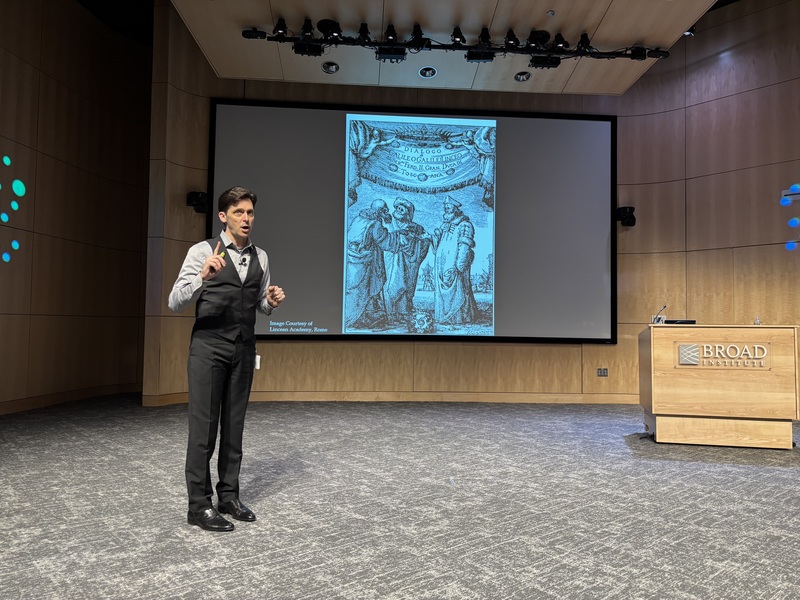
Vivian Hir–The Tech
It’s easy to assume that when scientists first discovered modern fundamental concepts like DNA and antibiotics, those findings received immediate widespread support. In reality, scientific breakthroughs have been met with significant pushback, even from experts, because they challenged established theories — an example being Charles Darwin’s theory of evolution. Although some scientists ultimately received support for their work, others faded into obscurity, never enjoying the credit they deserved for their potentially groundbreaking research.
The Economist Science Correspondent Matt Kaplan explores these past and present scientific cases in his book I Told You So!: Scientists Who Were Ridiculed, Exiled, and Imprisoned for Being Right. From Galileo Galilei to Katalin Karikó, Kaplan shows how the scientific community can be resistant to new ideas, even when these ideas are supported by facts and evidence. He uses the stories to argue for better collaboration in academia and research to enable faster progress in science.
Although Kaplan has written about science for a number of years, it wasn’t until the COVID-19 pandemic that he seriously considered devoting a book to “dysfunction in the scientific community."
In 2020, Kaplan focused on covering the pandemic, asking scientists for their ideas about how to solve the global problem. Many of those who shared their thoughts asked Kaplan not to publish their ideas because they were concerned about being wrong and harming their career and reputation.
These negative responses surprised Kaplan, influencing him to do research on the history of resistance in science and write I Told You So!.
“Science is an engine of discovery: it does great things, but it is a clunky engine,” Kaplan said. “The more I looked, the more I realized the engine has been in need of a tune up for quite some time, and that tune up is becoming more and more urgent.”
Correct but discredited
On Wednesday, March 11, Kaplan discussed scientific cases from his book at the Broad Institute. The event was part of the Broad Discovery Series, an educational program open to the public. He also gave a book talk at MIT on March 10 and at Harvard on March 12.
Throughout the talk, Kaplan discussed historical cases of scientists who made important discoveries but received little support from other scientists in their field, as they lacked significant connections or had ideas that did not conform to established scientific theories at that time.
After opening with the story of Galileo being punished for defending heliocentrism, Kaplan presented the faces of two unfamiliar scientists on the screen: Henri Toussaint and Pierre Gatlier. Toussaint created the anthrax vaccine and Gatlier developed the rabies vaccine. However, Louis Pasteur took credit for both of their works. The irony was that Pasteur initially discredited their work and did not believe their methods worked until he performed the experiments on animals and humans.
“I don’t like to think [that] the biographers of Louis Pasteur, who ultimately found his notebooks in the early 2000s, say, ‘You have to appreciate the high pressure environment of French academic life in the late 1800s to understand how he operated,’” Kaplan said.
Although the story of Pasteur happened more than a hundred years ago, Kaplan connected this example to a modern case of scientific misconduct: the alarming increase in the number of retractions in the biomedical field. According to a 2024 study, the retraction rate for European biomedical science papers quadrupled between 2000 and 2001. “We are pushing the envelope,” Kaplan said. “Most of these [retractions] are because of suspected fraud, because of outright fraud, error in contamination.”
Kaplan then presented the story of Ignaz Semmelweis, a Hungarian physician who identified the cause of childbed fever and advocated for hand washing as an antiseptic practice in the hospital. Although Semmelweis was correct, other physicians were doubtful of his recommendations, and he ultimately died alone in an insane asylum at age 47.
Despite the strong evidence, the reason that physicians did not believe in his findings was that Semmelweis was a “quintessential non-politician” who was not tactful and “said all the wrong things,” Kaplan explained. As a result, Semmelweis was fired and exiled. “It was a sad end, and his work never picked up anywhere else because of all these political faux pas,” he said.
While we would like to think that the treatment Semmelweis received is a thing of the past, Kaplan argued otherwise, using Nobel laureate Katalin Karikó as a recent example. Karikó received the Nobel Prize in Medicine in 2023 for her contributions to mRNA technology, which were pivotal for developing the mRNA vaccine against COVID-19. Before this recognition, however, her research was dismissed by most of her colleagues.
In the 1990s, Karikó struggled to make progress on her mRNA research project, and she failed to get funding for her research due to lack of results. Other researchers at the University of Pennsylvania were skeptical about the potential of mRNA research, and she got demoted four times. Despite the setbacks, Karikó persisted and was given the opportunity to collaborate with immunologist Drew Weissman on the project, where they ultimately succeeded in mRNA technology before it was picked up by biotechnology company BioNTech. In 2020, BioNTech partnered with Pfizer to make an mRNA vaccine for COVID-19.
Kaplan commended Karikó’s persistence in spite of the discouragement, stating that her work helped end the pandemic. However, Kaplan raised an important question: “Did she really have to go through 25 years of horrid pain to be able to get where she did? We’re really lucky she stuck with it, because I hate to think where it would be if she had been eventually thrown out.”
Calling for change
After presenting historical cases from his book, Kaplan proposed structural and cultural changes in the scientific community that would lead to greater acceptance of novel and risky ideas, rather than letting established ideas and fixed mindsets dominate the conversation. First, Kaplan suggested “democratizing” the grant funding process by using a lottery system for top grants like the Austrian Science Fund, since he believes that human bias is a contributing factor in grant selection. He cited studies that found that grants were more likely to be awarded to native English speakers or researchers from prestigious universities.
Besides implementing a partially randomized procedure for selecting grants, Kaplan believes that the current research environment should be more accepting of research that may fail. He compared the National Science Foundation (NSF) and National Institutes of Health (NIH) to the Howard Hughes Medical Institute (HHMI) and Arc Institute, stating that the NSF and NIH tend to fund research that is “incremental success” and “validation of something else.” On the other hand, HHMI and Arc support long-term and high-risk projects that, in his opinion, can result in a “giant leap forward.”
Kaplan then called for providing scientists with job protection, allowing them to challenge established ideas and not face repercussions in their career. Kaplan criticized the current hierarchy and power dynamics in academia, stating that PhD students are not necessarily safe if they disagree with their professor’s research methods or point out suspected fraud.
“The university has sided with the researcher bringing in hundreds of thousands of dollars a year, and not the PhD student who brings in very little,” Kaplan asserted. In addition to community efforts to promote inclusivity in academia, some universities are also addressing the harms caused by power dynamics.
Kaplan also argued for protecting scientists who are considered outsiders in a field. As a paleontologist by training, Kaplan recalled chemists involved in geology research who questioned the geologists’ methods, ultimately causing the chemists to leave because of the geologists’ disrespect. While they were not experts in the field, the chemists from Kaplan’s personal experience underscored the importance of outsiders for offering different perspectives in science.
In addition, Kaplan recommended that the government should establish laws for “robust punishment” of academic fraud and dishonesty. Although Kaplan believes that creating incentives to award ethical behavior is better than creating punishment, he thinks that the finances to fund incentives would be expensive and impractical.
Kaplan concluded the talk by calling for greater discussion about the scientific method in science journalism. One critique Kaplan had about science articles in newspapers is that they tend to focus on the successes and results, leading to “simple narratives” that do not go into detail about the experiments and methods that often fail initially.
“We need to be writing about how science actually works much more often, so that the public understands,” Kaplan said.