Give peas a chance (they could bring your community together)
Professor Kate Brown talks about her new book, ‘Tiny Gardens Everywhere’





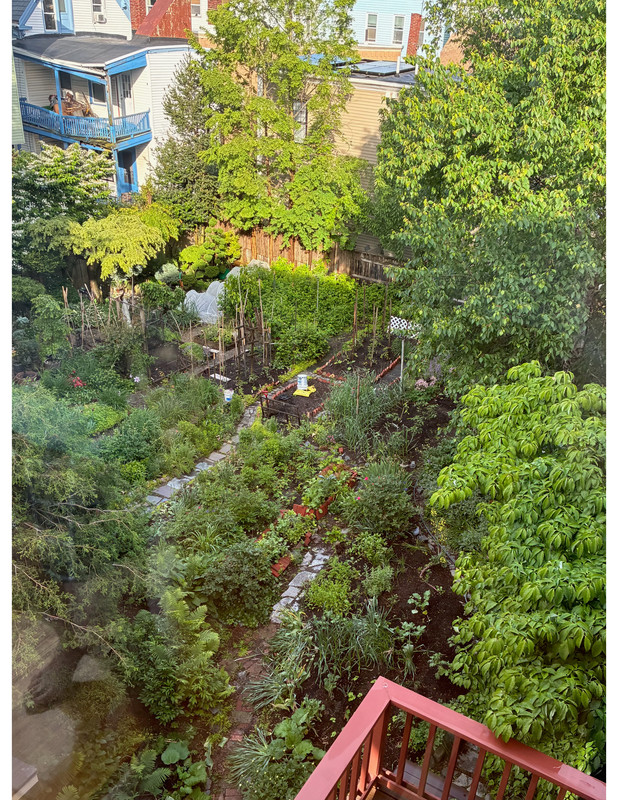
Photo provided by Professor Kate Brown
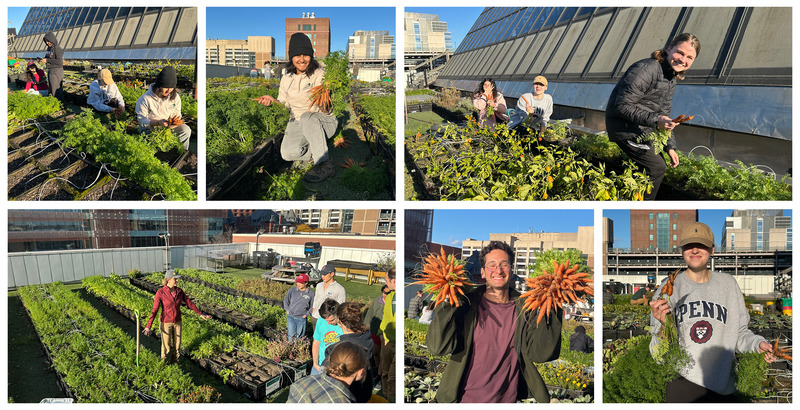
Photo provided by Professor Kate Brown
On Wednesday, Feb. 18, the MIT Museum hosted a book talk for Professor Kate Brown’s latest book, Tiny Gardens Everywhere: The Past, Present, and Future of the Self-Provisioning City. Brown, a professor in MIT’s Science, Technology, and Society program, spoke briefly about the book before conversing with Harvard Graduate School of Design Professor Antoine Picon.
Over the course of her remarks and spirited conversation with Picon, Brown touted the multifaceted benefits of urban agriculture. She argued that growing food in abandoned or unused spots in and around cities can simultaneously feed communities and bring them closer together, contributing to positive economic, health, and social change.
To support her claim, she pointed to poor laborers who moved from the countryside to Berlin in the 19th and early 20th centuries to work in factories. These factory workers squatted illegally on lands at the outskirts of the city and planted gardens to supplement their diets. While the soil had been overfarmed and was initially “basically sand,” the inhabitants collectively reclaimed it, using organic waste to make nutritious human-engineered soils. The result was a conversion of their lands from overfarmed slums to what Brown calls “green shantytowns,” with thriving gardens and communal resources, such as a free kindergarten. The produce from these gardens not only supplemented the residents’ diet, but also brought together a community that established what Brown calls “the sinews of a social welfare network.”
She additionally cited the African American communities west of the Anacostia River in Washington, D.C., in the 19th and 20th centuries. Segregation forced these communities to move to the least desirable districts in Washington, D.C., leaving them to live on land that lacked sanitation, jobs, and infrastructure. However, the inhabitants kept tiny gardens and livestock, feeding them with the organic waste and garbage that was dumped in the area. Sharing their produce and meat meant they were even able to survive the Great Depression with high rates of home ownership and community, despite having poorer infrastructure and lower rates of traditional employment.
Brown herself has a lot of experience with urban gardening, which was one of her reasons for writing the book. In both Tiny Gardens and her talk, she detailed her time working on an urban farm in Amsterdam and cultivating gardens in American cities. As an example, she highlighted her garden in Inman Square — a densely populated area — which she currently shares with five others. The resulting produce, which ranges from greens to root vegetables, not only supplements her diet year-round, but has also, she claims, brought her closer to her neighbors.
Brown argues that this is exactly why urban gardening should be translated to mainstream American culture. At a time of rising loneliness, division, and isolation, and when between 11 and 27% of the American population lives in areas that can be classified as food deserts, she believes urban gardening could be a meaningful solution, simultaneously feeding people and making them less lonely and “susceptible… [to] the politics of fear.”
But where will the space for these gardens come from? Brown visualizes using abandoned or unused spots when possible, but argues that urban gardening can be done in the smallest of spaces — and that new technologies, such as vertical farming, are not needed to solve the crisis. Instead, she believes that people simply need to adapt traditional gardening methods for varying conditions; as an example, she referenced her winter garden box, which is very small but still feeds her throughout the winter. If people do so in community gardens, she says, they “would be healthier and less lonely and isolated,” and “we’d have greener, more comfortable, safer cities.”
While she does acknowledge the many hurdles facing this idea, including municipal regulations and aesthetic guidelines, Brown suggests that people try not to be deterred by red tape. She mentioned a (presumably unsanctioned) food forest that she planted around a school in Washington, D.C., which “people loved,” and suggests that residents “just start planting [in unused spaces]” without waiting for official permission. Often, she says, these gardens are not only accepted, but welcomed.
In fact, Brown believes that such practices can be directly applicable not only to our broader society, but even to the MIT community itself, where according to the 2023 Undergraduate Enrolled Student Survey, 13% of undergraduates go to bed hungry at least one night a week. To combat this, Brown suggested an increase in urban agriculture on MIT’s campus — using greenhouses or self-sustaining cold frames during the winter — to help solve the problem. As of now, she herself has begun building a greenhouse on campus, but hopes to expand to other empty spaces in the future. Doing so would build on several MIT community farming efforts, including MIT Farm, the East Campus Community Garden, and garden plots for Ashdown residents.
Brown and other researchers have shown that communal gardening is an innately Mens et Manus (et Cor) activity with innumerable benefits. Perhaps, as she believes, practicing it in our own home really could bring us closer together.