MIT kicks off 52nd annual celebration of Dr. Martin Luther King, Jr. with Feb. 5 speaker panel
Dr. Martin Luther King Jr.: “We must accept finite disappointment, but never lose infinite hope”





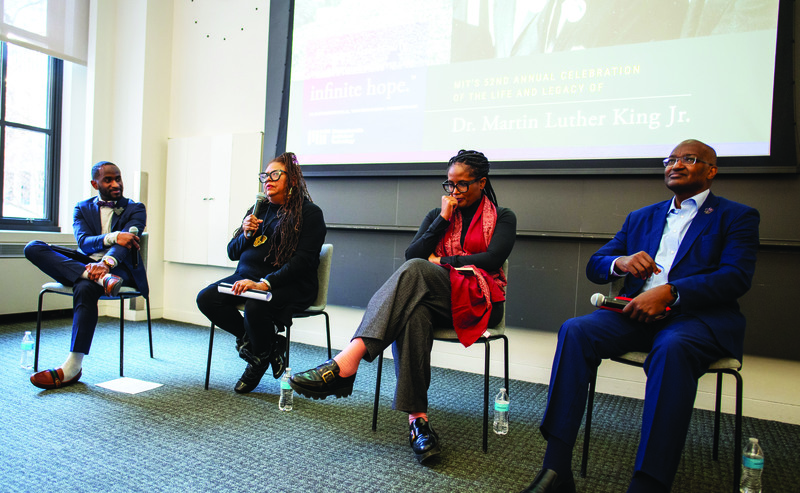
Photo courtesy of Corban Swain
On Feb. 5, MIT opened its 52nd annual celebration of Dr. Martin Luther King Jr. with a speaker panel hosting three MLK Scholars: L’Merchie Frazier, Dr. Patrick Njoroge, and Djamila Tais Ribeiro dos Santos. The three scholars attended as part of MIT’s MLK Visiting Professors and Scholars Program, which aims to bring 10–15 talented scholars from a variety of fields to MIT for visiting appointments every year, according to its website.
The panel was organized broadly by the MLK Celebration Committee, with committee members OACES Assistant Dean Krissy Robinson and panel moderator MIT Sloan Admissions Assistant Director RaeVaughn Gardner-Williams as the co-leads.
The panel revolved around Dr. King’s famous words spoken just two months before his passing: “We must accept finite disappointment, but never lose infinite hope.” The event began with the scholars explaining which term stood out the most to them within Dr. King’s quote: “infinite hope” or “finite disappointment.”
The silver lining within disappointment
L’Merchie Frazier, a visiting scholar in urban studies and planning (Course 11), spoke first, introducing herself as a “visual activist, public historian, poet, and human being.” Within her work, which centers around engaging with the last 500 years of Black and Indigenous history, Frazier prides herself on upholding four ideals: “I remember, I reclaim, I restore, and I reimagine.”
Frazier, using these four pillars as a lens, often works to both understand and proliferate Dr. King’s words. Frazier explained that she had been “looking beyond” Dr. King’s “I Have a Dream” speech for about 20 years and wished others could too.
Still, despite being well-versed with Dr. King’s rhetoric and philosophies, Frazier admitted she had to “brace” herself for Dr. King’s words on “accepting” disappointment. “Accept[ing] disappointment is not usually something I would do. And so I said, there must have been a reason. A man with a great depth of words would not casually put that ‘accept’ in.” In her investigation, she analyzed what Dr. King’s “accept” really meant.
Looking at the last 50 years of civil rights and its impact in Boston, Frazier noted, “There was a lesson to look deeper, to peer into what may be veiled, [and] to not give up. To actually look at how, in my work, remembering and reclaiming is in that finite envelope.”
“Do I accept that we can go beyond that?” Frazier posed rhetorically, referring to the act of accepting disappointment. She nodded in agreement a moment later, adding, “But rest for a while… just sit in [disappointment] and understand what it is that is given to us within disappointment. Not yielding to it, but at least recognizing it.”
Understanding infinite hope
As the panel went on, the other scholars shared their reflections on Dr. King’s words. D’jamila Ribeiro, a visiting scholar in women’s and gender studies, believed that finite disappointment and infinite hope can coexist. “As Black people, we are going to deal with disappointment in our lives on all levels. When you are engaged in shaping political movements for change, for transformations, for sure, we’re going to deal with disappointment.” Ribeiro said.
In the same vein, Ribeiro then discussed her experience advocating for social change across her communities in Brazil, describing progress as a nonlinear, long process with “ups and downs.”
“There was a moment in my life when I thought that disappointment was part of being a Black woman,” she admitted. “Growing up in Brazil at that time, when you turned on the television, for a long time [there was] only White people. In academia, only White people.”
“Even though the majority of Brazil is Black,” Ribeiro continued, “I was born in this kind of environment where I couldn’t see myself. But then I started to work in a Black feminist organization. I had the opportunity to read books written by Black women, and when I had the opportunity to see the world from the perspective of other Black women, everything changed for me.”
When Ribeiro considered how far she had come, she reflected on her accomplishments through a hopeful lens. After revealing she was the first person in her family to attend university, Ribeiro raised her finger to locate her daughter among the panel’s attendees. “I finished graduation when I was 32,” Ribeiro stated as she scanned the room, “and now my daughter is 20 and [has been] accepted into university.” The anecdote served as a reminder to Ribeiro of the power of perseverance and hope. “We are not going to lose this infinite hope. This is how [MLK’s] legacy continues to inspire. Do not let disappointment become our identity,” she urged.
Planting seeds now for a better tomorrow
Later, Dr. Patrick Njoroge, a visiting scholar and former governor of the Central Bank of Kenya, presented a different but insightful view on Dr. King’s words. He began by choosing “I’ve Been to the Mountaintop” as his favorite speech. “[MLK] says I’ve been to the mountaintop and I’ve seen the end, and I may not get there with you, but you will get there. He had a sense that he doesn’t need to be the hero who crosses the line with us,” Njoroge said.
Njoroge related his interpretation of Dr. King’s words to his own view on the idea of “infinite hope,” suggesting that hope does not need to be something with a tangible, easily-reached conclusion. Njoroge expanded on this by describing a story a minister from another country told him: “I saw this older farmer once who was planting coconuts. So I talked to the farmer and said, ‘I don't think you will eat from the fruit of this tree that you’re planting.’ The farmer turned to me and said, ‘Yes, I’m planting these coconuts that I will not eat from. However, I eat from this tree over here that I did not plant.’”
According to the minister, Njoroge concluded, society is at its best when we “plant coconuts that we know we will not eat from.”
As Thursday’s panel came to a close, moderator Gardner-Williams thanked the panelists and attendees, encouraging everyone to continue seeking out and contributing to the wealth of diversity found across MIT’s campus.
As part of annual MLK festivities, there will also be an award ceremony on Feb. 10 and a luncheon celebration on Feb. 11.
A correction was made on Feb. 12, 2026: An earlier version of this article misspelt L’Merchie Frazier’s surname as Frazie. The article has also been updated to clearly reflect that the panel was organized by the MLK Celebration Committee with Krissy Robinson and RaeVaughn Gardner-Williams as co-leads part of the committee.