Dr. Mouhab Rizkalla talks faith, history at annual “Reason for God” series
Rizkella defended the Christian faith in his talk titled “Who is the Real Jesus? A look at the Historical Evidence of Jesus Christ”





Kiro Moussa–The Tech
Kiro Moussa–The Tech
Around a hundred people gathered in the Stratton Student Center on Jan. 22 to hear Dr. Mouhab Rizkalla present historical evidence in defense of the Christian faith as part of the annual “Reason for God” series. The series, consisting of six talks hosted by MIT Christian organization Cru, is held every IAP and will also host viral evangelists Cliffe and Stuart Knechtle on March 5.
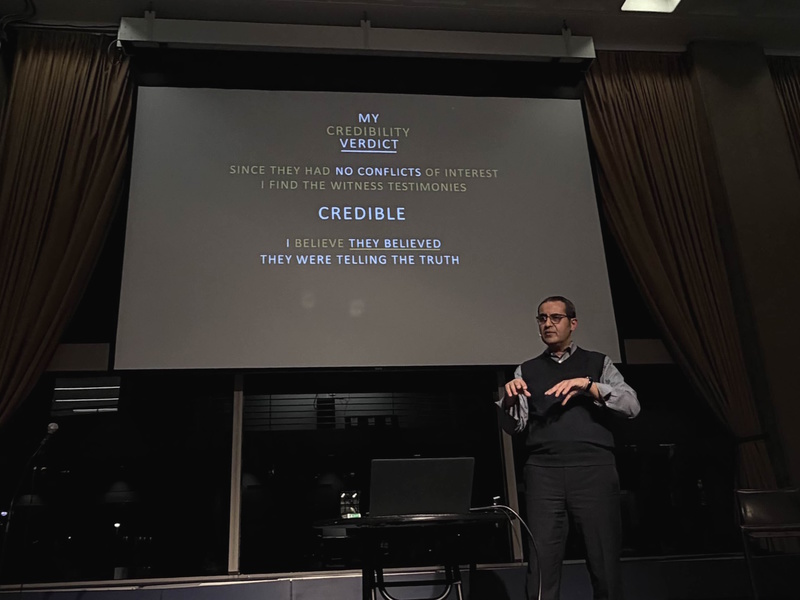
Rizkalla, who works in Orthodontics and Dentofacial Orthopedics, has spoken previously on scientific arguments for a God. Rizkalla’s talk on Thursday revolved around a “courtroom” metaphor through which he invited the audience to issue “credibility verdicts” on the various pieces of historical accounts he provided.
Rizkalla began his remarks with a disclaimer that he sought only to share his experience with God instead of persuading the audience to believe anything. He also presented his thoughts on belief, stating that belief is a combination of knowledge and faith, while also asserting that his faith was much smaller compared to his knowledge about God. According to Rizkalla, he would test “the Jesus Christ story via the courtroom approach” by discussing the importance of three categories of witnesses to Jesus’s divinity, which he dubbed the “disinterested, direct, and hostile.”
Throughout the talk, Rizkalla focused on witnesses living around the time of Jesus’s death. He started with “disinterested” witnesses like historians. These testimonies, he asserted, would be relatively unbiased, as they are not rooted in faith or opposition. Rizkalla provided the records of influential historians such as Flavius Josephus, who stated that “he appeared to them spending a third day restored to Christ,” Pinoy the Younger, who compared “Christ as to a God,” and Tacitus, who said that “Christus suffered the extreme penalty during the reign of Tiberius.”
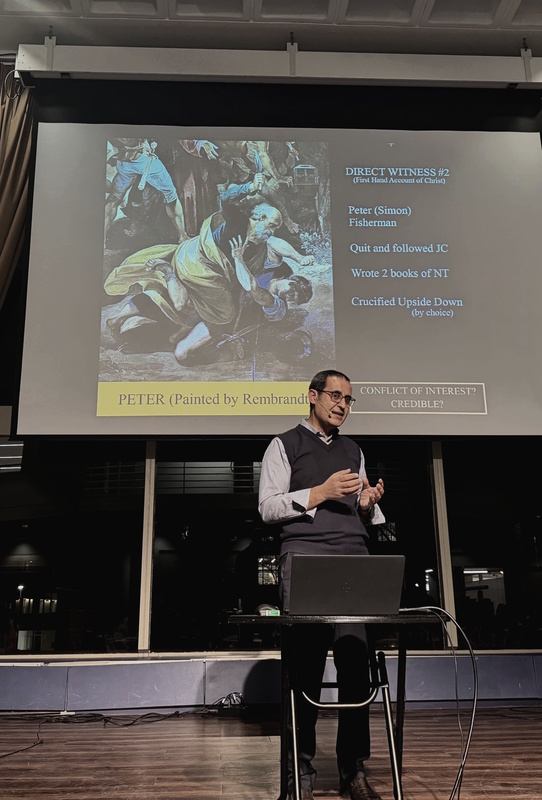
Rizkalla then discussed “direct” witnesses such as Jesus’s apostles and their willingness to follow Jesus despite being persecuted and martyred. For example, Rizkalla highlighted the fishermen Peter and John and the wealthy tax collector Mathew as individuals who left more comfortable lives to preach and testify. Rizkalla also provided the testimony of Mary Magdalene, a direct witness at the time she visited Jesus’s tomb. He used these “first-person records” with their varied yet aligned testimonies to support the story of Jesus’s death and resurrection.
Finally, Rizkalla used “hostile” witnesses — people who were injured due to their testimonies — to support the validity of the testimonies. He likened “hostile” witnesses to a mother telling the jury her son is guilty. In the same way it becomes difficult to believe the son’s innocence, Rizkalla argued, it is similarly difficult to doubt the Christian belief if hostile converts attest to Christianity. Rizkalla used the testimonies of people who were either doubtful or completely against the Christian belief; he specifically pointed out Thomas during Jesus’s resurrection and Paul, who went from persecuting Christians to writing “twelve to thirteen books” in the Bible.
At the end of the talk, Rizkalla circled back to his belief equation. Rizkalla asserted that his “tiny portion of faith” comes from his observation that these testimonies were not accidental and pointed to Jesus being God, especially since the witnesses did not directly benefit from their testimonies.
Using the rest of the time for questions, members of the audience criticized parts of Rizkalla’s argument. Some questioned whether the testimonies Rizkalla referenced were written by those credited and requested more concrete evidence. Others offered alternative perspectives on the testimonies, labeling the disciples’ actions as “cult-like,” arguing they stole Jesus’s body, and claiming their belief could be a myth.
At the same time, some even provided their own evidence, such as the Shroud of Christ, a linen cloth believed to be the burial cloth of Jesus, questioning why it was not used in the talk. Rizkalla responded by pointing out that such evidence could not be used since it cannot be fully proven. When talking about when Paul was martyred, Rizkalla said, “I have fought the good fight, I have finished the race, I have kept the faith.”