Acclaimed author Margaret Atwood presents ‘Book of Lives’ at First Parish Church
Atwood: “I think part of writing novels is entertaining yourself well”





Vivian Hir–The Tech
Margaret Atwood
Book of Lives: A Memoir of Sorts
First Parish Church, Cambridge
Jan. 27, 2026
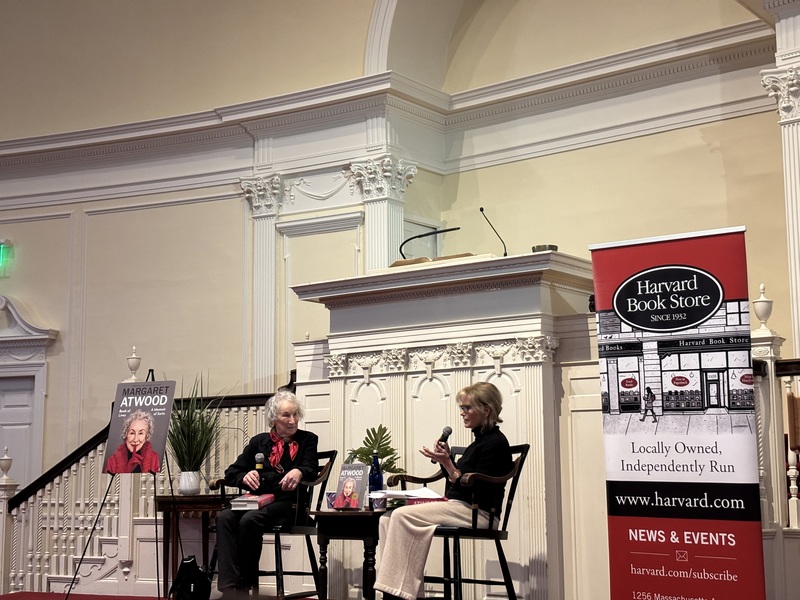
On Jan. 27, award-winning author Margaret Atwood presented her new memoir called Book of Lives at First Parish Church in Cambridge, hosted by Harvard Book Store. Robin Young, the host of NPR’s Here & Now, acted as moderator. A prolific author who has written more than 50 books of fiction, essays, and poetry, Atwood is best known for A Handmaid’s Tale, a dystopian novel about a theocratic regime called Gilead. Her work has won accolades including two Booker Prizes and the Arthur C. Clarke Award. Book of Lives is a detailed account of Atwood’s life, from her rural upbringing to critical experiences that have shaped her writing.
Atwood first discussed her childhood growing up in the forests of northern Quebec. Born in 1939, Atwood is the daughter of an entomologist who frequently conducted research in the woods. Atwood appreciated living in nature because the environment encouraged her to be adventurous and free, a life significantly different from the “very managed lives” of children today. Although her childhood was boring at times because of the isolation, Atwood stated that the experience taught her how to entertain herself, a skill she finds important in writing. “I think part of writing novels is entertaining yourself well,” she shared.
Atwood then discussed her earlier works, notably The Edible Woman, a 1969 novel about Marian McAlpin, a young woman who is unable to eat after her engagement. In the novel, Marian bakes a cake in the shape of herself and forces her boyfriend to eat it because she felt consumed by him. Cannibalism is a main theme in The Edible Woman, with Atwood stating that bride and groom cakes were a source of inspiration because they made her think of people “turning into a consumer product of a confectionary kind.” Atwood also critiqued how society in the 1960s oppressed women, from strict dress codes to patriarchal expectations.
In addition to feminism and women’s identities, Atwood also wrote about the cruelty of female bullies in Cat’s Eye, a novel based on Atwood’s childhood. Atwood described the girls who bullied her as “Machiavellian” and “Byzantine,” as they manipulated her through complex schemes. “It wasn’t ‘you’re a terrible person — we’re going to knock you down,’” Atwood said. “It was ‘We can help you.’” She then underscored that people tend to forget the bad things they have done to others, while clearly remembering the bad things that others have done to them.
Afterwards, Atwood read a passage from Book of Lives about the male stalkers of Founder’s House, a female graduate dorm residence at Radcliffe College, where Atwood studied English literature in the early 1960s. Atwood’s reading was engaging, as the passage was filled with vivid details about her peculiar experiences, from seeing an unfamiliar hand enter the open bathroom window to struggling to learn judo for self-defense. Although the topic was dark, Atwood’s witty and sharp humor was effective, causing the entire audience to laugh from time to time.
Atwood ended the talk by discussing in great depth the ideas that influenced her to write The Handmaid’s Tale. For Atwood, her interest in the history of 17th century Puritan New England played a major role in shaping the novel. She found the Puritans’ system of government contradictory and undemocratic, as they came to New England for freedom of religion, yet persecuted Quakers. “They came over so they can have freedom of religion for themselves, just not anybody else,” Atwood said.
Besides interest in the history of the Puritans, Atwood was also curious about the origins and developments of World War II, given that she grew up during the war. “Where did all this come from?” Atwood asked. “How was it that dictators had been able to take over in Germany and Russia, and then a little bit later in China?”
The other major factor that drove Atwood to write The Handmaid’s Tale was the rise of Christian nationalism in the 1980s as a “pushback” to second-wave feminism in the 1970s. Atwood connected the recent political initiative Project 2025 to The Handmaid’s Tale, as it similarly opposes abortion rights and has proposed marriage bootcamps to raise the country’s birth rate.
After the end of the talk, Atwood answered the audience’s many questions, including her thoughts on writing as a medium and how she approaches writing. Atwood acknowledged that she will never know who her readers are, unlike other art forms such as ballet and opera, where both the audience and artist are in the same space. “That’s what writing is. It’s one of the art forms in which the making of it is always separate from the consuming of it,” Atwood said.