The American Repertory Theater’s ‘Wonder’ is an absolute must-see
Watching ‘Wonder’ will have your inner child crawling out from their hiding place and giving you a hug






Photo provided by Hawver and Hall

Photo provided by Hawver and Hall
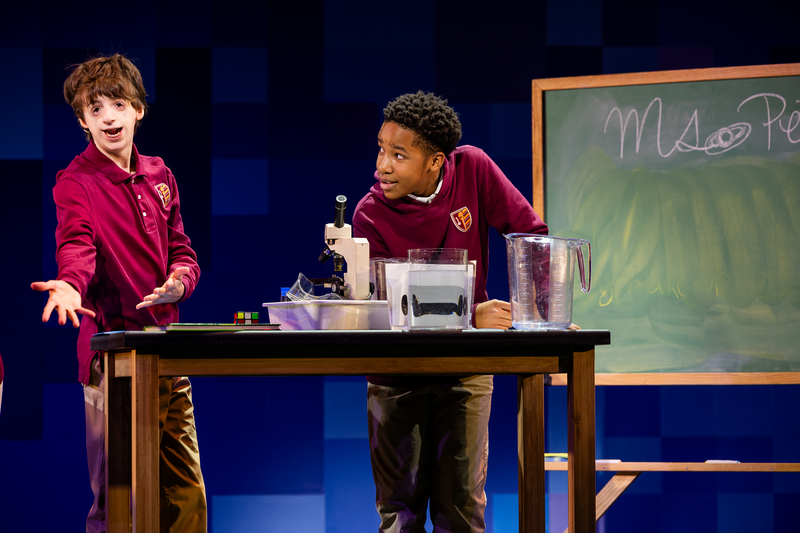
Photo provided by Hawver and Hall
Wonder
Story by Sarah Ruhl
Music composed by A Great Big World (Ian Axel and Chad King)
Directed by Taibi Magar
American Repertory Theater
Dec. 12, 2025 – Feb. 15, 2026
This review contains spoilers for the musical.
“Choose Kind.” That’s the main message of Wonder, an original musical premiering at the American Repertory Theatre through Feb. 15. Based on R. J. Palacio’s novel of the same name, Wonder tells the story of August “Auggie” Pullman (Max Voehl and Garrett McNally), a boy with a craniofacial difference that prevents him from going to school or making friends on the playground, until his parents enroll him in seventh grade at Beecher Prep. Bursting with vibrant colors, tear-jerking musical numbers, and what can only be described as middle school spunk, the musical offers a vision of hope for a more accepting world.
From the very beginning, Wonder tackles Auggie’s experience of looking different head-on, emphasizing all the ways he is an ordinary kid (“Ordinary”) and expanding his passion for outer space into a metaphor for his desire for escapism. The show opens with Auggie and his imaginary friend Moon Boy (Nathan Salstone) pretending to float in outer space. At first, Moon Boy, Auggie’s version of himself without a craniofacial difference, takes the singing lead in Auggie’s songs, but his playful presence fades away as Auggie gains real friends, gets used to middle school, and finds his own voice.
The role of Auggie Pullman is played by Max Voehl at some performances and Garrett McNally at others. Both actors are around Auggie’s age, and, just like him, they were born with craniofacial differences. On the night I attended the show, McNally’s performance was so believable that it was easy to forget he was acting. His restrained performance contrasted the stylized theatrical choices of some of the other characters, supporting the show’s central themes of kindness, empathy, and seeing people for who they are, not how they look.
Except for the beginning in outer space, Wonder takes place in two main settings: Beecher Prep and the Pullman family home, where Auggie lives with his parents (Alison Luff and Javier Muñoz) and older sister Via (Kaylin Hedges). Luff’s duets with Auggie were one of the most emotional parts of the show: it was easy to see how much she wanted the best for her son, and how much it hurt her to see anything go wrong. Though Via’s plotline was condensed in the adaptation from book to musical, Hedges did a breathtaking job portraying an older sister struggling to manage her own friendships as she enters high school while feeling an obligation to support her younger brother.
Despite the bullying Auggie faces at Beecher Prep, the school is also a source of the show’s funniest moments. Each classmate has a very distinct personality. The most memorable is Charlotte (Skylar Matthews), Beecher Prep’s resident theater kid, whose Mean Girls-esque tour of the social scene and gossipy narration of class drama is hysterical in the most middle-school way possible. Auggie’s new best friend, Jack Will (Donovan Louis Bazemore), is equally incredible as he shares his joy of being friends with Auggie and navigates attending a school where most students are of a higher socioeconomic status than he is.
In addition to encouraging empathy and envisioning a more caring world, the theater launched its own community service initiatives, such as a food and book drive, in the spirit of Wonder. The production team also consulted leaders of the craniofacial difference awareness organization myFace and directed audience members towards their myFace Wonder Project, which uses the Wonder book to teach students how to be upstanders to bullying.
The only place where the show might have gotten carried away with its message of empathy is its happy ending; both Auggie and his sister Via end up with more friends than they do in the original book, but maybe that’s what the world needs right now.
“Theater may not change the world the way teachers or politicians do, but it can change us,” director Taibi Magar wrote in the director’s note. “It can remind us of who we want to be.”
As the show came to a close, the actors bowed to a final reprise of “Choose Kind,” and the audience — families, couples, school-aged students, and kids with their own craniofacial differences — immediately rose to their feet in applause.
“Everyone deserves a standing ovation at least once in their lives,” Auggie says in the final scene. With earnest delivery and heartfelt encouragement to see the good in everyone, Wonder is certainly no exception.