MIT dives into the future of quantum technology at QMIT launch
Nobel laureates, industry leaders, and members of the MIT community celebrated the launch of the Institute’s quantum initiative





Gloria Zhu
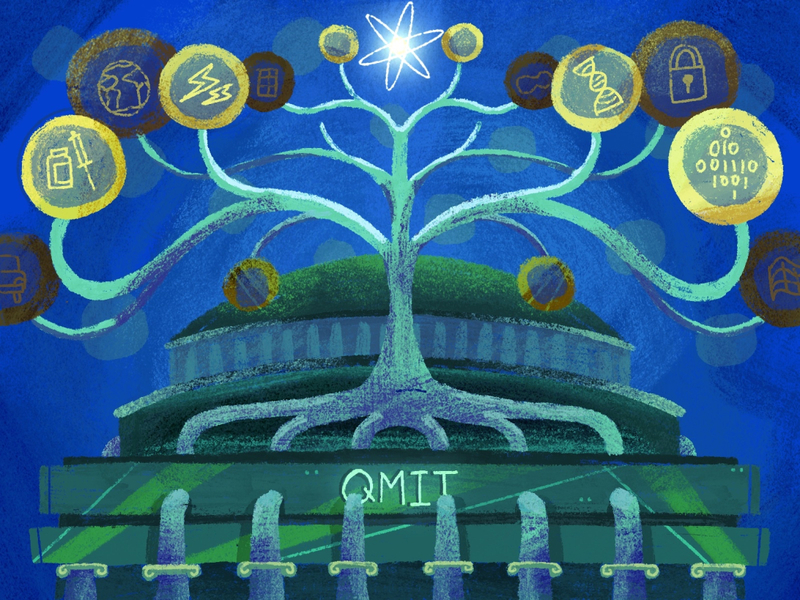
On Dec. 8, 2025, the Institute launched its MIT Quantum Initiative (QMIT) with a daylong conference that spearheaded quantum-focused collaboration among experts all across campus.
The initiative was launched by MIT President Sally Kornbluth in August with the goal of harnessing quantum science — the study of the complexity of subatomic activity — to solve “the most consequential challenges in science, technology, industry, and national security,” according to the QMIT website.
From students and faculty to industry leaders and Nobel laureates, dozens of attendees gathered in the Schwarzman College of Computing to witness how MIT would lead the world into the future of quantum technology.
The quantum future
Chief Quantum Innovation Officer at the Lighthouse Disruptive Innovation Group and MIT Media Lab Research Affiliate Dr. Parfait Atchadé expressed excitement about learning what the future had in store for quantum research at MIT.
“I wanted to be close to see what’s next,” he said, recounting a discussion he had with QMIT Faculty Director and Professor of Chemistry Danna Freedman PD ’12. “The question that I [had for Freedman] was, ‘What is the difference between yesterday and today or tomorrow? What will change?’”
While classical computation has already reached its physical limit of complexity, quantum computing has the potential to create elaborate simulations and discover solutions to problems we cannot yet solve.
For example, quantum computing can develop simulations for drugs that drastically increase the human lifespan. This would have various benefits for society. “If, somehow, we are very silly and we want to harm the Earth,” Atchadé said, “we can go further [and] make some kind of interstellar travel because we can live long [enough].”
Atchadé described computers as “the key unit of geopolitics.” In theory, a quantum computer may be sophisticated enough to bypass the encryption protecting another government’s sensitive information. The opposite is also true: nations may be able to use quantum computers to improve the encryption protecting their own important data.
“A company or a country that can build [a] very efficient quantum computer can try to change the role of geopolitics,” Atchadé concluded, pointing to the potential detriments quantum computing could have on developing regions. Since MIT launched their quantum initiative in 2025 (instead of 20 years prior), Atchadé has hope for places that still lack quantum research.
“Even if we start in Africa in five years, the race is not yet [over],” he said. Otherwise, “the gap between the country that has the quantum computer [and the one that does not] will be very, very, very high.”
Where research and industry collide
According to Duke University Professor Christopher Monroe ’87, the co-founder and chief scientist of quantum computing company IonQ, fostering collaboration between academia and industry is critical for accelerating quantum progress.
Because companies typically do not engage in broad, high-level research in the way that academic institutions do, “Private and industrial investments [in quantum computing research] outweigh government research investments by ten to one,” according to Monroe.
This disparity would not be a problem if the two sectors operated independently. However, in Monroe’s words, “They both need each other, even if they don’t know it.”
Ideally, a symbiotic relationship would exist between industry and academia. Industry would use academic research to improve the quality of their products, generating hype among the general public. This hype would, in turn, justify more funding for academic research, resulting in a positive feedback loop. There would need to be a delicate balance. “A little hype is okay, but if it’s too overhyped, academics will worry about people losing interest in the field,” Monroe said.
Monroe then discussed the other aspect of the industrial-academic dynamic in quantum research: heuristics.
Heuristics is a term used in computer science to describe shortcuts for improving problem solving, effectively functioning as “rules of thumb.” Heuristic algorithms are preferred when a quick approximate solution matters more than a precise one. Search engines, for instance, often use heuristics to show the most popular search results first, as people typically look for those results. This method is not necessarily precise; just because some results are the most popular does not mean that they are the best results for every user.
Monroe explained how heuristics (which he described as “a problem that you don’t know why it works, but it just does”) are often favored by those in industry — particularly in quantum computing — because of the need for consistent results without proof. The quantum industry believes quantum computers will be especially valuable in generating unprovable heuristics; conversely, academics avoid heuristics because they lack proof.
“I’ve been lucky to walk that fine line between both of them, having founded (probably) the biggest quantum computing company ... and being involved in the very research-y side of things as well,” Monroe said.
However, the interaction between industry and academia is almost never where development ends; as QMIT emphasized, quantum research would also require early adopters — those who first embrace a new technology — to succeed.
The importance of early adopters
“Fundamentally, everything in the quantum space relies on early adopters,” said Professor Danna Freedman.
Freedman spoke with Broad Institute Founding Director Emeritus and Biology Professor Eric S. Lander about the necessity of early adopters for the success of quantum research. Throughout the discussion, Lander drew parallels between ongoing quantum research and his own work mapping the human genome as part of the international Human Genome Project.
Lander started by highlighting the particular recipe necessary for technological innovation: an equal mix of those driving the technology forward and those inventing new uses for it.
According to him, a textbook example of early adopters’ role is MIT’s involvement in the development of automated DNA sequencing. While outside companies created automated sequencers, they often relied on MIT engineers to use the technology more effectively. “We would find new uses for their machines,” Lander said. This collaboration led to a lasting relationship in which DNA sequencing companies relied on MIT to improve upon their novel technologies.
As for what an early adopter would look like, Lander admitted that the answer was a little unintuitive. To him, those with decades of experience were less helpful due to fixed mindsets from years in the field. Instead, Lander suggested the ideal early adopter would be “a generation of young people who did not know [what they could and couldn’t do]” — those who would think openly about the technology.
“Then,” he continued, these early adopters would have resources at their disposal to “do crazy things, because that’s how all progress happens.”
Reflections on the success of QMIT
The Tech interviewed attendees of QMIT at the reception following the main events.
Some attendees were excited to hear from leading experts at the conference, as well as what they had to say about the future of quantum research at MIT. However, some were disillusioned by the apparent lack of specifics around the Institute’s next steps; it was unclear to them how much this initiative would cost or where it would be based.
Nonetheless, those involved with QMIT commended the conference’s accomplishments.
When asked about what he hoped attendees would take away from QMIT, Monroe reflected on how remarkable it was to have so many pioneers in quantum information science in one place, especially as specialists in their own respective sub-fields.
“It’s a big deal that MIT is formalizing this union,” Monroe said. “Hopefully, [these experts] will lead the way in terms of research in the future.”