National Geographic photojournalist Ami Vitale gives talk at MIT on Jan. 22
Vitale: “The more I see, the more I see how deeply connected we all are to life”





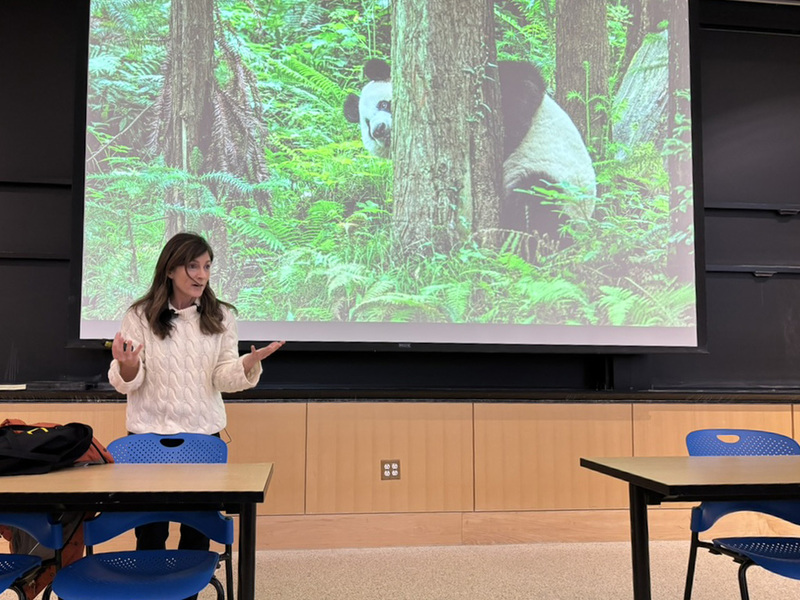
Vivian Hir–The Tech
On Thursday, Jan. 22, award-winning National Geographic photojournalist Ami Vitale gave a talk at MIT about using photography to cultivate empathy and hope worldwide. Around 50 people attended the talk in 2-190, and the event was sponsored by the Octet Collaborative, a Christian organization at MIT that promotes human flourishing.
Originally a conflict photographer, Vitale transitioned to wildlife photography after seeing how environmental problems — such as climate change — further contribute to human conflict. In her current work, Vitale focuses on the interconnected relationship between humans and wildlife. She is also the founder of Vital Impacts, a nonprofit that supports global humanitarian projects dedicated to environmental conservation.
Vitale began by discussing the title of the talk, which was “Wild Hope.” For Vitale, hope is a resistance to “cruelty and despair” marked by a relentless pursuit of “good work” in spite of how useless it may feel. “I think that history only looks at things in retrospect, but in real time, [history is] shaped by people deciding to show up and never giving up,” Vitale said.
Growing up, Vitale was very introverted and “painfully shy.” However, she quickly fell in love with photography as a teenager because of how self-empowering the art was for her. “It took attention away from myself and allowed me to focus on others and dive into situations I never imagined I had the courage to do,” Vitale said. She also highlighted the power of photography as a visual medium that transcends cultural and language barriers.
Vitale’s deep interest in learning about the stories of the human condition influenced her to become a war photographer, initially documenting violence on the frontlines in places like Afghanistan and Gaza. However, seeing a newlywed couple dance in the midst of the Second Intifada made Vitale question why her photos focused so much on destruction and not hope. As a result, Vitale decided to pivot toward wartime photos that showed resilience.
In the early to mid 2000s, Vitale lived in Kashmir to document the militarization and conflict between India and Pakistan. Instead of simply depicting the war, Vitale wanted her photos to “humanize” the conflict by focusing on stories that showed the “quieter moments” of people’s everyday lives, such as a woman getting henna for her wedding. But over time, Vitale began to feel that the “erosion of the natural world” in her work was related to human conflict and suffering. This spurred her to pursue wildlife photography instead.
Vitale’s shift from photographing people to wildlife was also due to seeing the intertwined relationship between humans and the surrounding land. “We talk about trees being the backdrop to our story, when in fact it’s the other way around,” Vitale said. “We are the backdrop to their story.”
One of Vitale’s early wildlife photo stories was about Sudan, the last male northern white rhino. In 2009, Sudan was moved from a safari zoo in the Czech Republic to the Ol Pejeta Conservancy in Kenya for rehabilitation and breeding, as there were only eight surviving white rhinos in the world. Vitale described her first encounter with Sudan as “magical” because of how “gentle and hulking” he was. “Just something inside of me shifted,” Vitale said. However, Sudan’s story was rejected. Despite this, Vitale persisted, covering the story because she wanted to document “what extinction will look like.”
Although the photos of Sudan in the conservancy are idyllic and peaceful, Sudan was always guarded by militarized men due to poaching concerns. Through this project, Vitale realized that local communities living near the animals were often left out of the narrative, even when these locals protected the wildlife.
“These people spend more time with these animals than they do with their own children and own families,” Vitale said. “And if that is not commitment, I don’t know what else it is.” Vitale argued that effective wildlife conservation requires not only stricter laws and greater enforcement, but also community engagement.
Vitale also covered the Reteti Elephant Sanctuary in Kenya, founded in 2016 as Africa’s first indigenously-owned elephant sanctuary. The sanctuary rescues and takes care of orphaned elephant calves, who then get released back into the wild once they are fully rehabilitated.
In Retiti, Vitale witnessed the symbiotic relationship between humans and elephants — elephants kept the ecosystem in balance by maintaining vegetation and finding water sources. “The more I [witness], the more I see how deeply connected we all are to life,” Vitale said. “We happen to be living in this bizarre spasm of violence against wildlife and humans destroying each other and our habitats.” She urged the audience to not be indifferent to the destruction of wildlife and climate change’s effects.
Vitale then discussed her project regarding the rewilding of pandas in China. Vitale shared that she learned many lessons about conservation from her time in China, particularly about the country’s efforts in reforestation and the movement to protect and restore panda populations. Such efforts were successful in moving pandas from the critically endangered to the vulnerable list of animal species.
At the end of the talk, Vitale returned to Sudan’s story, talking about his passing in 2018 and the fate of the white rhino species. She showed a poignant photo of rhino keeper Joseph Wachira putting his head and hands on Sudan before he died. What Vitale remembers most about that day was how quiet the surroundings were. “It was almost like the whole world was mourning because it signaled the functional extinction of the species,” she said.
Vitale then showed a heartbreaking photo of a dead white rhino fetus implanted by IVF in 2025. Although the IVF was successful, the surrogate mom died from a deadly bacteria infection during a flood. While the death was a huge loss for the conservation team, Vitale is hopeful that future IVFs will be successful.
Vitale concluded the talk by calling for everyone to take action and help protect the Earth. She encouraged people to start small. “We begin in our backyards, in our neighborhoods and the choices we make every day; how we consume, how we protect and how we notice the life around us,” Vitale said.