Major winter storm to deliver 1-2 feet of snow across New England
MIT to close from Sunday 3 p.m. to Monday 11 p.m.





Conrad Straden–The Tech
Conrad Straden–The Tech
Veronika Moroz–The Tech
As the New England region braces for what will be the biggest snowstorm in years, here is the latest breakdown of events.
In Boston, snow will break out on Sunday, Jan. 25 around noon, becoming heavier as the afternoon progresses. Temperatures will be in the teens and the 20s for the entire event, favoring high snow ratios that will produce fluffy and dry snow. In the evening, snowfall rates may exceed 2 inches per hour, making travel nearly impossible. Heavy snow will continue throughout the night, and winds will start to pick up. Northeast winds will have speeds from 15 to 20 mph, with gusts up to 40 mph. This will lead to brief blizzard conditions Sunday night, but will not last long enough for the storm to be classified as a blizzard. [1] By early morning on Monday, Jan. 26, snowfall rates will begin to ease off. Light snow will continue all day before the storm finally wraps up in the late evening.
Let’s break down how this storm evolved. You might have noticed how cold it was on Saturday morning — before the storm, the region was blasted with Arctic air connected to a tropopause polar vortex that swung down into Canada. This high pressure vortex locked the cold air in place on Saturday and Sunday, while a low pressure system out of the Southwest pulled in moisture from the Gulf, leading to our storm.
The warm moist air clashes with the cold air stretching from New Mexico through Maine this weekend, bringing snow, sleet, freezing rain, and rain; this setup is called an overrunning event because the warm air rises over the denser cold air and tries to advance northward. With the cold air trapped at the surface and warm air aloft, precipitation will fall as sleet or freezing rain. As a result, even though surface temperatures might be well below freezing, snow is not guaranteed. As the storm progresses east, the low pressure system lifts into the Appalachian Mountains before transferring offshore to the Atlantic, where it re-develops and brings heavy snow into New England. This low pressure transfer is the defining characteristic of a Miller B nor’easter.
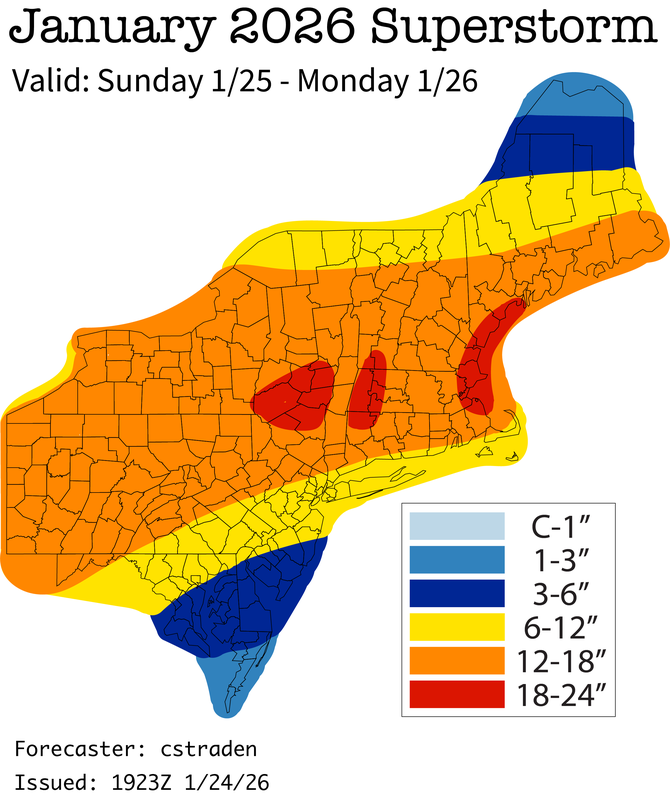
In the South, a major ice storm is playing out, with freezing rain expected in the Gulf Coast region and southern Appalachian states. Up to 1.25 inches of freezing rain is expected in Mississippi, which will cause severe damage to trees and powerlines. Further north, in the lower Midwest, 6 to 12 inches of snow is expected across a widespread region from Oklahoma to Ohio. In the Mid-Atlantic and Northeast, snowfall amounts will generally range from 12 to 18 inches, with less along the Mid-Atlantic coast and far northern Maine. On Sunday night, as warm air surges northward aloft, sleet may fall for New Jersey, Long Island, coastal Connecticut and Rhode Island, as well as far southeastern Massachusetts, hurting snow totals. However, it is very unlikely that this mixing line will reach Boston.
It has been four years since Boston’s last snowfall greater than 6 inches. The late January Blizzard of 2022 dumped nearly 2 feet of snow on campus, with Logan Airport measuring 23.8 inches of snow. While it is unlikely that we surpass that amount, 16 to 20 inches are expected with this storm. With temperatures remaining below freezing all week, this snow will not be going anywhere anytime soon. Stay warm out there.
As of Saturday evening, MIT announced that campus will be closed for all non-essential employees beginning at 3 p.m. on Sunday, Jan. 25 through 11 p.m. on Monday, Jan. 26. Additionally, Boston Mayor Michelle Wu declared a snow emergency in anticipation of the winter storm.
[1] The National Weather Service defines a blizzard as a period of falling or blowing snow with "winds in excess of 35 mph and visibilities of less than 1/4 mile for at least three hours."