Falling into the blue of ‘Serenade’
Seventeen’s main vocalists DK and Seungkwan make their subunit debut as DxS





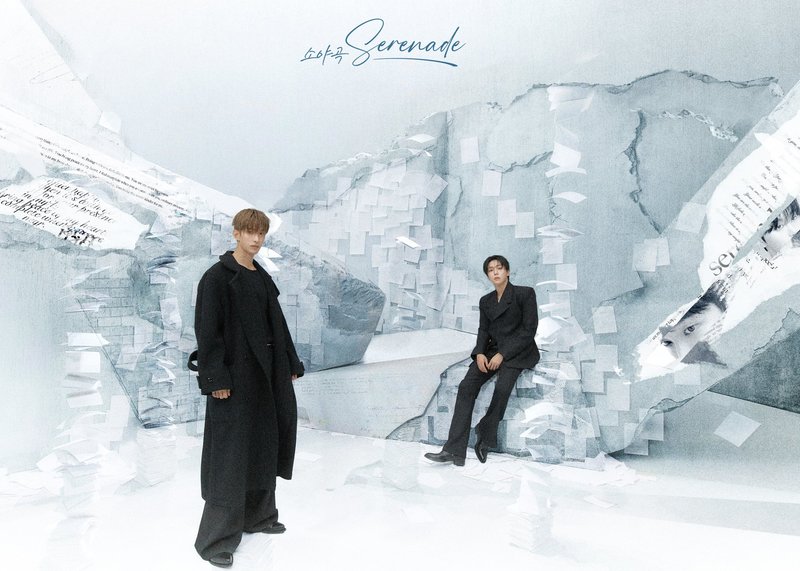
Photo Courtesy of Pledis Entertainment
★★★★✩½
Serenade
DxS (DK and Seungkwan of Seventeen)
Pledis Entertainment
Jan. 12, 2026
When the Epilogue version of “Blue” — the title track of DxS’s Serenade — dropped at 4 a.m. on Jan. 19, a fitting blanket of snow was enveloping Boston in tranquil darkness. I was somehow still awake, and took the opportunity to watch the premiere of the winter-wonderland-coded music video that mirrored my surroundings. A week before that, I was up at the same time for the similar purpose of listening to the newly-released EP.
DxS is a subunit of 13-member South Korean boy band Seventeen. The duo is composed of main vocalists DK and Seungkwan, who also happen to be my biases (favorite members). Seungkwan’s husky and emotional voice single-handedly converted me into a ballad fan, which is quite a feat considering that I used to regularly loop a playlist called “EDM no lyrics to get things done.” So as the release date drew closer and closer, my anticipation for this mini-album only grew.
Indeed, DxS presents a cohesive, vocally rich EP that spans pop rock, R&B, and ballads. In Seventeen, DK and Seungkwan deliver the powerful high notes that are a signature aspect of the group’s explosive final choruses. However, as DxS, their vocal colors and nuance take center stage, highlighting the full range of their artistry.
Rockstar (DK solo)
The EP opens with the upbeat “Rockstar,” although the retro synths stand out more than the electric guitar that gives the track its name. As always, DK’s voice is clear and bright, carrying a chorus that subconsciously makes me bop my head to its easygoing beat. That being said, I can’t help but want something more; the instrumental fades away to let his voice shine during the bridge, but when they come back during his high note, it’s the same electric guitar and groovy rhythm. As a result, the final chorus is very similar to the first and second, causing the song to feel more restrained than it should.
This fault is more of a product of the song’s arrangement rather than DK’s voice itself. I had similar issues with his solo “Happy Virus,” which was released last year for Seventeen’s 10th anniversary album Happy Burstday. Maybe he just prefers songs with lighter, feel-good vibes, which I can’t fault him for. However, I dearly crave another iconic moment like his divine high note in “Kidult” or even his strong pre-chorus in “HOT.” Goddamn, DK, you have such a strong voice; unleash it to its fullest extent!
Rating: 7.5/10
Blue
The title track gets a whopping seven-minute music video that could serve as an entire K-drama episode, with an epilogue released the following week. I was quite invested in its plot, so I made it a point to revisit the track on Spotify without any accompanying visuals to focus on the music itself.
At first, it’s a classic ballad composed solely of soft vocals and minimal piano. Strings then come in, creating layers upon layers that proceed toward the final chorus. The payoff is well worth the two-and-a-half minutes of slow buildup; we get an entire minute of DK and Seungkwan harmonizing beautifully, trading leading and supporting vocals as a full orchestra kicks in. For a brief moment, it feels like ascending to another dimension. Then, like the end of a long-held breath, the track concludes, finishing as delicately as it began.
There are a few missteps, though. One is a logistical issue: the sublime final chorus was released as a teaser prior to release. As a result, during my first few listens, it didn’t hit as hard, and the earlier sections felt underwhelming by comparison. I’ve learned to appreciate the momentum more, but it’s a point that still stands. Curse K-pop companies and their habit of pre-releasing the best part of the song.
The second is a very nitpicky detail, but it’s something that still strikes me — there’s not enough of a wait between Seungkwan’s aching “You didn’t come back to me” in the bridge and DK’s “오직 메아리만” (“All that’s left are echoes”) that introduces the final chorus. The listener gets so much development leading up to the climax: give them more than two counts to sit with it, let the stillness make the tension swell even more, and then let the sonical waves crash all at once.
Rating: 8.5/10
Guilty Pleasure
Oh my god. Boo Seungkwan, what a voice.
Putting that aside, this is the strongest track on the EP, demonstrating both of the vocalists’ lower registers that we rarely hear otherwise, especially in an R&B atmosphere. I shouldn’t be surprised: the song is literally called “Guilty Pleasure.” It’s sultry, it’s sleek, it’s confident. What more could you want?
During the countdown livestream before Serenade’s premiere, DK and Seungkwan shared that their staff had to convince them to include this track on the EP. Shout out to them for standing their ground — especially in Seungkwan’s case. His textured tone is a perfect match for this style, evident in his husky delivery of “Stop, ah, wait a minute,” and the following lines in the second verse.
“Guilty Pleasure” strikes a perfect balance between a chiller but complex instrumental and this more mature side of DK and Seungkwan. Both of their “I’ll never sto-o-o-o-o-p” vocal runs are charming, providing a smooth transition to the undeniably addictive choruses. There, the vocalists move seamlessly from chest voice to falsetto. In particular, the rich harmonization and effortless runs in the final chorus make this track such a highlight.
If I had any critiques, it would be that the bridge doesn’t stand out very much to me. Aside from a subtle key change, the instrumental remains consistent with the verses and choruses, causing the section to blend together with the rest of the song. Honestly, given how good they sound, it hardly matters.
One final note: Seungkwan. More R&B. Please.
Rating: 10/10
Silence
“Silence” is similar to “Blue” in that it’s a slow ballad that builds toward a vocal apex near the end. Here, ambient synths create a warm, twinkling atmosphere before we get a cascading instrumental of soft strings in the finale. A pulsing kick drum punctuates DK’s sustained “Ahhhh, oooh” vocalization that is his finest moment on the mini-album, one that reminds me of his best work in Seventeen.
I’d also like to take a moment to highlight the lyrics, which tell the story of a bittersweet, inevitable end to a romantic relationship. Sometimes, it’s the mundane details that ache the most — as Seungkwan sings in the second verse, translated from Korean, “A calendar square filled to the brim; the password that marked us.” I won’t pretend to know much about romance — between MIT and this publication, dating hasn’t exactly been a priority — but January, at least from what I’ve heard from others, seems to be a month of incompatibilities and breakups. By capturing that quiet resignation, this song helps me understand those experiences a bit better.
My only gripe with the song is that its opening section is a little too long, as the ballad piano takes up a full minute. For a track that’s only about two minutes and 40 seconds total, this leaves less room to flesh out the later part of the buildup and climax. As a result, it seems slower than it needs to, though I might not know as much ballad ball as I claim to.
Given that half of this EP is composed of ballads, the competition is stiff. On another project, I might’ve awarded it a higher rating, but here it’s outshined by others.
Rating: 8/10
Dream Serenade (Seungkwan solo)
When I saw the tracklist for Serenade, the first thing that caught my eye was Seungkwan’s nearly five-minute solo runtime — by far the longest track on the mini-album. Considering his role as the heart of Seventeen, it’s fitting that this song seems to lend its name to the EP itself.
In an interview with Clash Magazine, Seungkwan describes the song as an expression of “love that continues even after [a relationship] has ended.” His vocal talents stand out the most in ballads of yearning like these, where stripped-back production allows his entire range to shine. Even compared to “Blue” and “Silence,” the instrumental steps back further, making room for his carefully soft, intimate delivery. He takes his time with the crescendo, filling the quiet space between verses with gentle humming over piano and violin.
As the song builds, Seungkwan’s voice rises to meet it. This drawn-out anticipation, just slightly lacking on “Blue,” is realized here, thanks to the track’s extended length. Each time “Dream Serenade” seems to reach its peak, Seungkwan pushes it even further, his gorgeous, resonant vibrato overflowing with raw emotion as he belts in Korean, “I think I finally know now, the meaning of the word ‘love’ / Even if only in a dream, I want to tell you that you were love.”
This is a song that demands deliberate focus to fully appreciate its beauty. I mean this literally — after coming back from a walk, I sat down on a bench outside my dorm by the Charles River and gazed wistfully out at the Boston skyline as this song looped in my ears. It was quite a lovely experience, one that made me grateful to be where I am now.
Rating: 9/10
Prelude of Love
For the life of me, I can’t understand why Pledis Entertainment would include a song called “Prelude of Love” but then put it at the end of Serenade. It’s a prelude. Emphasis on the “pre-”. In addition, opening the EP with this track would make sense thematically, as it describes the giddy, infatuated start of a relationship while the project’s latter tracks narrate the resolution and emotional fallout. So when I listened to a full runthrough of the mini-album, I was caught off guard by how abruptly this song interrupted the lingering quiet after “Dream Serenade.”
Sonically, the acoustic-band arrangement suits DK’s and Seungkwan’s cheerful tones, where they sound closest to their poppy and bright work in Seventeen. It’s a song that would lift my spirits as I begrudgingly force myself to go to class, which only reinforces my conviction that it should open the EP. The subtler harmonies add a flourish to the final chorus, but other tracks accomplish this more effectively. All in all, “Prelude of Love” passes by a little too quickly, and doesn’t provide the closure I crave from a final track.
Rating: 7/10
Final Verdict
For the most part, Serenade is a very cohesive project focused on the rise and fall of a relationship — one that will almost certainly be in the top rankings of my 2026 Spotify Wrapped.
Overall, my biggest critique is the song order; “Prelude of Love” would’ve worked far better as an opening that sets the tone for the romance-themed narrative that unfolds over the course of the EP. “Blue,” with its resounding finale, feels more like a natural closer. With those changes, I’d be more inclined to overlook the minor criticisms across the individual tracks and give Serenade full marks. It’s hard to really go wrong with a project this vocally driven, but that also sets a high bar for my listening experience. At its best, I was genuinely in awe. At other moments, it was simply pleasant.
Regardless, this EP succeeds in highlighting DK and Seungkwan’s vocal strengths, establishing their positions as veteran main vocalists with over ten years of experience and showing that Seventeen is far more than just a performance powerhouse. For those who have been wondering where the live singing is in an industry dominated by heavy processing, Serenade offers a clear, melodious answer.
Rating: 9/10